
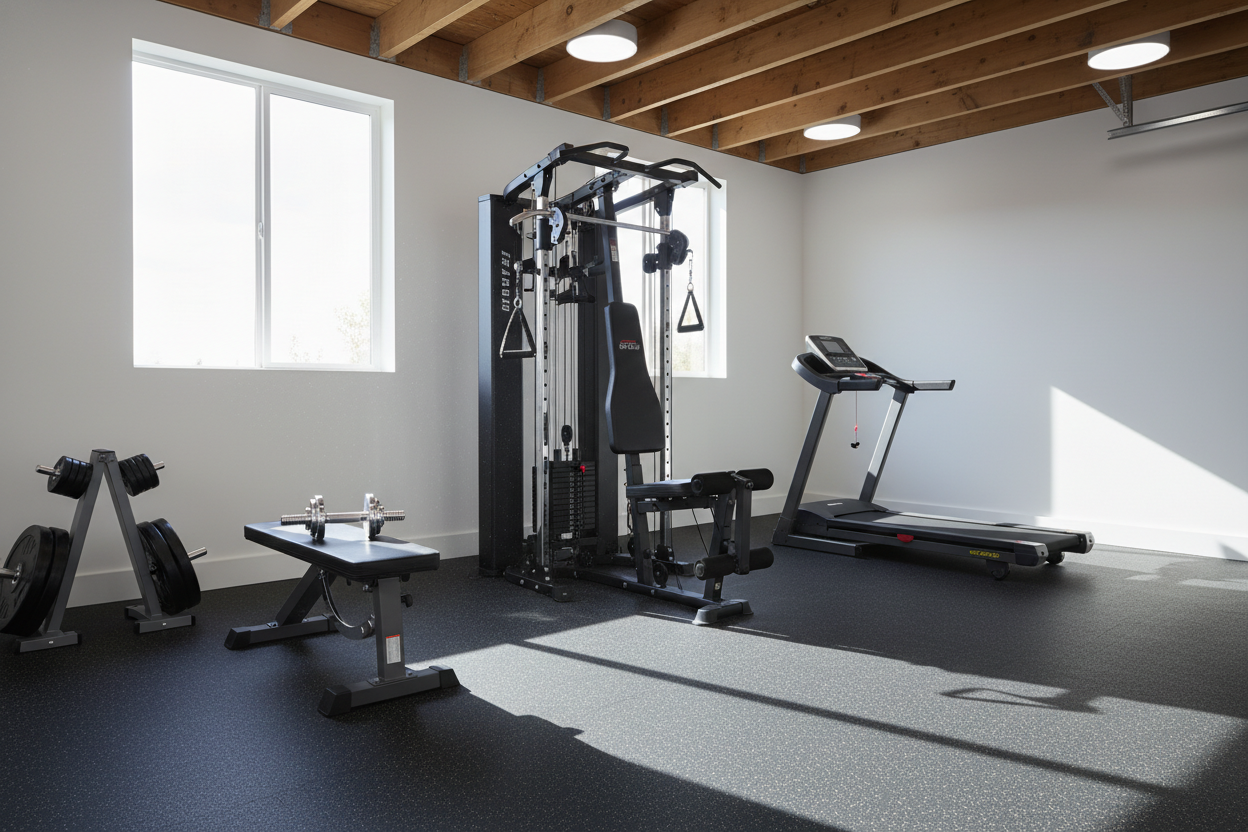
I remember staring at my one-car garage, realizing I had to choose between my power rack and actually being able to open my car door. It’s the classic lifter’s dilemma: you want the gains, but you don’t have the square footage of a commercial warehouse. I spent weeks measuring floor tiles and scrolling through forums late at night, trying to figure out if a single small home gym machine could actually handle a 400-pound squat without folding like a lawn chair.
We’ve all seen the ads for 'all-in-one' systems that look like they belong in a 1990s infomercial. They promise the world but usually deliver a wobbly mess of plastic pulleys and 14-gauge steel that feels about as stable as a Jenga tower. After testing dozens of setups in cramped corners, I’ve learned that finding the best home gym compact enough for your space requires looking past the flashy marketing and focusing on the raw specs.
Quick Takeaways
- Build quality over exercise count: A machine that does 5 things well is better than one that does 50 things poorly.
- Check the steel: Look for 11 or 12-gauge steel if you plan on lifting heavy.
- Pulley ratios matter: A 2:1 ratio feels different than a 1:1 ratio; know what you’re buying.
- Footprint vs. Working Area: A machine might be small, but you still need 'elbow room' to move.
The 'Do-Everything' Trap in Tiny Spaces
The biggest mistake I see people make when hunting for the best exercise equipment for a small space is falling for the 'Swiss Army Knife' trap. Manufacturers love to brag that their machine offers 60+ exercises in a 4x4 footprint. What they don't tell you is that 40 of those exercises feel awkward because the cable angles are trash or the seat doesn't adjust to a human-sized person.
When you try to cram too much into the best small exercise equipment, you usually end up with a jack-of-all-trades that masters absolutely nothing. I’ve tried those machines where you have to spend ten minutes reconfiguring cables just to switch from chest presses to rows. It kills your momentum and your heart rate. In a small gym, efficiency is king. You want best workout equipment for small space that allows for fast transitions and has a frame heavy enough to stay put when you’re grinding out that last rep.
If a machine feels light enough for you to pick up and move by yourself, it’s probably not going to handle a heavy eccentric load without vibrating. Look for weight—real, physical mass. The best small fitness equipment shouldn't move unless you want it to. If the footprint is tiny but the center of gravity is high, you're asking for a tip-over during heavy lat pulldowns.
Non-Negotiables for Your Small Home Gym Machine
If you're tight on space, every square inch has to earn its keep. You can't afford to waste room on flimsy attachments. When I’m vetting the best small gym equipment, I look at the pulley system first. Cheap nylon pulleys will drag and stutter, making a 50-pound stack feel like 70 pounds one second and 30 the next. You want sealed ball bearings and high-tensile cables that don't stretch over time.
Steel gauge is your next priority. Most budget-tier best small home workout equipment uses 14-gauge steel, which is fine for light toning but feels like a toy once you start pulling serious weight. I always recommend at least 12-gauge steel for the frame. It’s the difference between a machine that lasts two years and one you’ll leave to your kids. You should also be wary of 'no-name' brands flooding marketplaces with unvetted gear. It’s vital to know how to spot compact home fitness equipment that won't kill you before you click buy on a deal that looks too good to be true.
Lastly, check the weight horn diameter. If you already own Olympic plates, make sure your small home gym machine uses 2-inch posts. Nothing is more annoying than buying a 'compact' machine only to realize you need to buy a whole new set of 1-inch standard plates just to use it. The best compact workout equipment should integrate seamlessly with the gear you already own.
Why Guided Barbell Systems Win the Footprint War
For the solo lifter in a basement or spare bedroom, safety is the biggest hurdle. You can't exactly bail on a 300-pound back squat when your bed is three feet behind you. This is where a Smith machine home gym station becomes the MVP of the best exercise machine for small spaces. It combines the safety of fixed tracks with the versatility of a rack, all while keeping the footprint manageable.
A traditional power rack requires a 7-foot Olympic bar, which means you need at least 10 feet of horizontal clearance to load plates without hitting the walls. A guided system often has a shorter, integrated bar or a more vertical design that saves massive amounts of lateral space. It’s the best equipment for a small home gym because it replaces a spotter, a rack, and often a cable crossover in one shot.
I’ve found that the best compact home fitness equipment in this category uses linear bearings. If the bar doesn't glide smoothly, it’ll ruin your joints. When I tested a high-end integrated station recently, I was able to hit heavy inclines and shrugs in a space no bigger than a walk-in closet. That’s the kind of efficiency you need when you're dealing with the best exercise machine small space constraints.
Solving the Leg Day Problem in a Closet
Leg day is usually the first casualty of a small home gym. It’s easy to find a way to do curls or presses, but heavy lower-body training usually requires massive machines. Most 'compact' leg extensions are barely worth the effort, and vertical leg presses can feel sketchy on your lower back. If you want real mass, you need a solution that allows for heavy pressing without taking up half the garage.
The most effective fix I’ve found is a compact 30 degree leg press hack squat combo. By angling the carriage, manufacturers can shave feet off the total length of the machine while still giving you a full range of motion. It’s the best compact exercise machines option for anyone who refuses to skip legs just because they live in an apartment.
When you're looking at best small workout machines for legs, pay attention to the footplate size. If the plate is too small, you can't adjust your stance to target different muscle groups. A good combo machine should feel locked in, with zero lateral play in the sled. I’ve used some best compact home workout equipment that felt like the sled was going to jump the tracks—avoid those at all costs. You want heavy-duty rollers and a frame that doesn't groan when you load four plates on each side.
Squeezing in Cardio Without Ruining Your Floor Plan
Once you’ve got your strength station dialed in, cardio is usually an afterthought because treadmills are absolute space-hogs. Unless you have the room for a 6-foot deck, you need to look at stow-away options. The best small home gym equipment for heart health is something that can vanish when you're done with it.
I’m a big fan of the foldable upright exercise bike for this exact reason. You can hammer out a 20-minute HIIT session, fold the thing up, and slide it behind a couch or into a closet. It’s the best home exercise equipment for small spaces because it doesn't demand a permanent spot on your floor. Magnetic resistance is also a plus here—it’s nearly silent, so you won't wake up the neighbors or your roommates during a 6 AM ride.
Don't bother with the cheap 'under-desk' pedals if you actually want to get fit. You need a full range of motion and enough resistance to actually challenge your lungs. Look for best fitness equipment for small spaces that has wheels on the base; if it's a pain to move, you won't use it. The best compact fitness equipment is the gear that stays out of your way until you need it.
The Final Verdict: Quality Over Clutter
At the end of the day, your small home gym machine should make you want to train, not make you frustrated with its limitations. It is far better to have one high-quality, heavy-duty station than a room filled with five different pieces of best small fitness equipment that all feel like they’re going to break. Focus on the big movements: can you squat, press, and pull? If the answer is yes, and the machine doesn't shake, you've found a winner.
Stop trying to replicate a 10,000-square-foot commercial gym in a spare bedroom. Pick a solid foundation, prioritize the best compact workout equipment with the highest weight ratings, and leave the gimmicks for the people who don't actually lift. Your floor space is a premium resource—spend it wisely.
My Personal Experience: The Wobbly Tower Lesson
A few years back, I tried to save a few bucks by buying a generic cable tower off a discount site. On paper, it was the best exercise machine for small space use—it was thin, tall, and cheap. The first time I tried a heavy tricep extension, the whole unit tipped forward and nearly took out my TV. The 'linear bearings' were actually just plastic sleeves that screeched with every rep. I ended up selling it for $40 on Craigslist and buying a real, 11-gauge steel station. The lesson? If the price seems too good to be true for 'heavy-duty' gear, your safety is usually the hidden cost. Buy once, cry once.
Small Gym FAQ
How much floor space do I actually need for a small home gym?
At a bare minimum, you need a 6x6 foot area. While the machine might only be 4x4, you need room to move around it, load plates, and ensure you aren't hitting walls during your eccentric phase. Always measure your ceiling height too—many 'compact' towers are surprisingly tall.
Are compact machines as effective as free weights?
Yes, if the resistance is sufficient. Your muscles don't know if a 200-pound load comes from a barbell or a high-quality cable stack. The key is ensuring the machine allows for progressive overload and a natural range of motion.
Can I put a heavy gym machine on an upper-floor apartment?
You need to check your floor's weight capacity. A 400-pound machine plus a 200-pound lifter is a lot of concentrated stress. Using high-density rubber stall mats can help distribute the weight and dampen the noise for neighbors below.
Share:
Why Your Collapsible Weight Bench Under Bed Feels Like a Deathtrap
Why Your Cheap Bench for Gym Workouts Is Ruining Your Shoulders