
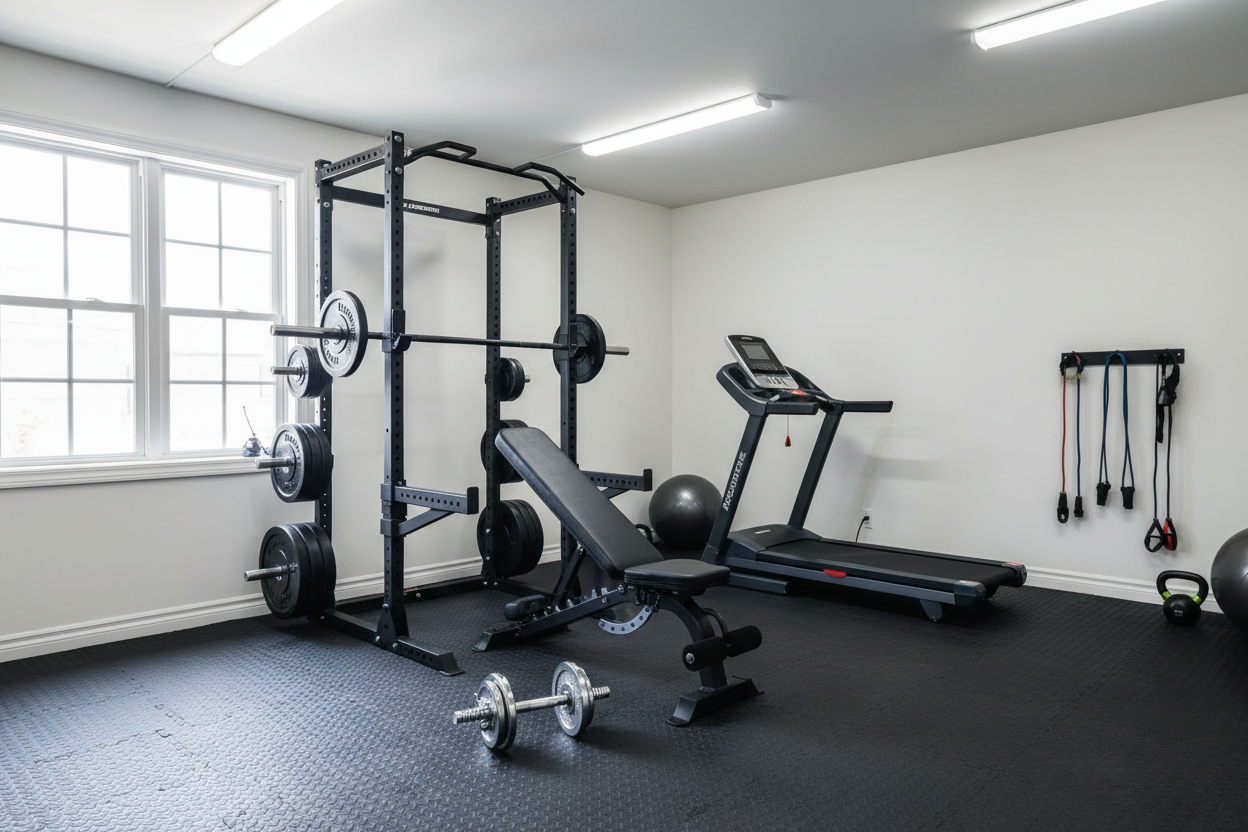
I used to spend twenty minutes of every workout just hunting for my 5-lb change plates or clearing a path to the power rack. My garage looked like a bomb went off in a Rogue warehouse, and while I loved the aesthetic of a 'black iron' dungeon, my schedule couldn't keep up. I was scrolling through forums at midnight, trying to figure out how to fit a 90-minute hypertrophy session into a 45-minute window before the kids woke up. That is when I realized I needed to stop treating my garage like a commercial gym and start treating it like a high-efficiency lab for full body home workout equipment.
Quick Takeaways
- Centralized stations slash transition times between exercises by 60% or more.
- Stability is king; if the frame weighs less than you do, don't buy it.
- Hypertrophy requires progressive overload, which means your station needs a high weight capacity (300+ lbs).
- Safety bails or a Smith-style lockout are non-negotiable for solo lifters.
I Was a Free-Weight Snob (Until I Ran Out of Time)
I used to swear that if you weren't using a standalone barbell and a pile of loose plates, you weren't really training. I thought all-in-one units were for people who bought fitness DVDs. But when my free time evaporated, I spent more time loading and unloading bars than actually moving them. The pacing between my squat rack and my cable crossover was eating my gains.
I finally decided to stop buying single machines and looked for a centralized hub. The shift was immediate. Instead of walking across the room to change exercises, I was just moving a pin or adjusting a pulley height. I wasn't just saving time; I was keeping my heart rate up and getting a much better pump because the rest intervals were actually tight for once.
Why Most At Home Full Body Workout Equipment Is Garbage
Let's be real: most at home full body workout equipment you see on social media is junk. I've tested units that used plastic pulleys so cheap they started fraying after three leg days. If the machine feels wobbly when you're doing a simple chest press, it’s going to be a nightmare when you try to move real weight. There is a massive problem with full body workout equipment designed for mass-market retail—it's built for 'toning,' not for people who want to put on ten pounds of lean mass.
You need to avoid anything that relies solely on thin resistance bands or light-gauge steel. If the maximum resistance tops out at 150 lbs, you're going to outgrow it in six months. Real muscle building requires mechanical tension. If the machine can't provide that tension safely, it's just a very expensive place to hang your laundry.
The 3 Non-Negotiables for a Real Training Station
To build a physique that actually looks like you lift, your equipment needs to meet three strict criteria. Forget the fancy digital screens and the 'AI coaching' subscriptions. You need physics on your side.
It Has to Survive Heavy Compound Loading
If you're doing heavy rows or squats, you need a frame that stays planted. Look for 11-gauge or 12-gauge steel. A unit like the multifunctional training station M1 is a great example of what to look for—it has a footprint that doesn't require bolting to the floor but stays rock solid when you're re-racking 300 lbs. If the uprights are less than 2x2 inches, keep looking.
You Need Safe Bails for Solo Lifting
Training alone in a garage is the ultimate test of grit, but it's also a great way to get pinned under a bar. I've been there, and doing the 'roll of shame' with 225 lbs across your ribs is a mistake you only make once. A Smith machine home gym station or a rack with integrated spotter arms allows you to push that final, ugly rep to absolute failure. That is where the growth happens. If you can't fail safely, you'll always sub-consciously hold back.
How I Run a Brutal 45-Minute Session on One Machine
My current go-to is a push/pull superset routine that would take two hours in a commercial gym. I start with a heavy press, then immediately pivot to a lat pulldown or a row on the same station. Because the cable system and the press arm are right there, the transition is five seconds. I'm not fighting for a bench or waiting for someone to finish their sets.
I usually finish with some isolation work like cable flies or tricep extensions. By the time I'm done, I've hit every major muscle group, and my sweat is pooling on the mat. Building an efficient home gym isn't about having a dozen different stations; it's about having one station that doesn't limit your intensity. I’ve found that my density and strength have actually improved because I’m forced to work harder in a shorter window.
FAQ
Can I really build as much muscle as I would with a barbell?
Yes. Your muscles don't have eyes; they only know tension and fatigue. If you are hitting the same weights and reps with good form, the stimulus is identical. In fact, the stability of a machine often lets you isolate the target muscle better than a shaky barbell set.
How much space do these stations actually take up?
Most high-quality all-in-one stations need about a 6x8 foot area. You want at least two feet of clearance around the sides to load plates and move comfortably. It’s a lot less space than a full rack, a bench, and a cable tower combined.
Is it worth getting a plate-loaded or selectorized (weight stack) unit?
Weight stacks are faster for transitions, but plate-loaded units are usually cheaper and have a higher ceiling for total weight. If you already own Olympic plates, a plate-loaded station is the smartest move for your wallet.
Share:
Why Your Cheap Bench for Gym Workouts Is Ruining Your Shoulders
I Tested 4 Cheap Home Weight Machines (And Kept Exactly Zero)