
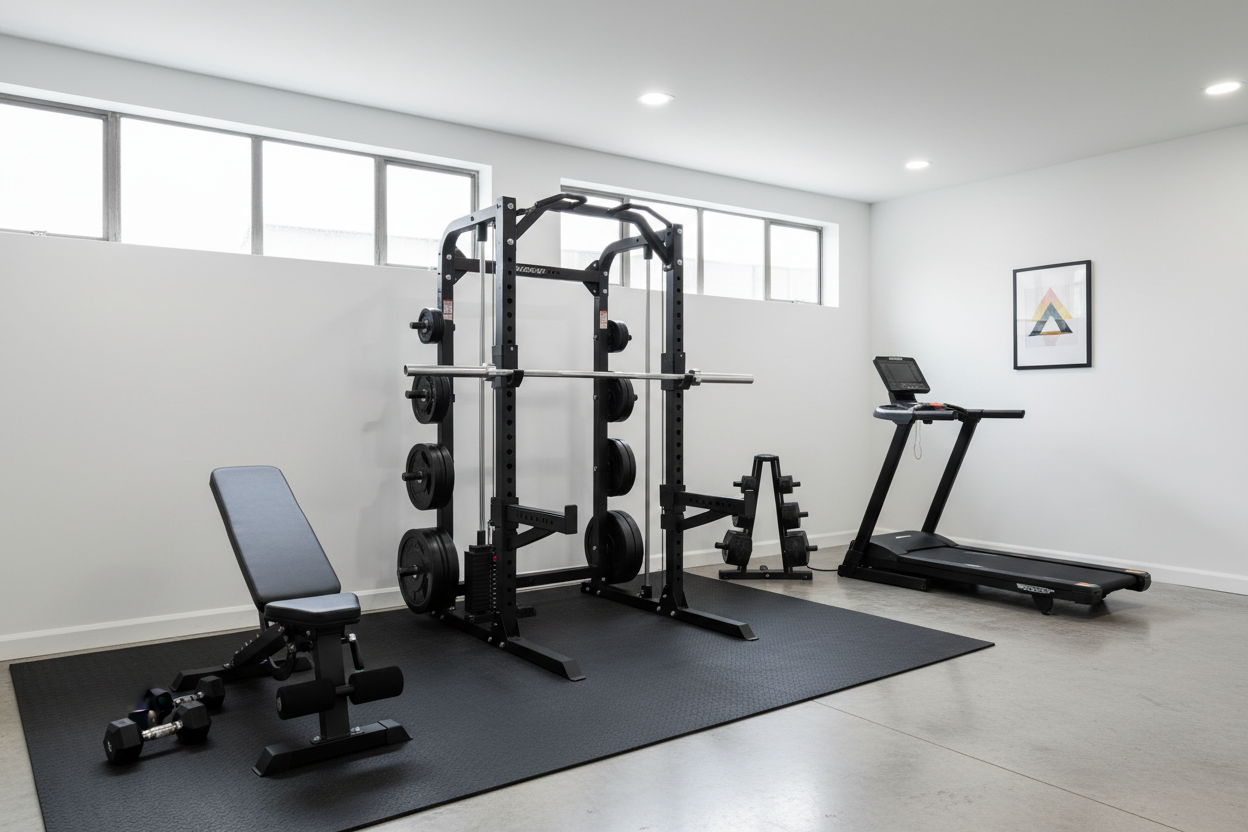
I spent years trying to build the ultimate garage setup one piece at a time. I thought I was being smart, hunting for deals on single-purpose machines, but I ended up with a graveyard of steel that left no room for an actual workout. Finding the best at home full body workout equipment isn't about how many pieces you own; it is about how much utility you can squeeze out of a single footprint.
- Stop buying single-use machines; they kill your floor space and your budget.
- Prioritize 2:1 pulley ratios for smoother, more versatile cable movements.
- A commercial-grade Smith bar is safer for solo heavy lifting and hypertrophy.
- Heavy-duty steel (11 or 12-gauge) is the difference between a tool and a toy.
The Delusion of the 'Perfect' 10-Machine Garage Setup
The biggest mistake I see beginners make is trying to replicate a commercial gym layout in a 200-square-foot garage. You buy a dedicated leg extension, a standalone pec deck, and a squat rack. Within six months, you are shimmying sideways just to reach your dumbbells. It is a spatial nightmare that kills your motivation to train.
Commercial gyms have the luxury of space; you do not. When you try to buy a separate machine for every muscle group, you end up with low-quality, 'prosumer' gear that wobbles the moment you load more than two plates. One heavy-duty, multi-functional rig will always outperform five pieces of junk.
Why I Stopped Hoarding Single-Use Gear
If you spend $400 on a cheap rack, $300 on a budget pulley system, and $500 on a standalone leg press, you have spent $1,200 on three mediocre tools. When building a functional home gym, that money is better spent on one tank-like station. I learned this the hard way after my third 'budget' pulley snapped a cable mid-row, nearly taking my teeth out.
A single-use machine is a liability in a home environment. It does one thing, takes up 15 square feet, and usually ends up as a place to hang your laundry. Transitioning to a centralized station saved my sanity and actually gave me room to stretch between sets.
Free Weights vs. The Best Full Body Workout Machine at Home
I used to be a barbell purist. If it wasn't a raw squat or a deadlift off the floor, I thought it was a waste of time. But as I got older and my joints started barking, I realized why I traded free weights for a full body workout machine for about 70% of my accessory work. A best full body workout machine at home allows for better time under tension and safer failure points when training solo.
Don't get me wrong, I still love my plates. But a high-end multi-station allows you to chase hypertrophy without needing a spotter. You can take a set of chest presses to absolute failure on a best full body home exercise machine without the fear of a 225-lb bar crushing your windpipe.
Anatomy of the Best Full Body Home Exercise Machine
Avoid the stuff sold on late-night infomercials with plastic parts and 'resistance bands' instead of weight stacks. You want 11-gauge or 12-gauge steel. If the frame weighs less than 300 lbs total, it is going to shake when you re-rack a heavy bar, and that is a dealbreaker for me.
Cables That Don't Feel Like Sandpaper
Cheaper machines use plastic pulleys that feel like dragging a sled through mud. You want aluminum pulleys and high-tensile strength cables. A 2:1 ratio is ideal for functional training because it gives you more cable travel and a smoother feel for movements like lateral raises or face pulls.
A Smith Rack That Can Actually Take Real Weight
A solid Smith machine home gym station needs linear bearings, not plastic bushings. If the bar sticks or catches while you are descending, you are begging for a shoulder injury. When the movement is butter-smooth, it becomes the best full body home workout machine for high-volume leg and chest days.
Putting It All Together: My Top Equipment Pick
If you want to stop overthinking your gear and start training, I recommend a multi training station Smith machine. The DM01, for instance, fits a power rack, a Smith bar, and a dual cable system into a 6x5 foot footprint. It is built with the kind of steel that survives daily abuse without needing to be bolted to the floor.
I have loaded these racks with over 400 lbs, and they don't budge. Having the ability to switch from a cable fly to a Smith machine squat in ten seconds is what keeps your heart rate up and your workout efficient. It is the only logical endgame for someone tired of a cluttered garage.
How to Structure Your Full-Body Workout at Home Equipment
With full-body workout at home equipment, I suggest a Push/Pull/Legs split or a heavy Upper/Lower split. Since everything is in one spot, your transition times are non-existent. You can superset a Smith machine press with a cable row without walking across the room.
Focus on your big compound movements first—squats or presses on the Smith bar—then move to your cable isolation work. This setup ensures you hit every muscle fiber without needing a room full of commercial machines. It is about training smarter, not owning more steel.
FAQ
Does this equipment need to be bolted to the floor?
Most high-quality multi-stations weigh enough (400+ lbs) that they are stable without bolts. However, if you are doing heavy pull-ups or using a TRX attachment, bolting it down adds that extra layer of 'tank-like' security.
Can I use my existing 2-inch Olympic plates?
Yes. Any legitimate Smith or plate-loaded station will be designed for 2-inch Olympic plates. Avoid anything that uses 1-inch 'standard' pegs; they are usually built for kids' toys, not serious lifting.
Is assembly a nightmare?
I won't lie—it takes time. Plan for a 4-6 hour Saturday. Grab a real socket wrench set instead of the flat metal tools they include in the box. Your hands will thank me later.
Share:
I Wanted Yellow Gym Equipment (Until I Saw the Price Tag)
How to Squeeze a Compact Smith Machine Into a Spare Bedroom