
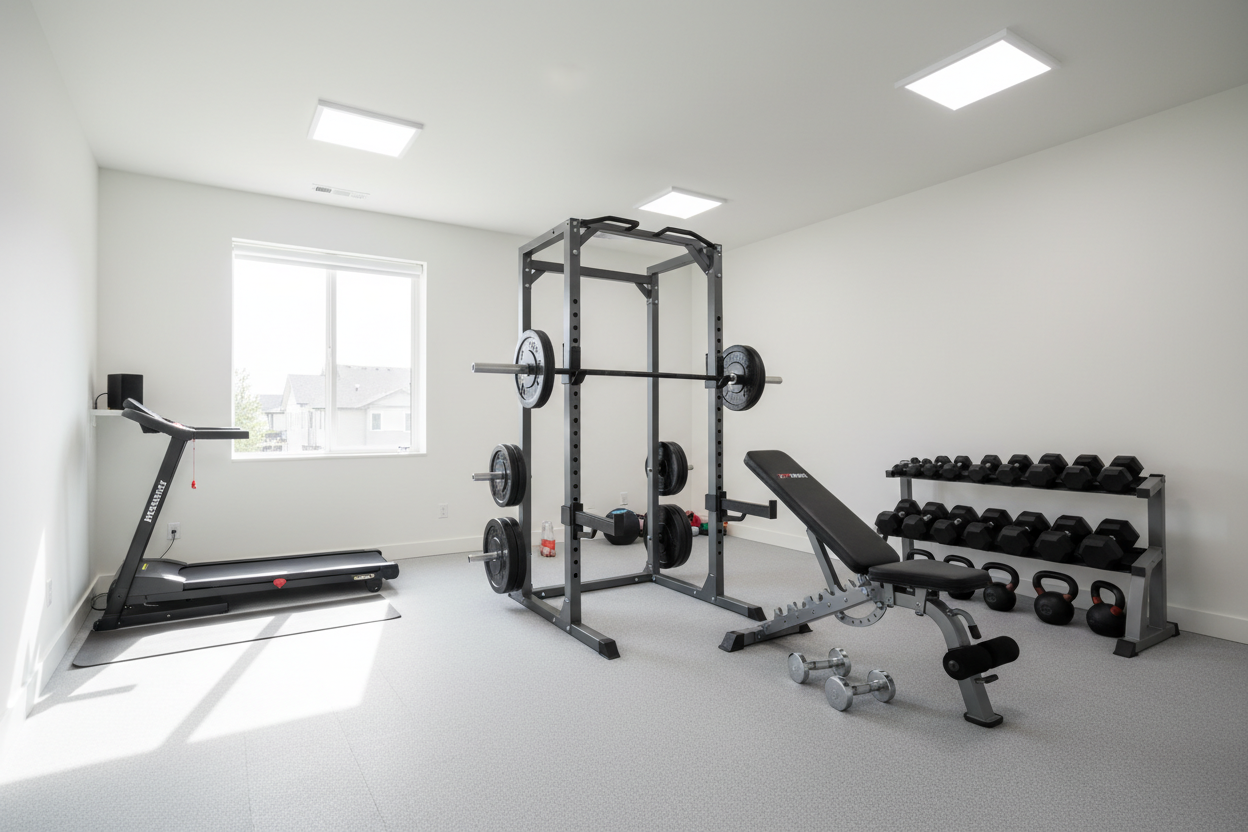
I remember staring at my spare bedroom—a 10x10 cube of beige carpet and wasted potential—thinking I could fit a full-sized commercial power rack. I was wrong. After measuring twice and realizing the door wouldn't even open halfway, I pivoted. I needed a compact smith machine that didn't treat my drywall like a punching bag.
Quick Takeaways
- A 10x10 room actually offers about 8x9 of usable space once you account for door swings.
- Look for 'ghost footprints'—the extra 12-18 inches needed on each side to load plates.
- Integrated cable systems are mandatory in small spaces to replace standalone lat pulldown machines.
- 3/4-inch horse stall mats are the minimum requirement for floor protection.
The Brutal Math of a 10x10 Room
On paper, 100 square feet sounds like plenty. In reality, a standard spare bedroom is a claustrophobic trap for gym equipment. You have to account for the 'active zone.' If your room has a closet with swinging doors, you've already lost two feet of depth. If there is a window, you probably don't want to block the light or risk a stray plate cracking the glass.
Most people forget about baseboards, too. A machine that is 48 inches wide won't sit flush against the wall because the trim adds an extra half-inch on both sides. Then there is the door to the room itself. Unless you plan on climbing over your bench to get inside, you need a clear path for that door to swing 90 degrees. This usually leaves you with a corner or a single wall to anchor your entire setup. Don't eyeball this. Use painter's tape to outline the machine on the floor before you hit 'buy.'
What Actually Makes a Rig a 'Compact' Smith Machine?
A true smith machine compact design isn't just a shrunken version of what you see at Gold's Gym. It is an exercise in efficiency. Standard Smith machines often have massive, sprawling bases for stability, but compact units use heavy-gauge steel and bolt-down options to keep the footprint tight. You want to look for a depth of 50 inches or less.
Height is the next killer. Most residential ceilings are 8 feet (96 inches). A commercial unit might stand 90 inches tall, leaving you almost no room to actually bolt the top crossmember together or perform a pull-up without hitting your head on the ceiling. When you browse modern Smith machine setups, look for 'short' or 'residential' models that hover around the 80 to 84-inch mark. This gives you enough clearance for the guide rods and your skull.
Narrow frames are also a hallmark of the compact category. While a standard Olympic bar is 86 inches long, some compact rigs use specialized bars or narrower frame widths to shave off those crucial inches that prevent you from scraping the paint off your walls during a set of incline presses.
The 'Ghost Footprint': Plate Loading and Bar Overhang
This is the mistake that ruins home gyms. You see a spec sheet that says the machine is 48 inches wide, and you think, 'Perfect, I have 50 inches of space.' You're forgetting the bar. A standard Smith bar extends well past the frame. If you don't account for this 'ghost footprint,' you'll realize too late that you can't actually slide a 45-pound plate onto the sleeve because it's pressed against the wall.
While testing multiple rigs for a garage gym, I found that you need at least 12 inches of clearance on either side of the bar's maximum width. If the bar is 86 inches, you realistically need a room width of 110 inches to load the machine comfortably. If you're tighter than that, you have to look for machines with 'front-loading' weight pegs or a shorter, specialized bar. I've seen guys have to move their entire rig three inches to the left just to fit a 10-pound plate on. Don't be that guy.
Choosing the Best Smith Machine for Small Spaces
When space is your primary constraint, your smith machine for small spaces cannot just be a Smith machine. It has to be your entire gym. I'm a big fan of 'all-in-one' trainers that bake a functional trainer (cables) and a power rack into the Smith frame. If you buy a standalone fixed-path rig, you'll eventually want a cable machine for crossovers or lat pulldowns, and you simply won't have the floor space left to buy one.
I personally prefer units that use a 2:1 cable ratio for versatility. It allows for finer weight increments, which is vital for smaller muscle groups. If you're a leg day specialist, you might even consider a compact leg press combo machine. These hybrid units are the only way to get a 'big gym' leg pump in a room that was originally designed for a twin bed and a nightstand. Look for machines that offer storage pegs on the back of the frame—this keeps your plates off the floor and adds stability to the rig without increasing the footprint.
Will 500 Pounds of Iron Destroy Your Floor?
If you're on a second floor or have nice hardwoods, the answer is yes. A loaded Smith machine plus your body weight can easily put 700+ pounds of pressure on four small contact points. Standard carpet padding will flatten like a pancake in a week. I always recommend 3/4-inch recycled rubber horse stall mats. They are dense, cheap, and much better than the 'puzzle piece' foam mats that slide around the moment you try to do a lunge.
For maximum protection, I've used a 'sandwich' method: a layer of 1/2-inch plywood directly on the floor, topped with the rubber mats. This distributes the weight across the floor joists and prevents the feet of the machine from leaving permanent indentations in your subfloor. It raises the height by an inch, so double-check your ceiling clearance again.
FAQ
Is a Smith machine better than a power rack for small rooms?
Usually, yes. Because the bar is on a fixed track, you don't need the extra 'spotting' space required for a free-weight barbell. It is a more contained, predictable footprint.
Can I assemble a Smith machine by myself?
I've done it, but I don't recommend it. You'll need someone to hold the uprights steady while you bolt the top crossmember. Also, buy a real socket wrench set; the 'tools' included in the box are usually garbage.
How much ceiling height do I really need?
Aim for at least 12 inches of clearance above the machine's height. This gives you room to do pull-ups and ensures you won't hit the ceiling light fixture when you're moving parts around during assembly.
Share:
Stop Buying Single Machines: The Best At Home Full Body Workout Equipment
Struggling With Quad Growth? Try the Narrow Stance Smith Machine Squat