
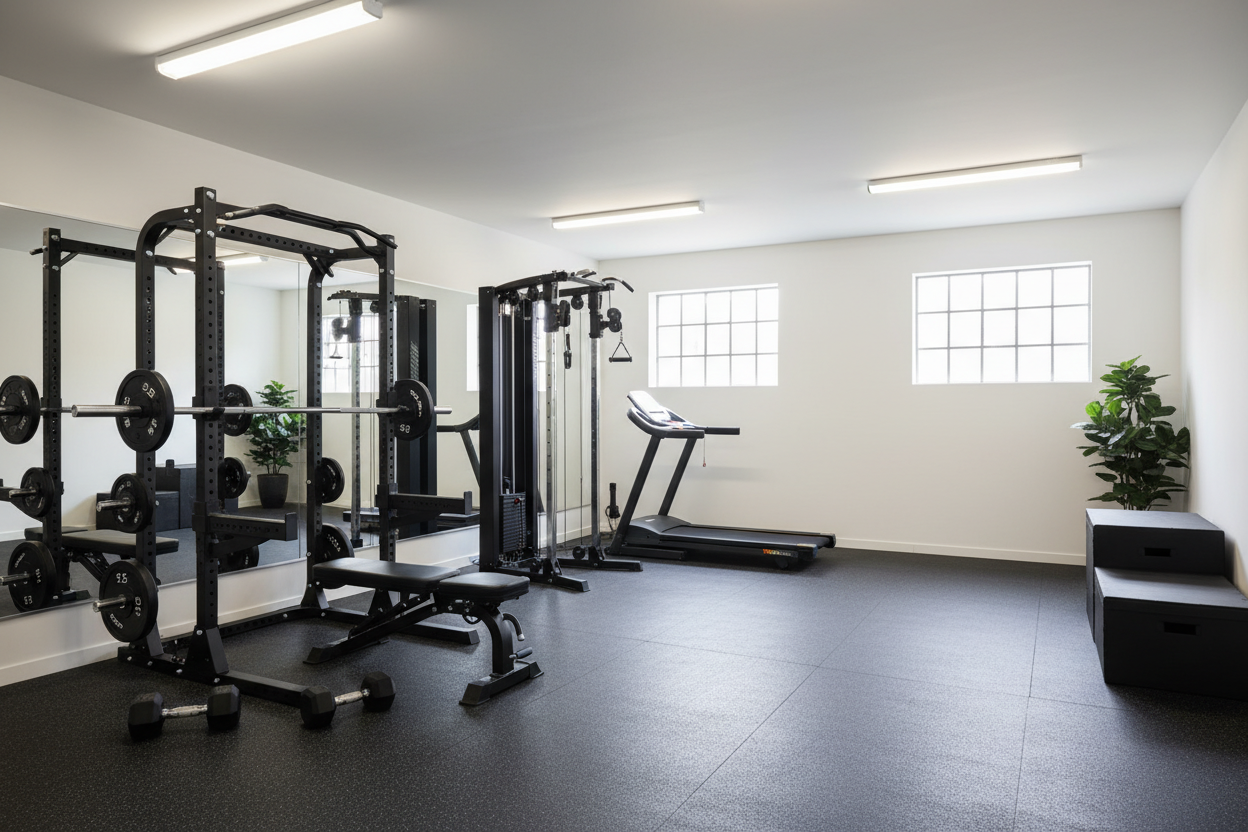
I remember the day I finally canceled my commercial gym membership. I had just finished bolting my power rack to the concrete, and I felt like a king. But three weeks into my new garage routine, I hit a wall. My joints were cranky, my accessory work felt clunky, and I weirdly missed the smooth, mindless glide of the fitness 19 equipment I used to mock.
There is a specific, friction-free isolation you get from commercial circuits that is hard to replicate with a barbell and a prayer. The functional fitness crowd is wrong about exercise on machines—sometimes you need to shut your brain off and just chase a pump without worrying about your midline stability or bracing for dear life. You want that pin-loaded convenience, but you don't have the $50,000 budget of a franchise owner.
- Commercial Secret: Club machines use high-grade bearings and 11-gauge steel frames for stability.
- The Trap: Buying retired commercial gear usually ends in a logistical nightmare of weight and size.
- The Fix: Plate-loaded leverage machines offer the same fixed path for 70% less cost.
- The Detail: Upgrading your home cable pulleys to aluminum can bridge the 'feel' gap instantly.
Why I Actually Missed the Budget Gym Vibe
For years, I was a barbell purist. If it didn't involve a squat rack or a platform, I didn't want it. But after a few months of strictly free-weight training in my garage, my elbows started barking. I realized that the fitness 19 machines I used to breeze through were doing something my home gym wasn't: providing constant tension without the joint tax.
Commercial gyms are designed for high-volume turnover. That means the machines have to be intuitive and smooth enough for a total novice to use without getting hurt. In a garage gym, we often trade that smoothness for versatility. We try to make one cable tower do fifteen different things, and in the process, we lose that 'locked-in' feeling of a dedicated chest press or a seated row station.
The reality is that isolation work is the glue that keeps a training program together. When you can't hit a set of 15 leg extensions to finish a quad workout, you end up doing more squats, which eventually beats you into the dirt. Replicating that club feel isn't just about luxury; it’s about longevity.
Who Actually Manufactures Fitness 19 Equipment?
If you walk into a typical location, you aren't looking at generic 'no-name' gear. You are usually seeing fitness 19 machines manufactured by titans like Matrix, Precor, or Life Fitness. These brands don't sell to the public at Walmart. They build stuff meant to survive 18 hours of daily use by people who treat equipment like garbage.
The reason a Matrix Aura series lat pulldown feels so much better than a home gym equivalent comes down to the weight stack and the cam system. Commercial units use precision-machined guide rods and heavy-duty weight stacks that are often 'selectorized'—meaning you just move a pin. The internal pulleys are often larger in diameter, which reduces the 'drag' on the cable as it travels.
These companies also invest heavily in biomechanics. The pivot points on a commercial leg press are designed to keep the tension on the muscle through the entire range of motion. Most home gym gear uses a linear path that can feel 'dead' at the top or bottom of the movement. That’s the gap we’re trying to close.
The Hidden Trap of Buying Used Fitness 19 Machines
You’ll see them on Facebook Marketplace: a retired Life Fitness chest press for $400. It looks like a steal. You think, 'I’ll just put this in the corner of the garage and have that club feel forever.' Don't do it. I’ve made this mistake, and my lower back still regrets the move.
First, commercial fitness 19 equipment is incredibly heavy. A single selectorized machine can weigh 600 to 900 pounds. Most of that is the cast-iron weight stack. Unless you have a pallet jack and a roll-up door, getting that into a standard residential room is a disaster. I once spent four hours trying to shimmy a commercial leg extension through a standard 32-inch door frame. I ended up having to take the entire frame apart, and it was never as stable again.
Second, the footprint is massive. Commercial gyms have thousands of square feet. Your garage doesn't. A single dedicated commercial machine usually does one thing and takes up a 4x6 foot space. In a home gym, that’s prime real estate. Finally, parts are proprietary. If a cable snaps on a 10-year-old Matrix machine, you can't just buy a replacement at Home Depot. You’ll be hunting down specialized dealers who might not even sell to individuals.
How to Fake the Commercial Feel in Your Garage
You don't need a $4,000 pin-loaded stack to get the same training effect. You just need to be smarter about the mechanics. The goal is to mimic the fixed-path resistance of those fitness 19 machines without the commercial price tag or the massive weight.
Swapping Selectorized Stacks for Plate-Loaded Leverage
The best way to get that 'locked-in' feeling is through plate-loaded leverage machines. Brands like Titan, Rogue, and Griffin make 'leverage' versions of chest presses and rows. Instead of a cable pulling a stack, you’re pushing a steel arm that pivots on a heavy-duty bearing. It’s the same physics used in high-end commercial gear.
The benefit here is twofold: cost and maintenance. You already own the Olympic plates, so you aren't paying for 200 pounds of cast iron to be shipped to your house. Because there are no cables or pulleys involved in a leverage machine, there is zero friction. It feels just as smooth as a $5,000 selectorized unit, but it fits in a smaller footprint and costs a fraction of the price.
Upgrading Your Cable Smoothness
If you already have a functional trainer or a lat pulldown, the 'cheap' feeling usually comes from the pulleys. Most home gym equipment ships with nylon (plastic) pulleys. Over time, these develop flat spots or just create a lot of drag. If you want your home gear to feel like fitness 19 equipment, swap them out for machined aluminum pulleys with high-quality bearings.
I did this on my budget lat pulldown last year. It cost me about $80 for a full set of 6061 aluminum pulleys. The difference was night and day. Suddenly, the weight didn't 'stutter' on the way down. You should also look at your cable ratio. A 2:1 ratio (where 100 lbs feels like 50) is standard for functional trainers because it allows for more cable travel and a smoother pull. If your home gym feels 'heavy' and 'jerky,' it’s likely a 1:1 ratio with cheap plastic wheels.
Is the Club Experience Actually Worth Chasing?
At the end of the day, you have to ask if you’re building a gym to train or a gym to look at. You can spend a lifetime trying to perfectly replicate a commercial circuit, but you’ll run out of space long before you run out of money. My advice? Pick two 'luxury' items—usually a high-quality cable station and one leverage-based press—and keep the rest of the gym focused on the basics.
I don't miss the monthly fees or the guy doing curls in the squat rack, but I do respect the engineering behind commercial gear. By focusing on pulley quality and leverage arms, you can get 90% of that fitness 19 equipment feel without the 100% commercial price tag. Spend your money on the touchpoints—the handles, the pulleys, and the bearings—and your garage will feel like a pro club in no time.
FAQ
Why do machines at Fitness 19 feel smoother than my home gym?
It comes down to pulley diameter and bearing quality. Commercial machines use larger pulleys which reduce the bend angle of the cable, creating less friction. They also use heavier steel frames that don't vibrate or flex during the lift.
Can I add a weight stack to my plate-loaded home gym?
Technically yes, but it’s rarely worth it. Adding a selectorized stack requires guide rods and a specific frame height. You’re better off using a high-quality loading pin or buying a dedicated cable tower designed for a stack from the start.
What is the best brand for 'commercial feel' home equipment?
For my money, brands like Rep Fitness and Rogue are leading the pack in 'pro-sumer' gear. They use the same 11-gauge steel as the big club brands but design the footprints to actually fit in a standard 10x10 bedroom or garage space.
Share:
Stop Doing Standard Reps: 4 Different Squats on Smith Machine
I Built the Perfect Lifting Weights Set With Just 3 Purchases