
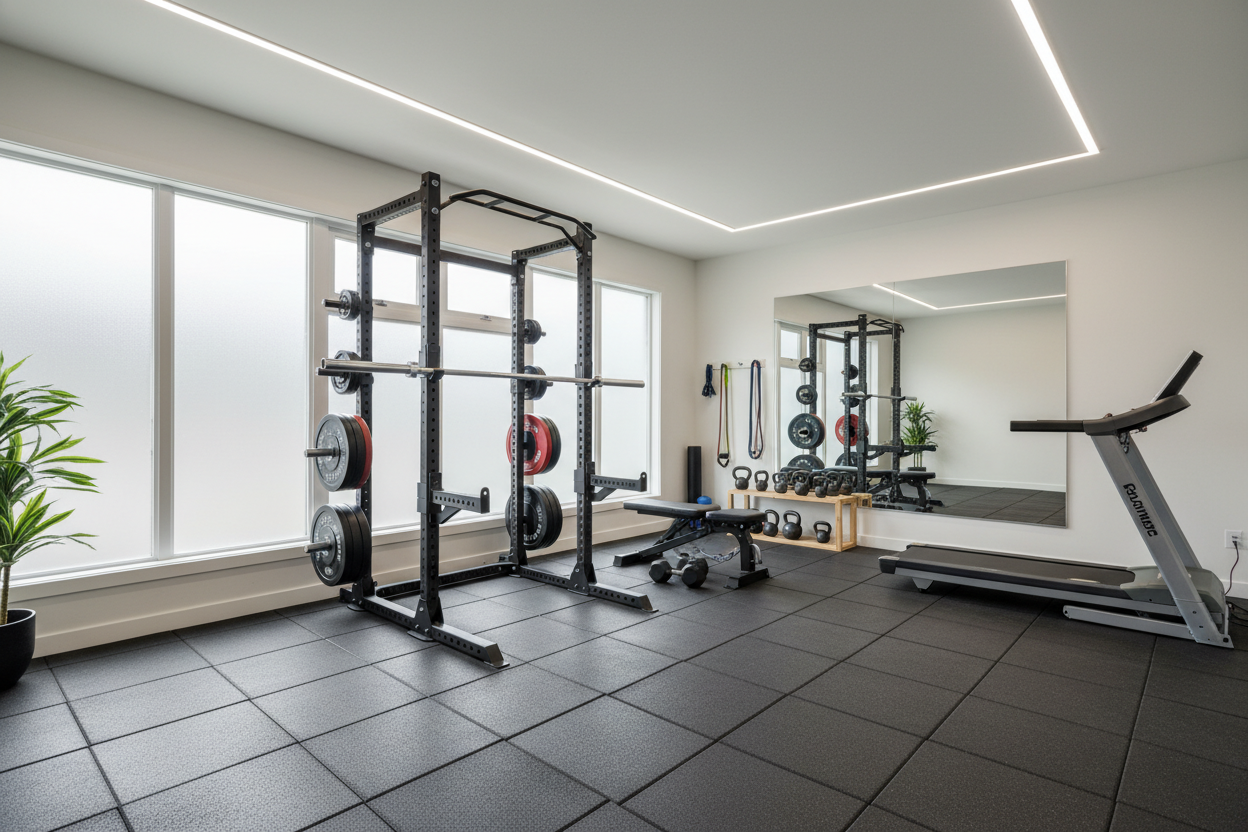
I remember the exact moment I hated my first garage gym. I’d just spent three grand on a beautiful power rack and a set of competition bumpers, but I couldn’t actually finish a workout without cursing. I was tripping over a stray adjustable bench just to load a 45-pound plate. My gym setup design was a total disaster because I treated floor space like a game of Tetris rather than a functional training environment.
Quick Takeaways
- Clear the barbell path: You need at least 9 feet of horizontal width to load plates safely.
- Verticality is king: If it’s on the floor and not being lifted, it’s in the way.
- The 'One-Step' Rule: Plates should never be more than one step away from the rack.
- Lighting and airflow aren't 'extras'—they are safety requirements.
The Moment I Realized My Layout Was Trash
I was halfway through a heavy squat session in my basement. I went to grab a pair of 10-pound change plates and realized they were buried behind a stack of kettlebells in the far corner. To get to them, I had to shimmy past a loaded barbell with about two inches of clearance. It was dangerous, annoying, and it killed my heart rate. This is the trap of poor house gym design.
We tend to shove everything against the walls to 'open up' the middle of the room. In reality, this creates a cramped perimeter where all the actual work happens. You end up working in a series of tiny, claustrophobic pockets. A real gym needs breathing room around the equipment, not just a patch of open carpet in the center of the room that you only use for burpees.
Stop Pretending You Have a Commercial Space
The biggest mistake I see is the 'copy-paste' error. You see a massive training facility on Instagram and try to shrink that home gym plan design into a 12x12 spare bedroom. It doesn't work. Commercial gyms have the luxury of dedicated zones for every body part. You don't. Stop Letting Pinterest Ruin Your Gym at Home Design by convincing you that you need a leg extension machine, a dedicated rowing erg, and a full dumbbell rack in a space meant for a twin bed.
When you cram too much gear into a basement gym layout, you lose the ability to move dynamically. If you have to move a mountain of gear just to set up for deadlifts, you’re going to start skipping deadlifts. Your layout should remove friction, not add it. If a piece of equipment doesn't serve three or more purposes, and you're tight on space, it has to go.
The Flow State Rule for a Perfect Home Gym Layout
The perfect home gym layout is built around the barbell. A standard Olympic bar is 7.2 feet long. If you don't have at least a foot of clearance on either side of that bar, you’re going to be banging plates against your drywall or your water heater. I recommend a 'dead zone' of 9 feet wide for any lifting area. This gives you room to slide plates on without performing a balancing act.
Think about your 'working radius.' Your chalk bowl, your collars, and your primary plates should be within arm's reach of the rack. I spent years walking across the garage to grab a pair of clips. It sounds small, but over a 90-minute session, that wasted movement adds up. You want to stay in the 'flow state' where the only thing you're thinking about is the next set, not where you left your lifting belt.
The 3-Zone Method for Any Basement Gym Layout
To fix a messy space, I use the 3-Zone Method. It keeps things organized and ensures you aren't constantly rearranging furniture mid-workout. Zone 1 is your Heavy Lifting Zone. This is the anchor of your home gym. It’s where your rack and platform live. This area stays clear of all clutter—no stretching mats, no foam rollers, no stray shoes.
Zone 2 is the Vertical Storage Zone. Use your wall studs. Wall-mounted plate racks and barbell hangers are the best investment you can make for a small space. Zone 3 is the Accessory Zone. This is for your adjustable dumbbells, bands, and benches. By separating the 'big movements' from the 'accessory work,' you create a natural flow to your training. You start in Zone 1 for the heavy stuff and migrate to Zone 3 to finish off.
Gear That Actually Respects Your Floor Plan
If you're fighting for every square inch, you have to be ruthless with your gear selection. This is where multi-functional units shine. Instead of a standalone power rack and a separate cable crossover, I often point people toward a smith machine home gym station. These units often integrate pull-up bars, cable pulleys, and plate storage into one footprint. It’s about density.
I once owned a dedicated GHD that took up nearly 20 square feet. I used it twice a week. That was a massive failure in gym setup design. I eventually sold it and bought a Nordic curl strap that fits in a drawer. Always ask yourself: 'Does this piece of gear earn its footprint?' If it only does one thing, it better be the most important thing in your program.
FAQ
How much space do I really need for a home gym?
At a minimum, you need an 8x8 foot area for a power rack and plate loading. If you want to include a cardio piece or a dumbbell bench, aim for at least 150 square feet to avoid feeling cramped.
Should I put my rack in the center or against the wall?
If you have a full power rack (4 posts), putting it slightly away from the wall allows you to load plates from both sides and use the back of the rack for storage. If you have a half rack, flush against the wall is usually fine.
What is the best flooring for a basement gym?
Skip the cheap foam puzzle mats. They compress under heavy loads and slide around. Go to a farm supply store and get 3/4-inch rubber horse stall mats. They are indestructible, provide great vibration dampening, and stay put.
Share:
I Built the Perfect Lifting Weights Set With Just 3 Purchases
Why Buying a Dedicated Arm Weight Set Is a Waste of Space