
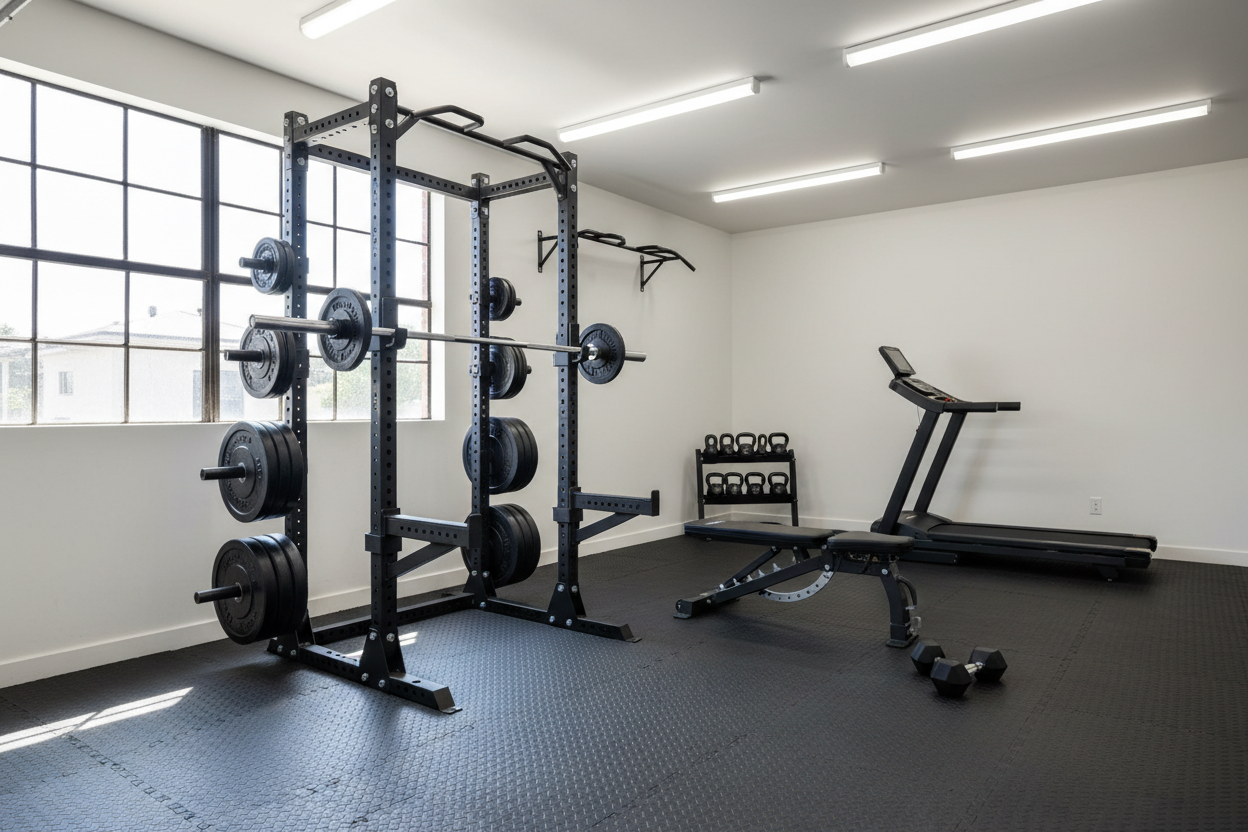
You just dropped three months' rent on a 3x3 rack and a calibrated plate set. It arrives on a pallet, looking glorious in the sun, until you realize you have to move 800 pounds of powder-coated steel into your basement by yourself. A home gym install isn't just about turning bolts; it's about making sure your house stays standing when you rerack a heavy triple. I've spent enough time cursing at stripped bolts and uneven concrete to know that the 'honeymoon phase' of new gear ends the moment you realize you're missing a 19mm socket.
- Level your floor first; garages are built to drain water, meaning they are rarely flat.
- Throw away the included 'toy' wrenches and use a real 1/2-inch impact wrench.
- Anchoring to concrete requires 3/8-inch wedge anchors, not just plastic wall plugs.
- If your rack has more than four pulleys, consider hiring pros to save your sanity.
The 'Easy Assembly' Myth (Why People Mess This Up)
Marketing photos are a lie. They show a pristine, sun-drenched room with a perfectly placed rack, but they never show the three hours spent unboxing plastic-wrapped uprights that are covered in industrial grease. Most home gym installation failures start with the tools. If you try to build a 11-gauge steel power rack using the flat, stamped-metal wrenches included in the box, you're going to have a bad time. Those tools are designed for IKEA coffee tables, not structural steel that needs to hold half a ton.
You need a real socket set and preferably an impact driver. I’ve seen guys spend an entire Saturday hand-cranking 5/8-inch bolts only to realize they didn't tighten them enough, leading to a rack that sways like a palm tree in a hurricane. Also, check your hardware immediately. There is nothing worse than being 90% done with a gym installation and realizing you're short two washers. Lay everything out on the floor like an exploded diagram before you even touch the uprights.
Flooring First: You Can't Build on a Crooked Foundation
Before you tighten a single bolt, look at your floor. Most garage floors have a pitch—usually dropping about one inch for every ten feet—to ensure water drains out toward the door. If you build your rack directly on that slope, your barbell will never be level. This isn't just an OCD thing; it's a safety issue. Squatting on a slant puts uneven shear force on your knees and hips. You’ll find yourself wondering why your left side always feels tighter, and the answer is usually your floor, not your mobility.
I always recommend starting with a solid layer of 3/4-inch horse stall mats or specialized rubber tiles. If you want the best surface to build on, the gold standard 4x8 gym mat is the way to go. It provides a dense, non-slip base that protects your concrete from cracks when you inevitably drop a deadlift. If the slope is severe, you might need to build a wooden lifting platform and shim the low side to create a truly level playing field. Don't skip this. A rack built on a bad floor is a rack you'll eventually have to take apart and move anyway.
Anchoring the Heavy Metal: Concrete vs. Wood Studs
If you're installing a wall-mounted rack or a slim-profile unit, you have to anchor it. Period. I’ve seen 'freestanding' racks tip over because someone did a heavy pull-up with too much momentum. When you're deciding between a power rack or a heavy smith machine, keep in mind that the anchoring requirements change. A smith machine is often more stable due to its fixed path, but a power rack needs that rock-solid connection to the earth to handle lateral movement.
For concrete, skip the cheap Tapcons. Go to the hardware store and buy 3/8-inch or 1/2-inch wedge anchors. You'll need a hammer drill—not a standard drill—to get through the slab. If you're mounting to wood studs in a finished room, do not trust the drywall. Use a 2x10 stringer board across at least three studs to distribute the load. I once saw a guy rip a folding rack straight out of the wall because he missed the center of the stud by half an inch. It wasn't a cheap mistake to fix.
When to Swallow Your Pride and Hire Home Gym Fitters
I’m a DIY guy to the core, but even I have limits. If your dream gym involves a dual-weight stack functional trainer with a complex cable routing system, you might want to call in professional home gym fitters. Cable tension is a fickle beast. If you route one pulley over instead of under, you’ll end up with frayed cables and a weight stack that hitches every time you try to do a chest fly. It’s a massive headache that can turn a fun project into a week-long nightmare.
The same applies to electrical needs. If you’re installing a high-end treadmill or an infrared sauna, you might need a dedicated 20-amp circuit. Don't just plug a commercial-grade treadmill into a daisy-chained power strip and hope for the best. You'll trip the breaker every time you hit 8 mph. If the manual mentions structural ceiling joists for a boxing bag or a TRX mount, and you aren't 100% sure what's behind your ceiling, pay a pro. The cost of a fitter is significantly less than the cost of repairing a collapsed ceiling.
The Final Shake Test Before You Lift
Once the steel is up and the bolts are 'tight,' you aren't done. You need to perform a mandatory safety check. Go around every single joint with a torque wrench. You’re looking for 'snug plus a quarter turn' for most 5/8-inch hardware. If you hear the steel groaning, you’re doing it right. Then, give the rack the 'shake test.' Grab the uprights and try to move them. If there’s any play in the base, your anchors aren't deep enough or your bolts are loose.
Check for cable friction by running the handles through their full range of motion without any weight. It should feel like butter. If there's a 'catch,' a pulley is likely misaligned. Once everything is verified, you finally have a complete home gym setup that won't kill you mid-set. It’s a lot of work, but the first time you hit a PR in your own garage without a crowd of teenagers hogging the bench, you’ll realize every drop of sweat during the install was worth it.
How long does a full home gym installation take?
For a standard power rack, bench, and flooring, plan for about 4 to 6 hours if you're working alone. If you have a buddy and an impact wrench, you can probably knock it out in 3. Complex cable machines can easily take a full 8-hour day.
Do I need a special drill for concrete floors?
Yes. A standard cordless drill will just burn out the motor. You need a hammer drill and a high-quality masonry bit. Most hardware stores rent them for 20 bucks, which is way cheaper than buying a tool you'll only use once every five years.
Can I install a gym on the second floor?
It depends on your house's construction. Most modern homes can handle a rack and some weights, but I wouldn't recommend dropping 500-lb deadlifts on a second-story floor without structural reinforcement. Keep the heavy lifting in the garage or basement if possible.
Share:
The Exact Order to Follow When Buying Gym Equipment for Home
I Unplugged Every Electric Exercise Machine in My Garage (Here's Why)