
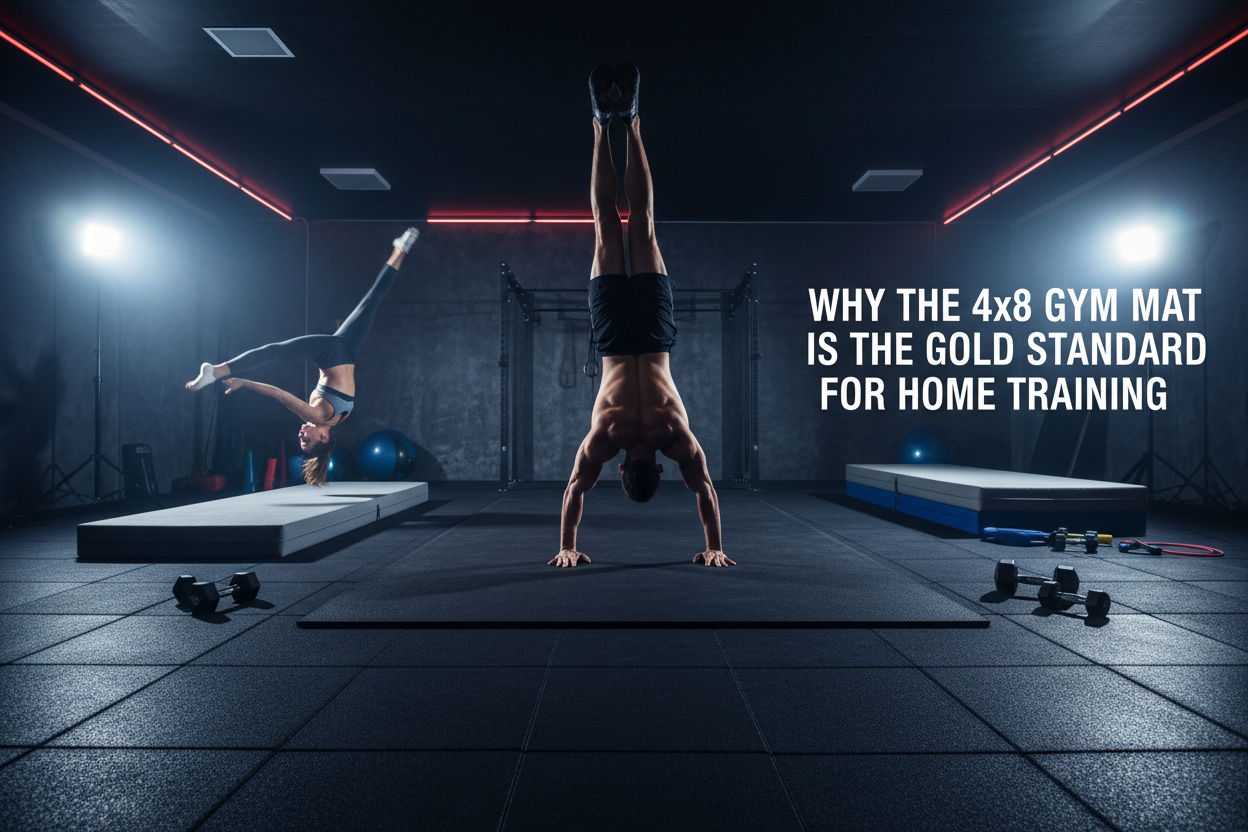
Most home gym setups have a glaring weakness: the floor. You might have the best kettlebells or the perfect pull-up bar, but if you are doing burpees on concrete or trying to stretch on a slipping yoga towel, your performance suffers. This is where the 4x8 gym mat changes the dynamic.
It isn't just a pad; it is a defined workspace. Whether you are practicing martial arts, teaching a child a forward roll, or just trying to save your knees during HIIT, this specific dimension offers the perfect balance of coverage and storability. Let's break down why this size is the industry standard and how to choose the right one without wasting money on low-density foam that flattens in a month.
Key Takeaways
- Ideal Dimensions: A 4x8 surface accommodates a fully extended adult body with room to spare for rolling or lateral movement.
- Thickness Impact: Standard 1-3/8 inch mats are best for general fitness; 2-inch mats are required for high-impact tumbling or takedowns.
- Expandability: Look for mats with Velcro strips on all four sides to connect multiple units for a larger floor area.
- Core Material: Cross-linked polyethylene foam offers the best rebound and shock absorption compared to cheap open-cell sponge foam.
The "Goldilocks" Size: Why 32 Square Feet?
You might wonder why the gym mat 4 x 8 configuration is so prevalent. It comes down to human biomechanics. The average adult male is under 6 feet tall. A 6-foot mat often leaves your head or feet dangling on the cold floor during savasana or floor presses. The extra two feet provided by an 8-foot length ensures your entire body remains protected, even when your arms are extended overhead.
Furthermore, the 4-foot width is exactly enough to perform a log roll or a side plank without drifting off the edge. It is wide enough to be safe, but narrow enough that the folded mat (usually folding into four 2-foot panels) fits easily into a closet or behind a sofa.
Understanding Foam Density and Thickness
Not all mats are built the same. When shopping for a gymnastics mat 4 x 8, the exterior vinyl often looks identical, but the "science" happens inside the cover.
1-3/8 Inch vs. 2 Inch
For most general users, the 1-3/8 inch thickness is standard. It provides enough cushion to protect elbows and knees but remains firm enough to stand on for balance exercises. If you are sinking in too deep, you lose stability.
However, if you are looking for a tumbling mat 4x8 specifically for gymnastics landings, cheerleading, or judo throws, you need the 2-inch thickness. That extra fraction of an inch drastically increases shock absorption (G-force reduction) upon impact, saving ankles and lower backs from cumulative stress.
Cross-Link Polyethylene
Avoid "sponge" foam. You want cross-linked polyethylene foam. This material is closed-cell, meaning it doesn't absorb moisture (sweat) and resists "bottoming out." When you step on a high-quality 4 x 8 tumbling mat, it should snap back to its original shape instantly. If you leave a footprint that takes ten seconds to disappear, the foam density is too low.
Panel Configuration and Portability
A standard exercise mat 4x8 usually consists of four panels. This paneled design allows the mat to fold into a 4ft x 2ft x (approx) 8-inch block. This is crucial for home gyms that double as living rooms or garages.
A pro tip for durability: Check the stitching between the panels. This is the highest stress point. Double-stitching is non-negotiable here. If the vinyl tears at the fold, the foam gets exposed and starts to crumble.
My Personal Experience with 4x8 Gym Mats
I have spent years training on various surfaces, from puzzle tiles to horse stall mats, but my relationship with the folding panel mat is specific. I currently keep a 4 x 8 gymnastics mat in my garage for mobility work.
Here is the unpolished truth about them: The Velcro seams can be brutal.
Most of these mats have hook-and-loop fasteners on the sides to connect them. When I'm doing ground work—specifically Brazilian Jiu-Jitsu drills or even just sloppy burpees—if I slide across that Velcro connection point without a rash guard or long socks, it feels like sandpaper dragging across the skin. It leaves a distinct "mat burn" that lingers for days.
Another thing the spec sheets don't tell you is the "slide factor." Even a heavy mat will drift on a laminate or hardwood floor if you hit it with lateral momentum (like a skater lunge). I learned the hard way that you need a cheap rug gripper pad underneath it, or you risk surfing the mat right into the drywall.
Conclusion
The 4 x 8 gymnastics mat remains the most versatile piece of equipment for a home gym. It transforms any hard surface into a safe training zone instantly. Whether you call it a tumbling mat 4x8 or just an exercise pad, prioritizing high-density foam and durable vinyl casing will ensure the mat outlasts your current training program.
Frequently Asked Questions
Can I connect two 4x8 mats together?
Yes, most high-quality mats come with Velcro strips (hook and loop fasteners) on at least two sides, sometimes four. This allows you to connect two mats to create an 8x8 square or a 4x16 runway for tumbling passes.
Is a 4x8 mat big enough for adult gymnastics?
For static drills, handstands, and conditioning, yes. However, for running tumbling passes, a single 4 x 8 tumbling mat is too short. You would need to connect at least two or three to safely perform a round-off back handspring sequence.
How do I clean a vinyl gym mat?
Vinyl is non-porous, making it easy to clean. Use a mixture of warm water and mild dish soap. Avoid harsh bleach or alcohol-based cleaners as they can dry out the vinyl over time, leading to cracks. Wipe it down and let it air dry before folding it back up.
Share:
Is the Valor Fitness Smith Machine Actually Smooth Under Heavy Weight?