
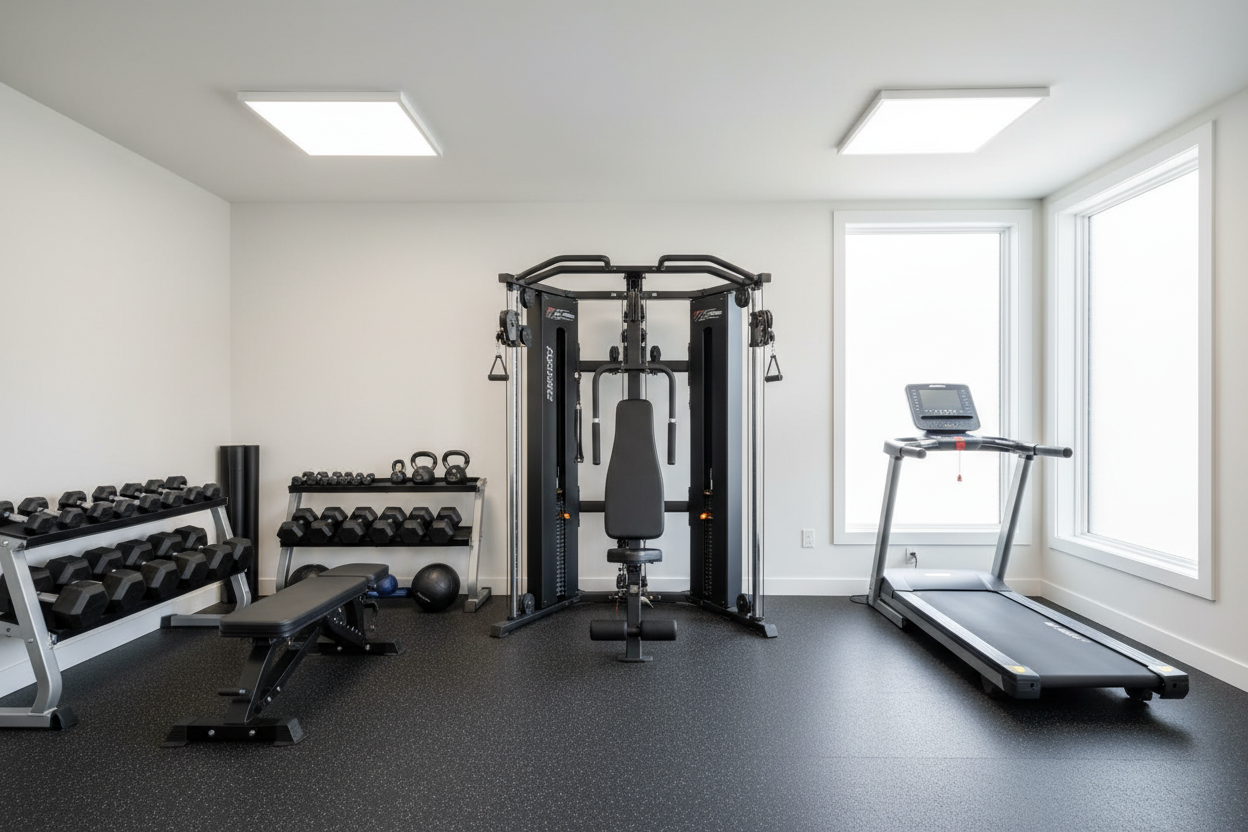
I remember the night I finally hit 'buy' on my first budget rig. My local commercial gym had just raised its monthly dues again, and I was tired of waiting 20 minutes for a squat rack that smelled like old pennies. When the boxes arrived, I realized I’d made a mistake. The steel felt like a soda can, and the cables stuttered every time I hit the eccentric phase of a row. If you are hunting for the best home gym all-in-one, you cannot afford to make that same mistake.
Quick Takeaways
- Steel Matters: Never buy anything less than 11-gauge steel if you plan on lifting heavy.
- The Ratio Trap: A 2:1 pulley ratio means your 200lb stack only provides 100lbs of actual resistance.
- Bearings over Bushings: Linear bearings provide that smoothness you expect; plastic bushings will eventually stick and jerk.
- The Working Footprint: Your actual training area is always at least 2 feet wider and deeper than the machine's static dimensions.
Why So Many Multi-Station Rigs Feel Like Cheap Plastic Toys
The market is currently flooded with machines that promise the moon but deliver a wobbly mess. These companies know that a shiny coat of paint and a list of 60 possible exercises look great in an Instagram ad. But once you actually get under the bar, the reality sets in. The uprights sway when you re-rack a heavy set of squats, and the pulleys start to squeak after three weeks of use.
Buying a machine based solely on how many exercises it promises is a massive trap. Most of those 'extra' exercises are just awkward variations that you will never actually do because the range of motion is terrible. When building a functional home gym, you should prioritize the quality of the primary movements: the squat, the press, and the pull.
Cheap rigs use thin 14-gauge steel and plastic pulleys that degrade. They feel 'crunchy' when you pull. A real machine should feel invisible during your set, letting you focus on the muscle contraction rather than wondering if a cable is about to snap.
The 3 Non-Negotiable Specs for the Best All-In-One Exercise Machine
If you want the best all-in-one exercise machine, you have to ignore the marketing fluff and look at the engineering. First, check the steel gauge. In the world of iron, a lower number means thicker steel. Most high-end rigs use 11-gauge steel. If a brand doesn't list the gauge, it is probably 14-gauge junk that will vibrate every time you drop a plate.
Second, look at the guide rods and bearings. Cheap machines use plastic rollers or bushings that slide over painted metal. This creates friction and heat. You want solid steel guide rods and linear bearings. This is what gives the carriage that buttery-smooth glide you find in professional facilities. It ensures the resistance stays consistent through the entire rep.
Finally, verify the actual weight rating. A lot of brands claim a 1,000-lb capacity, but that is 'static' weight—meaning the weight it can hold without moving. You need to know the 'dynamic' rating. If you are a 200-lb person doing pull-ups on a machine with a low dynamic rating, the frame is going to flex uncomfortably.
Stop Ignoring Your Pulley Ratios
This is where most people get burned. You see a 200-lb weight stack and think you are set for life. Then you realize the machine has a 2:1 pulley ratio. In plain English, that means for every 2 pounds on the stack, you only feel 1 pound of resistance. This is great for functional training and isolation work because it allows for smaller weight increments, but it is a rude awakening for heavy lifters.
If you are a heavy hitter, you want to look for machines that offer a 1:1 ratio or at least have a massive weight stack to compensate for the 2:1 mechanical advantage. Don't let a 'heavy' stack fool you until you’ve done the math on the actual tension at the handle.
Does the Best All-In One Workout Machine Actually Save Space?
The biggest lie in fitness marketing is the footprint. A brand will tell you their best all-in one workout machine only takes up 15 square feet. What they aren't telling you is the 'working footprint.' You need room to slide 45-lb plates onto the sleeves without hitting your drywall. You need room to extend your legs during a seated row.
I have seen guys buy a compact smith machine home gym station only to realize they can't actually use the pull-up bar because it's too close to their low basement ceiling. Always add at least 24 inches to the width and depth of the machine's specs to account for plate loading and your own body movement. If you're tight on space, look for 'plate-loaded' options that keep the weight storage internal to the frame rather than sticking out the sides.
My Top Pick for the Best All-In-One Home Gym Machine Right Now
I have spent thousands of hours testing gear, and I tested 12 all-in-ones to find the best gym machine for home use this year alone. Most of them were 'fine,' but only one felt like it belonged in a professional weight room. If you want the best all-in-one home gym machine that won't require an upgrade in two years, the choice is easy.
The All In One Smith Machine With Cable Crossover S1 V4 is the rig I currently recommend to anyone who is serious about their garage gains. It nails the balance of heavy-duty 11-gauge construction and smooth cable action. The Smith bar uses high-grade linear bearings, so it doesn't catch or stutter even when you're grinding out that last rep of a heavy incline press.
What impressed me most was the stability. I loaded 405 lbs on the Smith bar and did some heavy shrugs, and the frame didn't even flinch. It’s a beast of a machine that actually justifies its footprint by replacing a power rack, a cable crossover, and a Smith machine in one shot.
Personal Experience: The Bolt That Snapped
Early in my lifting career, I bought a 'deal' on a multi-gym from a local sporting goods store. I was halfway through a heavy set of lat pulldowns when the top pulley bolt—a cheap, Grade 2 zinc bolt—literally sheared in half. The handle hit me in the forehead, and the weight stack slammed down so hard it cracked my garage floor. That was the day I stopped buying 'deals' and started buying specs. Now, I check every bolt head and every weld. If the manufacturer is cutting corners on a $5 bolt, imagine what they are doing with the cables.
Frequently Asked Questions
Are all-in-one machines better than free weights?
Not necessarily 'better,' but more efficient. They allow you to switch exercises in seconds and provide constant tension that you can't get from dumbbells. For most home lifters, the safety of a Smith machine or cable system outweighs the slight benefits of pure free weights.
How much ceiling height do I really need?
Most of these rigs are about 80 to 84 inches tall. I recommend a minimum of an 8-foot ceiling (96 inches) so you have room to actually get your head above the bar during pull-ups without cracking your skull.
Do I need to bolt these machines to the floor?
If the machine is heavy enough (over 400 lbs) and has a wide base, you usually don't have to. However, if you are doing heavy explosive movements or using TRX straps attached to the top, bolting it down is a smart safety move.
Share:
How Many Machines Should I Use at the Gym Before It's Junk Volume?
Are Weight Machines Effective? What the Free Weights Crowd Misses