
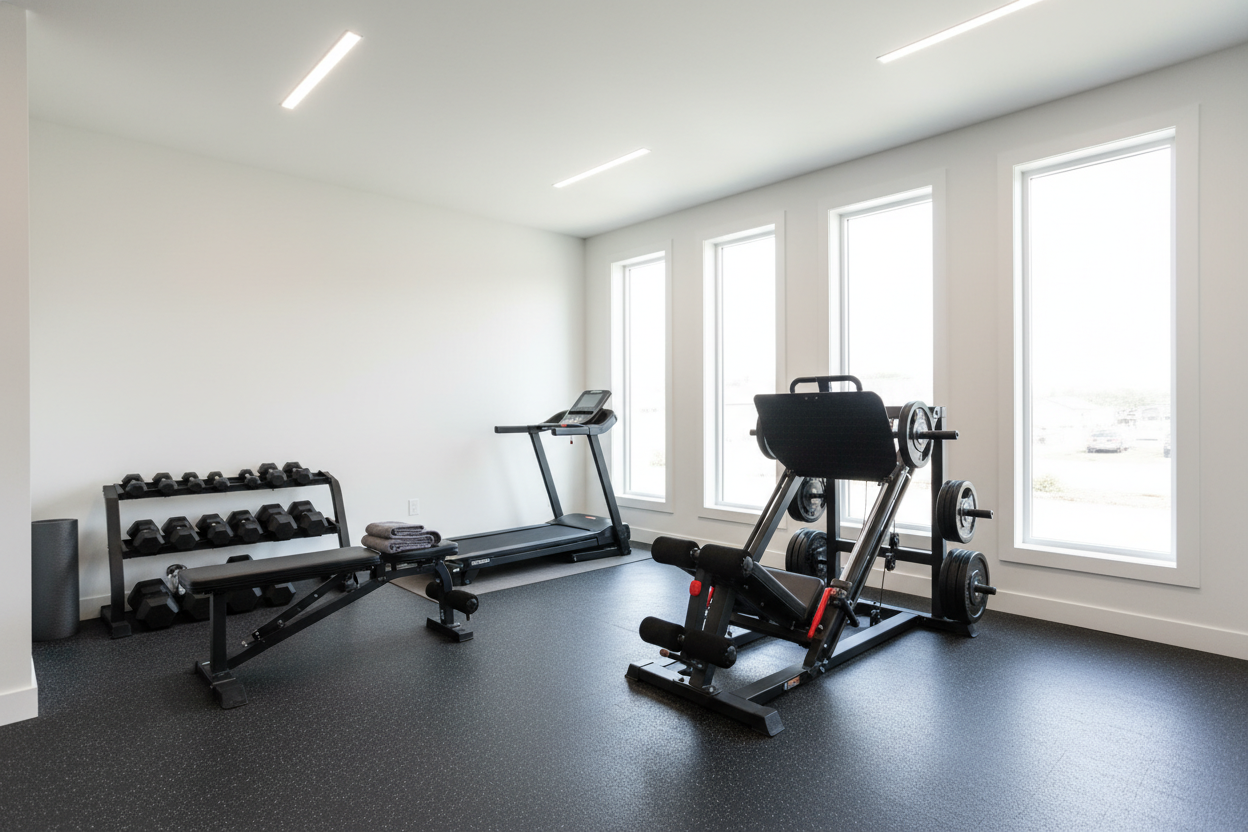
I remember standing in my one-car garage, looking at a 100-pound stack of bumper plates and realizing I had exactly zero room left for a commercial-grade leg press. If you have ever tried to play Tetris with a power rack and a lawnmower, you know the struggle. Finding the best at home leg machine isn't just about finding something that moves weight; it is about finding something that does not force you to park your car on the street forever.
Quick Takeaways
- Resistance band setups are great for travel but usually fail to provide the mechanical tension needed for serious hypertrophy.
- A 30-degree angle sled is the sweet spot for saving floor space without sacrificing the range of motion.
- Expect to spend between $600 for basic sleds and $2,000 for high-end combo units.
- Always check the carriage weight; a light carriage feels cheap and unstable under heavy loads.
The Reality of Leg Days in a Tiny Garage
Most commercial leg presses have a footprint roughly the size of a Smart car. In a home gym, space is your most valuable currency. I have seen guys buy massive 45-degree sleds only to realize they can no longer reach their toolbench or open their freezer. It is a rookie mistake that leads to gear being sold on Marketplace three months later.
When you are hunt for the right gear, you have to be ruthless. You need a machine that justifies its existence by hitting the quads harder than a standard barbell squat can, especially if you are working around a cranky lower back. If it takes up 20 square feet and you only use it once a week, it is a bad investment.
Are Portable and Resistance Rigs Actually Worth It?
You have seen the ads for the small portable leg press machine that fits under a bed. These usually rely on heavy-duty resistance bands. While a resistance leg press machine is a godsend for physical therapy or maintaining some tone while traveling, let’s be real: they are rarely enough for someone trying to move the needle on leg size.
Resistance bands have a linear weight curve, meaning it is easiest at the bottom—where you actually want the most tension—and hardest at the top. If you are used to squatting three plates, a portable band rig will feel like a toy. It is better than nothing, but it is not a primary mass builder.
The Mini Sled: Can a Tiny Footprint Handle Heavy Plates?
The mini leg press for home use is where things get interesting. These machines often use a vertical or steep-angle design to cut the length of the machine in half. By utilizing a compact 30 degree leg press, manufacturers can keep the footprint tight while still giving you that deep, quad-focused stretch.
The key is the bearing quality. Cheap mini sleds use plastic rollers that feel like dragging a cardboard box across gravel. Look for linear bearings and hard-chrome guide rods. A steeper angle also means you don't need 800 pounds of plates to feel the burn, which is a secret win for people who don't want to buy twenty more 45-pounders just to fill a sleeve.
Budgeting for Your Lower Body Setup
So, how much does a leg press machine cost? You can find entry-level bolt-together units for around $500, but I’d advise caution. These often have significant 'frame sway' when you start loading more than three plates per side. A solid, mid-range residential machine usually lands in the $800 to $1,200 bracket.
If you go too cheap, you will face the brutal truth about buying a machine: the shipping costs on returns will kill you when you realize the unit is too wobbly to use safely. Buy once, cry once. Look for 11-gauge steel and a weight capacity of at least 700 pounds if you plan on getting strong.
Why a Combo Unit Usually Wins the Space Wars
If you are going to give up a 5x5 foot section of your gym, don't just buy a leg press. A 3 in 1 hack squat leg press combo is almost always the smarter play. These machines allow you to flip a backpad or adjust a footplate to switch from a standard press to a hack squat or even calf raises.
In my own testing, the ability to switch to a hack squat—which mimics a barbell squat but supports the spine—is what actually builds the teardrop in the quads. It turns a single-use station into a complete lower-body laboratory. It costs more upfront, but it replaces three different machines.
My Personal Lesson in Cheap Steel
I once bought a 'bargain' vertical leg press off an auction site. It looked fine in photos, but the first time I loaded 400 pounds, the carriage actually flexed. The friction was so bad I had to 'kick' it to get the movement started. I ended up selling it for half what I paid just to get it out of my sight. Now, I prioritize the smoothness of the slide over everything else. If the carriage doesn't move with a pinky finger when empty, don't buy it.
FAQ
Is a vertical leg press better for small spaces?
Yes, they have the smallest footprint, but they can be awkward to load and get into. They also put a lot of pressure on the lower back if your hip mobility isn't perfect.
Can I use standard plates on these machines?
Most high-quality home units are built for Olympic (2-inch) plates. Some budget models use 1-inch pegs, but these are generally less durable and harder to load heavy.
Do I need a professional to assemble it?
If you can put together IKEA furniture, you can build a leg press. Just give yourself four hours, a real socket wrench set, and a buddy to help hold the heavy frame pieces in place.
Share:
Is There a Single Dumbbell Set Best for Every Lifter?
Which Exercise Machine Types Actually Survive Garage Gym Abuse?