
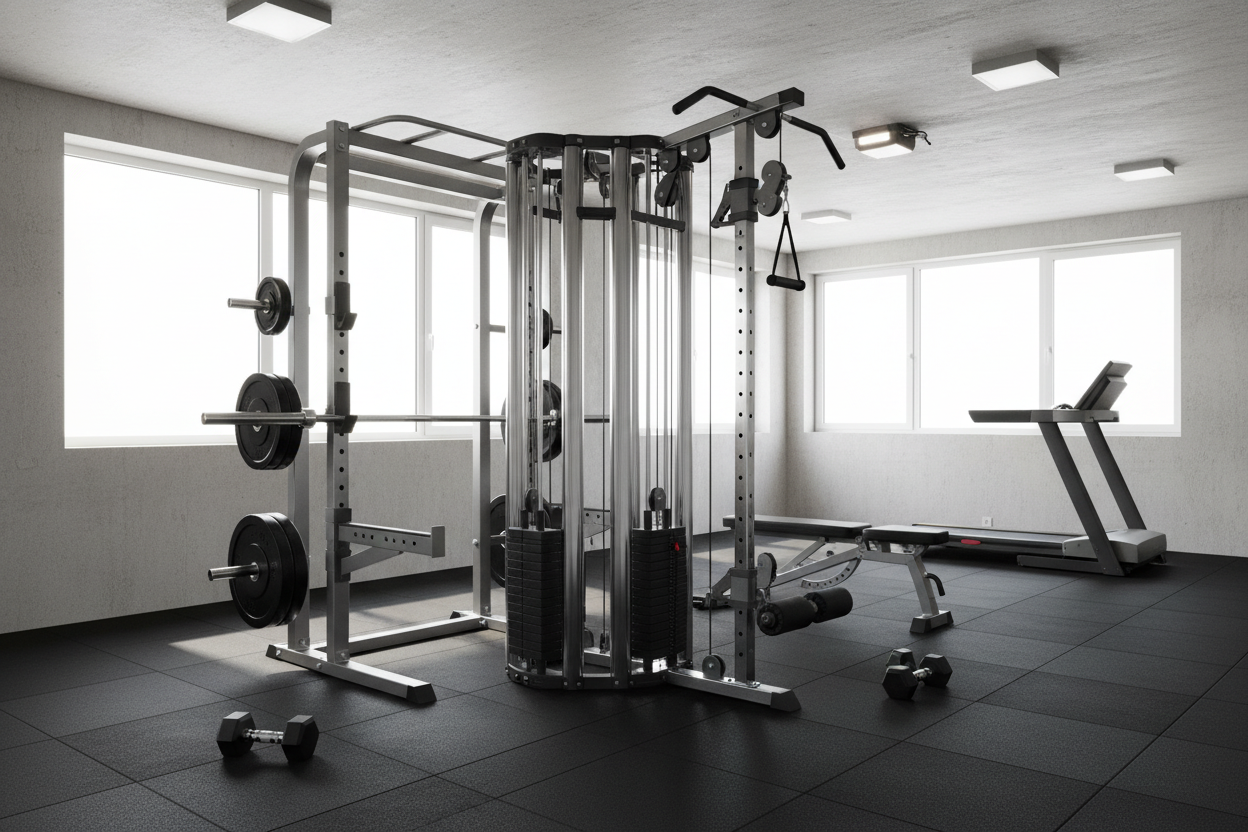
I spent years thinking barbells were the only way to get truly strong. I had the power rack, the rusty plates, and a 'no excuses' attitude. But after a few years of heavy lifting, my shoulders started clicking and my elbows were constantly inflamed. I realized I deeply missed the targeted isolation I used to get from high-end machine weights at my old commercial gym. There is a specific kind of muscle growth you can only trigger when you aren't fighting to balance a heavy bar, and your joints eventually demand a break from the constant stabilization of free weights.
Quick Takeaways
- Lever arms provide a plate-loaded alternative that saves massive floor space.
- Independent (bilateral) movement is crucial for fixing muscle imbalances.
- Friction is the enemy; look for ball-bearing pivots over plastic bushings.
- A rock-solid bench is the literal foundation of any machine-style press.
The Post-Commercial Gym Hangover
I remember the day I cancelled my commercial gym membership. I thought I was free. But three months in, my chest development stalled. I could bench press until the cows came home, but I couldn't find that 'squeeze' you get from a dedicated gym weight machine. Free weights are king for raw strength, but for accessory work and hypertrophy, machines offer a level of stability that lets you push a muscle to absolute failure without your form breaking down.
Moving to a home gym often feels like a trade-off. You get the convenience, but you lose the variety. For a long time, I thought I was stuck with just dumbbells for my accessory work. I was wrong. The technology has finally caught up to the garage gym market, and you can now get that buttery-smooth commercial feel without needing a 20,000-square-foot facility.
Why Most 'All-In-One' Home Rigs Feel Awful
I’ve made the mistake of buying the cheap stuff. I once spent $400 on a multi-station that felt like it was filled with sand. The pulleys were plastic, the cables were thin, and the whole frame wobbled if I loaded more than 100 lbs. Many beginners fall into the trap of buying a massive corner multi-gym setup because it looks like it does everything. In reality, it does ten things poorly instead of one thing well.
The friction in these low-end units is a workout killer. If the resistance isn't consistent throughout the entire range of motion, you lose the eccentric tension that drives muscle growth. Furthermore, a bulky weight machine for gym use rarely fits in a standard 20x20 garage once you factor in the space needed for a car or a lawnmower. Trying to cram a universal gym weight machine into a tight corner usually results in restricted movement and a lot of frustration. I eventually sold mine for pennies on the dollar just to get my floor space back.
The Magic of Independent Lever Arms
The real 'aha' moment for me was discovering independent lever arms. This is the ultimate weight exercise machine alternative for the home lifter. Instead of a complex system of cables and pulleys that can snap or bind, lever arms use a simple pivot point. They allow you to use your existing Olympic plates, which saves you from buying a dedicated 300-lb weight stack that costs a fortune to ship.
What makes these better than a standard weight workout machines setup is the independent movement. Most machines have a fixed bar that connects both sides. If your right arm is stronger, it’s going to do 60% of the work. Using a chest press machine with independent arms forces each side to carry its own weight. This fixed my nagging left-shoulder weakness in about eight weeks because I could no longer 'cheat' the movement.
These systems also replicate the convergent arc of high-end commercial gear. Instead of pushing straight up in a fixed line, the arms move slightly inward as you reach full extension. This matches the natural path of the pec muscle fibers. You get the safety of a machine with the natural feel of a free-weight movement. It’s the best of both worlds, and it fits right onto your existing power rack or a small dedicated base.
The Unsung Hero: Your Foundation Matters
You can have the smoothest lever arms in the world, but if your bench is wobbling, the movement will feel like trash. You can't fire a cannon from a canoe. When I moved away from cables and started using heavy lever-style pressing, I realized my old department-store bench was a safety hazard. It would shift mid-set, throwing my shoulders out of alignment.
To really replicate a commercial experience, you need a heavy-duty adjustable weight bench that is rated for at least 800 lbs. Look for 11-gauge steel and a wide rear base. When you are pinned under heavy weight on a machine movement, you need to know that the pad under your spine isn't going to compress or slide. A high-quality bench allows you to drive your feet into the floor and create the tension necessary to move serious weight safely.
Stop Compromising Your Accessory Work
Building a home gym doesn't mean you have to settle for 'good enough.' You don't need fifty different pieces of equipment to get a professional-grade pump. By focusing on one or two mechanically sound pieces—like a solid lever system and a pro-grade bench—you can replicate the feel of a $50,000 commercial circuit in the corner of your garage. Stop fighting with clunky cables and start using equipment that actually follows your body's natural mechanics. Your joints will thank you, and your progress won't stall just because you left the big box gym behind.
FAQ
Do lever arms feel the same as cable machines?
No, they feel more like plate-loaded machines (think Hammer Strength). Cables provide constant tension, while lever arms provide a very stable, heavy feel that is better for top-end strength and explosive movements.
Can I use bumper plates on lever arms?
Usually, yes, but keep an eye on the sleeve length. Bumper plates are much wider than iron plates, so you might run out of room if you're a high-level lifter pushing 400+ lbs.
Are these machines hard to maintain?
One of the best parts about lever systems is the low maintenance. Unlike cables that fray or pulleys that need grease, a good lever arm just needs the occasional check on the pivot bolts to ensure everything is tight and smooth.
Share:
How to Pick the Best Home Resistance Gym for Serious Lifting
The Sweaty, Slippery Truth About Lifting With a Chrome Dumbbell