
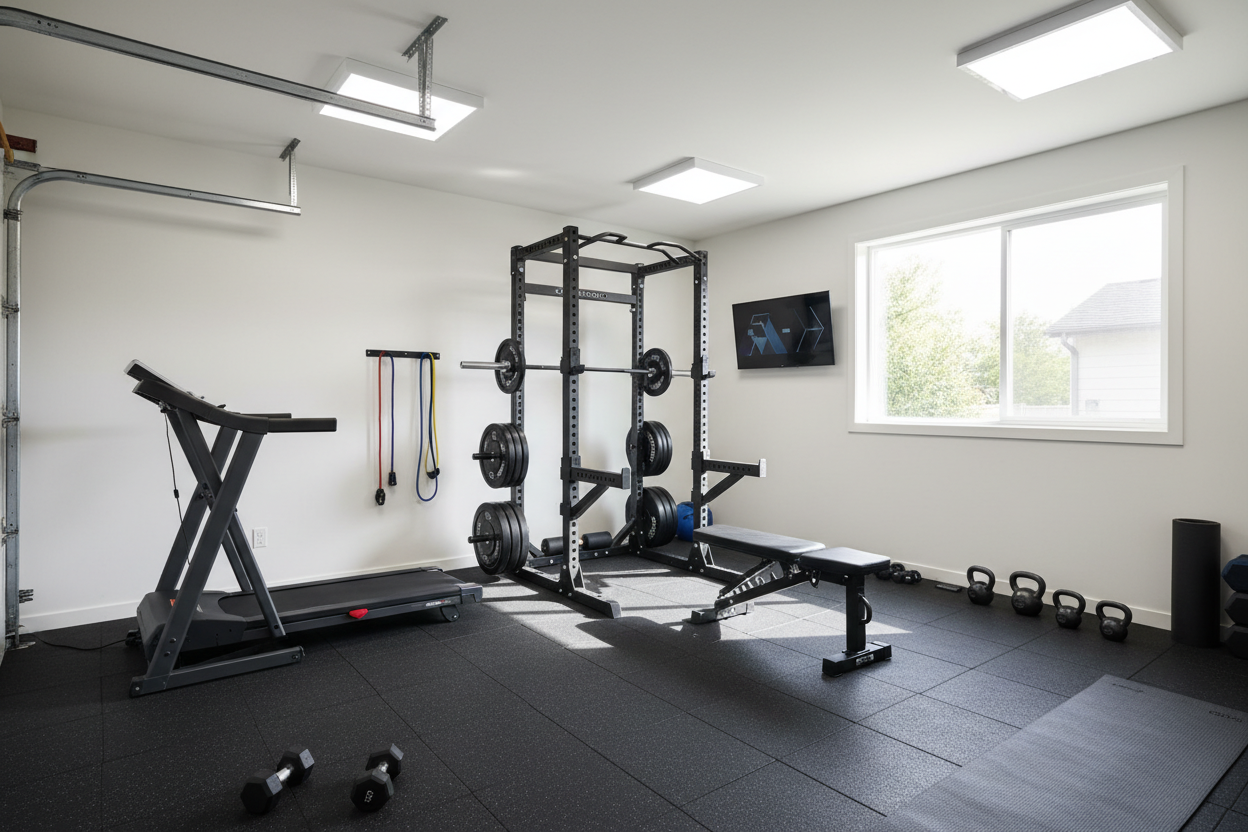
I remember the night I almost clicked 'buy' on a commercial-grade leg press. My garage was already a Tetris nightmare of half-unpacked boxes and a lawnmower, but I was convinced I needed it. I didn't. I needed a tape measure and a reality check.
The best gym setup isn't the one with the most shiny chrome; it's the one that actually lets you move. Most people start by shopping for gear they want, rather than the space they actually have. That's how you end up with a $2,000 power rack that you can't even fit a barbell inside because it's pinned against a wall.
Quick Takeaways
- Floor space is your most valuable asset—don't crowd it with single-use machines.
- A 7-foot barbell needs at least 9 feet of width to safely load plates.
- Quality flooring is non-negotiable for noise reduction and equipment longevity.
- Vertical storage turns a cluttered mess into a functional training zone.
The Mistake of Buying Gear Before Mapping Your Floor
I’ve seen it a dozen times: someone buys a massive six-post rack before measuring their ceiling height. They forget that the best home gym setup requires more than just the footprint of the machine itself. You need a 'buffer zone' for loading plates, stepping back for squats, and actually breathing between sets.
When you're building a functional home gym, start with a roll of blue painter’s tape. Mark out where the rack goes, then stand there. Mimic a bench press. If your knuckles are going to hit the water heater every time you rack the bar, you need a different plan. Flow matters more than variety.
The Big Three: Anchoring Your Space with Essentials
If you have $2,000 to spend, $1,500 of it should go toward a rack, a bench, and flooring. I’m a snob about 11-gauge steel for a reason. Cheap racks with 2x2 posts wobble the second you try to re-rack 315 pounds. You want 3x3 posts with 1-inch or 5/8-inch holes—standard sizes that let you add attachments later like dip bars or landmines.
For the bench, stop looking at the $99 specials. A rock-solid adjustable bench should feel like a tank. If it wobbles when you sit down, it’s going to fail when you’re mid-press. Pair that with 3/4-inch horse stall mats. Don't buy those flimsy foam puzzle tiles; they’ll compress under a heavy rack and leave your floor looking like a topographical map of the moon.
Reclaiming Floor Space from the Dumbbell Rack
Commercial gyms love those 15-foot-long dumbbell racks because they have the square footage to burn. You don't. In a home environment, the best home workout setup usually ditches the massive horizontal rack in favor of something smarter. A full set of 5-100 lb dumbbells takes up an entire wall that could be used for a cable machine or a folding rack.
You don't need endless rows of fixed dumbbells to get a massive pump. High-quality adjustable dumbbells—the ones that go up to 80 or 90 pounds—occupy about two square feet. That’s enough space saved to fit a rower or a stationary bike. If you insist on fixed weights, get a vertical rack. Your shins and your floor plan will thank you.
When Multi-Functional Machines Actually Make Sense
I used to be a free-weight purist, but training alone in a garage changes your perspective. Sometimes you want to push to failure without worrying about a bar crushing your windpipe. This is where a plate-loaded smith machine station becomes a strategic play. It’s not just for calf raises; it’s a self-spotting ecosystem.
The best home workout setup often includes one 'anchor' machine that handles the stuff a barbell can't do easily. Think about a piece that offers a pull-up bar, a pulley system, and a guided press. By choosing one versatile unit, you replace a dedicated lat pulldown, a squat stand, and a cable crossover. It’s about density, not just quantity.
Maximizing the Margins in Tight Spaces
If you’re working in a single-car garage, every inch is a battle. I’m a huge fan of wall-mounted plate pegs. Getting those 45-pound bumpers off the floor makes the room feel twice as big. If you still need to park your car in the gym, a folding rack is the only way to go. They've come a long way—some of the newer ones are just as sturdy as a fixed four-post rack.
Focus on maximizing a smaller training footprint by using your vertical real estate. Hang your jump ropes, your bands, and even your extra barbells. A clean floor is a safe floor. I’ve tripped over a stray 10-lb plate more times than I care to admit, and it’s never a graceful fall.
My Biggest Gear Mistake
Three years ago, I bought a 'deal' on a generic adjustable bench from a big-box store. It looked fine in the photos. The first time I tried to do heavy incline presses, the back support shifted three inches to the left. I almost dumped 225 lbs on my face. I sold it for twenty bucks on Marketplace and bought a competition-spec bench the next day. Cheap gear is a tax on people who don't want to buy it right the first time.
FAQ
How much space do I actually need for a rack?
At minimum, you need an 8' x 8' area. This gives you room for a 4' wide rack and enough space on either side to slide plates onto a 7' barbell without hitting the walls.
Is a 1-car garage enough for a full gym?
Absolutely. A standard 12' x 20' garage is plenty. You can fit a full power rack, a bench, a set of dumbbells, and even a piece of cardio equipment if you're smart with storage.
Should I buy a 1-inch or 2-inch hole rack?
Go with 2-inch (or 5/8' / 1' standard) holes on 3x3 or 2x3 tubing. Avoid 1-inch 'standard' racks; they are usually built with thinner steel and won't hold up to serious weight.
Share:
The Sweaty, Slippery Truth About Lifting With a Chrome Dumbbell
I Swapped My Rack for Adjustable Weights and Bench