
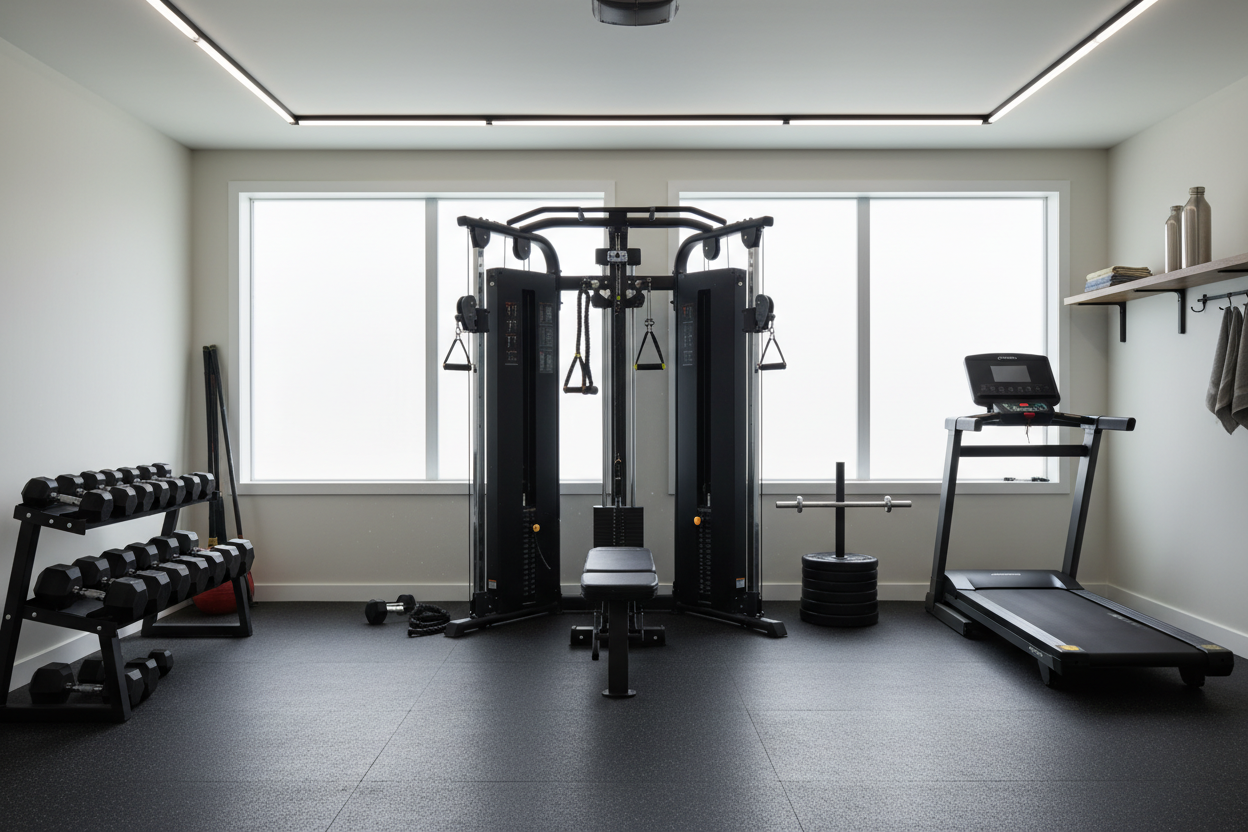
I remember staring at my 1-car garage, looking at my squat rack and a pile of boxes, wondering how I would ever fit a cable machine in there without losing my mind. Most commercial units are massive, and the low-end options on Amazon look like they would snap if you sneezed on them. Finding a legitimate functional trainer for home gym use is about balancing the footprint with the actual quality of the pull.
Quick Takeaways
- Prioritize a 2:1 pulley ratio for smooth, long-travel movements.
- Aluminum pulleys are non-negotiable if you want to avoid friction.
- Rack-integrated systems are the ultimate space-savers for tight garages.
- A small footprint is useless if you don't have the 'working width' for flies.
Why You'll Regret Buying a Cheap Functional Trainer
I have seen it a hundred times. Someone buys a cheap functional trainer because the price tag looks friendly, only to realize the cables feel like they are running through sandpaper. Most budget units use plastic pulleys and nylon bushings that create massive amounts of friction. When you are trying to do high-rep lateral raises, that 'stutter' in the cable ruins the tension.
A functional trainer cheap enough to seem like a steal usually has a 1:1 ratio. This sounds good on paper because you get more weight, but the cable travel is too short. You'll hit the end of the line mid-rep on a chest fly. Plus, those thin frames shake like a leaf when you're doing heavy rows. If the weight stack isn't selectorized, you'll also spend half your workout swapping plates, which is a total vibe killer.
The Illusion of the 'Small Functional Trainer'
When you're shopping for a small functional trainer, the spec sheet usually only tells you the base dimensions. It might say 36 inches deep, but it doesn't account for the fact that your arms need to be 6 feet apart to actually use it. I have seen guys cram a functional trainer home setup into a corner only to realize they can't do a single movement without hitting the wall or their rack.
When planning your Home Gym, you have to measure the 'working footprint.' This is the space the machine takes up plus the 3-4 feet of clearance on either side. If you are truly tight on space, look for units with adjustable arms that can tuck away when you're not using them. Otherwise, you're just buying a very expensive coat rack.
Standalone Cables vs. Rack Attachments
If you have the floor space, a standalone functional trainer machine for home is the gold standard. It’s always ready to go. But in my 1-car garage, floor space is more valuable than gold. This is where rack-integrated systems win. By mounting the pulleys directly to your existing 3x3 uprights, you get commercial-grade cable work without losing an extra 20 square feet of floor.
I’m a big fan of systems like the Dual Pulley Power Rack Functional Trainer Dp01 V4. It bridges the gap perfectly. You get the stability of a bolted-down power rack with the versatility of dual 2:1 cables. It’s the smartest way to get a home gym functional trainer experience without having to park your car in the driveway forever.
What About All-In-One Combo Machines?
The 'all-in-one' units are tempting. You see a machine that claims to be a rack, a cable system, and a Smith Machine Home Gym Station all at once. For some, this is a space-saving miracle. For others, it’s a series of compromises. The Smith bar can sometimes get in the way of your cable paths, or the footprint can be unnecessarily deep.
I’ve tested both styles extensively. If you are a dedicated powerlifter, you might find the Smith machine components distracting. I actually wrote a deep dive on this exact debate: Power Rack or Smith Machine for Home Gym? I Tried Both. Read that before you drop two grand on a combo unit that might not fit your training style.
The 3 Specs That Actually Matter for a Home Gym Functional Trainer
First, look at the pulley material. Aluminum pulleys with high-quality bearings are the only way to get that 'buttery' feel. Plastic will eventually flat-spot or crack. Second, check the ratio. A 2:1 ratio means 100 lbs feels like 50 lbs, but you get twice the cable length. This is essential for any movement where you’re moving away from the machine.
Finally, look at the weight stacks. A 160-lb stack might seem like enough, but with a 2:1 ratio, that’s only 80 lbs of actual resistance. If you’re planning on doing heavy seated rows or lat pulldowns, you’ll want at least 200-lb stacks. Don't settle for less, or you'll be pinning 10-lb plates to the stack within six months.
Personal Experience: My Garage Setup
When I first started, I bought a cheap plate-loaded wall-mount cable. It was a nightmare. The plates would clank against the wall, and the carriage would stick if I didn't grease the poles every three days. I eventually upgraded to a selectorized dual-stack unit. The difference in my accessory work was night and day. If you're serious about hypertrophy, the friction-free movement of a real functional trainer is worth every penny of the investment.
FAQ
Is a 2:1 or 1:1 ratio better?
For a functional trainer, 2:1 is almost always better. It allows for more cable travel and a smoother start to the movement, which is exactly what you want for isolation exercises like flies and rotations.
Can I put a functional trainer on a stall mat?
Yes, and you should. It helps level the machine and protects your concrete. Just make sure the mats are high-density so the machine doesn't wobble when you're pulling from the top height.
How much height do I need?
Most standard trainers are between 80 and 84 inches. Always measure your ceiling height twice, especially if you have a garage door opener or low-hanging joists in the way.
Share:
Don't Waste $2,000 on Home Gym Equipment With Leg Press
The Real Reason You Don't Exercise at Home Gym Setups