
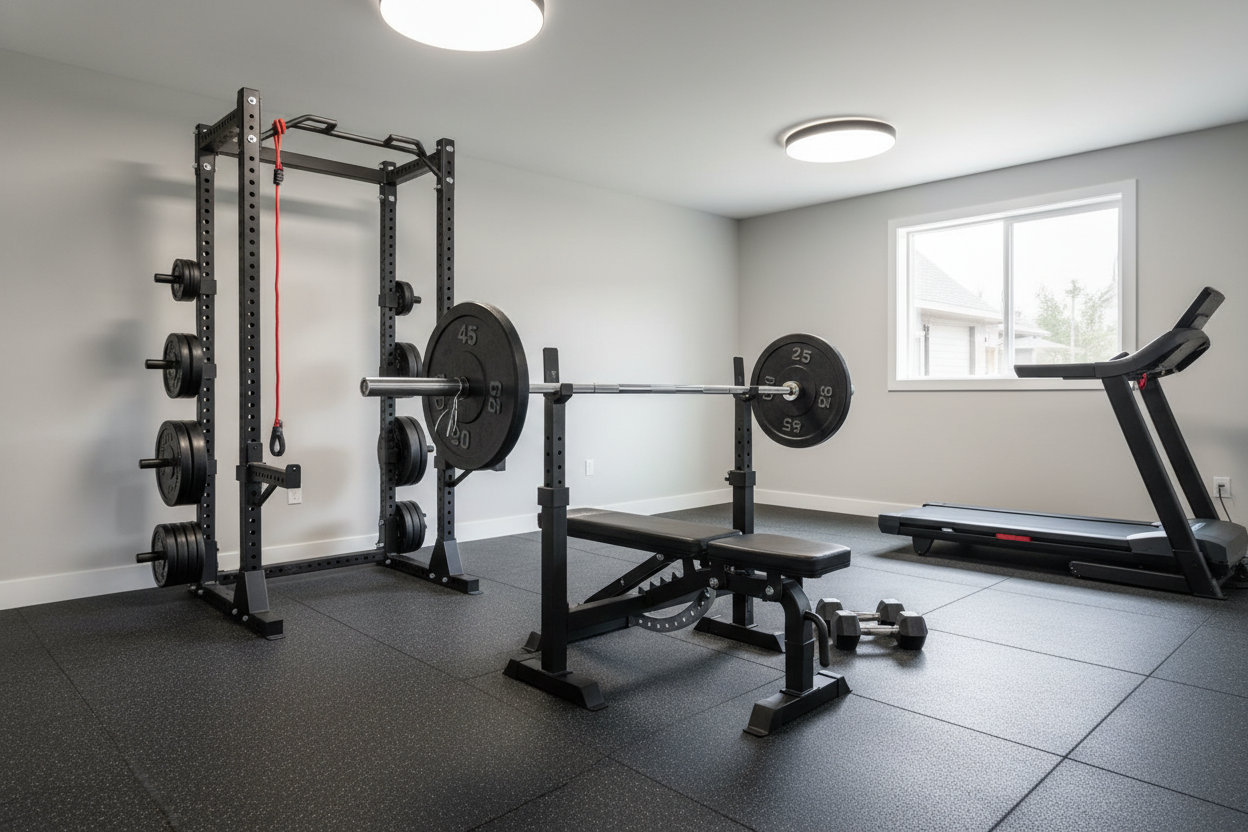
We have all been there. You are tired of the gym commute, the guy hogging the rack for bicep curls, and the monthly membership fee that keeps creeping up. You decide it is time. You pull up a website, see a shiny bench barbell set for under three hundred bucks, and think you have hacked the system. Stop right there.
I have spent the last decade testing everything from five-thousand-dollar power racks to the flimsiest basement setups imaginable. Most all-in-one kits are designed to look good in a catalog but fail the second you try to actually train. If you want a setup that grows with your strength instead of ending up on Facebook Marketplace by July, you need to know what you are actually buying.
The TL;DR
- Avoid fixed, welded uprights; they kill your shoulder mechanics.
- Check the bar diameter—1-inch 'standard' bars are a dead end for progression.
- Prioritize a bench with at least 14-gauge steel and a 500-lb total capacity.
- If space is tight, look for independent movement arms over fixed barbell paths.
The Trap of the Big-Box Store Starter Kit
The allure is simple: one box, one price, total body transformation. But walk into any sporting goods store and look at that bench press bar and weight set sitting on the floor. The padding is usually about as thick as a yoga mat, and the frame is made of thin-walled steel that shivers when you sit on it. These kits are built for the 'casual' user, which is code for 'people who won't actually lift heavy.'
The biggest red flag is the width. Many of these beginner setups are 'narrow-pro' width. This means the uprights sit right where your hands should be for a proper chest press. You end up having to use a bizarrely narrow grip that fries your triceps and puts unnecessary stress on your wrists. If you are looking at a standard vinyl weight set bundle, understand that those plates are bulky, take up too much room on the bar, and the bar itself usually has a weight limit that you will outgrow in six months of consistent effort.
Why Attached Uprights Are a Nightmare for Your Shoulders
In the world of cheap gear, 'combo' usually means 'compromise.' When a bench is permanently welded to the rack, you lose the ability to adjust the horizontal position of your body relative to the bar. If the uprights are too far back, you are performing a dangerous behind-the-head tricep extension just to unrack the weight. If they are too far forward, you are hitting the steel on every rep.
I always tell people to buy a freestanding flat or adjustable weight bench first. This allows you to pair it with a separate squat stand or half-rack later. This modularity means you can slide the bench out to do standing overhead presses or rows. When the bench is welded to the rack, it is a one-trick pony that often does that one trick poorly. Your shoulders deserve an unrack that doesn't feel like a rotator cuff injury waiting to happen.
The Truth About the Steel They Include
The 'barbell' in these kits is usually the weakest link. Most beginner sets include a 1-inch 'standard' bar. These are not the 2-inch Olympic bars you see in real gyms. They are thin, they hurt your hands, and they are almost impossible to find quality plates for once you need more weight. Even if the kit includes a 2-inch bar, it is often a hollow tube or a cheap alloy that starts to permanent-bend (we call it 'taking a set') once you put 200 pounds on it.
Then there is the weight lie. A real Olympic bar weighs exactly 20kg or 45lb. The bars included in these bundles often weigh 15, 25, or 32 pounds. If you aren't calculating your actual bar weight, you have no idea what your real PR is. You think you are benching 135, but you are actually doing 112. That is a rude awakening the next time you step into a commercial gym.
How to Build a Real Bench Press Bar and Weight Set
If you want to do this right without spending five grand, you have to look at the specs. Look for 2x2 inch or 3x3 inch steel tubing. Look for J-cups that are lined with plastic (UHMW) so you don't grind the knurling off your bar every time you rack it. You want a bench with a 'tripod' foot design if possible, so your feet have a place to go for proper leg drive.
If you absolutely must have a combo unit for space reasons, get a weight bench with an adjustable barbell rack. The key word there is 'adjustable.' Being able to move the height of the hooks ensures you get a safe lockout. Pair this with some basic cast iron plates. They don't need to be fancy or calibrated; they just need to be heavy and made of metal, not sand-filled plastic.
When an All-In-One Actually Makes Sense
I am a purist, but I am also a realist. If you are living in a 600-square-foot apartment, a full power rack is a dream, not a reality. In these cases, a high-quality combo unit can work, provided it uses heavy-gauge steel and offers something better than a fixed barbell path. Fixed paths (like Smith machines) force your body into unnatural movements.
A better alternative for the space-constrained lifter is a bench featuring independent press arms. This gives you the safety of a machine—you aren't going to get pinned under a bar—but the independent arms ensure your dominant side isn't doing all the work. It is a much better compromise than a wobbly, cheap barbell set that feels like it might collapse during your third set.
My First Mistake
I started my journey with a 110-lb plastic-coated set I bought at a garage sale. Within two months, the 'cement' inside the plates started rattling. One day, I dropped a 25-lb plate, the plastic cracked, and grey sand spilled all over my mom's garage floor. I also realized I couldn't fit my hands on the bar because the uprights were so narrow. I spent $50 on that set and it was $50 wasted. I ended up buying a real bar and a separate bench three months later. Buy once, cry once.
FAQ
Is a 1-inch bar okay for beginners?
Only if you never plan on lifting more than 100 pounds. They are harder to grip, the plates are harder to find, and they aren't compatible with any standard rack accessories. Go Olympic (2-inch) from day one.
How much weight capacity do I really need?
Don't just look at your body weight. If you weigh 200 lbs and want to bench 200 lbs, you need a bench rated for at least 500 lbs to account for the force of the movement and a safety buffer.
Can I use a barbell set without a rack?
For floor presses or deadlifts, sure. But for a bench press, it is incredibly dangerous to try and 'clean' the weight into position while lying down. Get a rack or a bench with integrated hooks.
Share:
Are 100 lb Adjustable Dumbbells Too Clunky for Heavy Lifters?
Why Buying a Pre-Packaged Olympic Weight Set and Bar Usually Fails