
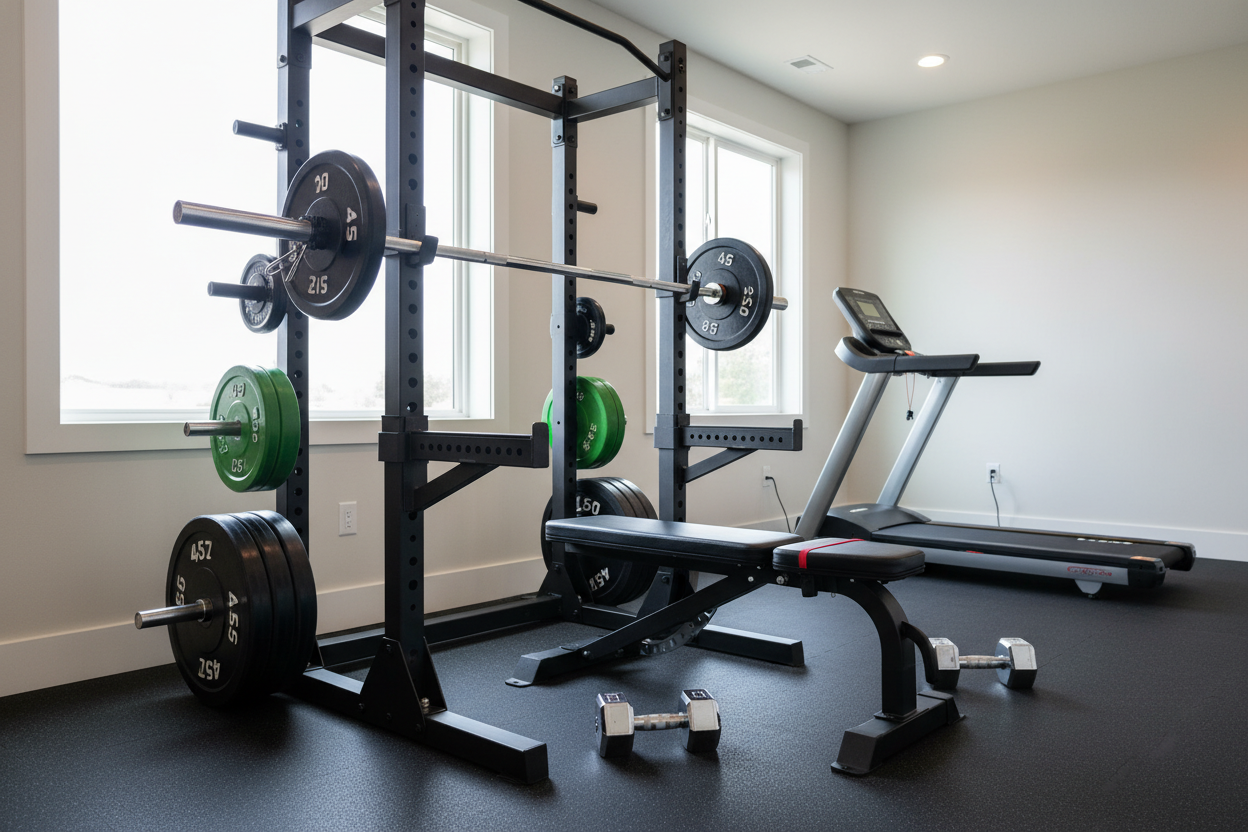
I remember staring at a $299 special at a local sporting goods store. It looked like the ultimate score: 300 pounds of iron and a shiny chrome bar. I hauled it home, felt like a king for a week, and then I started actually lifting. Within three months of moderate deadlifts, that bar had a permanent 'smile' in it, and the 'chrome' was flaking off into my palms like glitter. Buying a generic olympic weight set and bar feels like a smart shortcut, but for anyone planning to actually get strong, it is usually a waste of hard-earned cash.
- Cheap bundle bars typically bend permanently under loads as low as 250 lbs.
- Standard '300lb sets' often use bottom-tier bars with slippery, passive knurling.
- Plate weight tolerances in budget bundles are notoriously inaccurate.
- Investing in a quality barbell first saves you from buying the same equipment twice.
The Trap of the 300-Pound Big Box Bundle
Those big box store sets are designed for people who use their equipment as expensive clothes hangers. The bars included are typically made of low-grade steel with a tensile strength well under 130,000 PSI. If you are pulling four plates, that bar is toast. It simply lacks the 'memory' to snap back into a straight line after a heavy lift.
Beyond the bar, the plates themselves are often cast with massive air pockets or inconsistent densities. You might think you are hitting a new PR, but your '45 lb' plate might actually weigh 41 lbs. It is worth learning How to Tell if an Olympic Weight Set With Bar Is Total Junk before you swipe your card on a deal that seems too good to be true. Most of the time, you are just paying for scrap metal with a pretty coating.
Where You Actually Need to Spend Your Money
If you have a limited budget, put 70% of it into the bar. Look for a tensile strength of 190,000 PSI or higher. You want a decent knurl—something that bites into your skin enough to provide grip without acting like a cheese grater on your shins. If you are doing cleans or snatches, you need smooth sleeve rotation from needle bearings; for general powerlifting, bronze bushings are the reliable workhorse.
Manufacturers love to hide these specs behind flashy branding. However, What Nobody Tells You About Buying an Olympic Weight Bar Set is that the sleeve spin and the type of finish—like hard chrome or zinc—matter way more for the long-term health of your gym than the brand name on the endcap. A bar that rusts in a humid garage becomes a sandpaper nightmare within a year.
Matching the Right Weight Set for Olympic Bar Training
Choosing a dedicated weight set for olympic bar training depends heavily on your floor and your noise tolerance. If you are training in a garage with bare concrete, you need bumper plates. If you have thick horse stall mats, iron is fine and usually cheaper. Iron plates are also thinner, which matters once you are squatting over 400 lbs and running out of sleeve space.
I prefer machined iron plates over the basic 'pony' sets found in bundles. Machined plates have the center hole bored to a precise diameter, so they don't rattle or shift mid-set. There is nothing more distracting than a plate that wobbles every time you try to set your feet for a heavy pull. Buy your plates in pairs rather than a pre-boxed set so you can control the quality of every pound.
Don't Neglect What You're Pressing On
I have seen guys buy a $600 professional bar and then try to bench press on a rickety fold-up bench they found on the curb. It is a safety hazard. You need a rock-solid foundation, like a heavy-duty Adjustable Weight Bench Owb01, to ensure your shoulders are supported when the weights get heavy. A bench with a 1,000-lb capacity gives you the confidence to push your limits without wondering if the frame is about to buckle.
If that specific model doesn't fit your layout, browse a dedicated Weight Bench collection to find one with a wide tripod base or a high-density foam pad. A stable surface is just as important as the bar in your hands. If the bench wobbles, your force production drops, and your risk of injury skyrockets.
My Blueprint for Sourcing Your First Iron Setup
Stop looking for the 'all-in-one' box. Instead, use the 'Pair of Everything' strategy. Start by purchasing a high-quality 20kg multi-purpose bar. Then, buy two 45s, two 25s, two 10s, four 5s, and two 2.5s. This setup gets you to 245 lbs and allows for the small 5-lb jumps necessary for linear progression programs like Starting Strength or 5/3/1.
As you get stronger, just add more 45s. You will end up spending about $150 more than the 'big box' bundle, but you won't be scrolling through marketplaces six months from now trying to sell a bent bar and chipped plates for pennies on the dollar. Build it right the first time.
Personal Experience: The 'Small Hole' Nightmare
I once bought a budget 'bargain' plate set where the center hole of one 45lb plate was slightly too small for my barbell. I had to spend an hour with a metal file just to get it to slide onto the sleeve. It was a miserable, sweaty reminder that 'cheap' usually means 'unfinished.' Now, I always check that plates have a stainless steel or machined inner ring to avoid that metal-on-metal grinding.
FAQ
Can I drop iron plates?
No. Dropping iron plates can crack the metal and will eventually destroy your barbell's internal bushings. If you plan on dropping weights from overhead or shoulder height, you must use bumper plates.
What is the standard bar weight?
A standard Olympic bar is 20kg (roughly 44 lbs). Be careful with cheap sets; they often include 'standard' bars that weigh only 25 or 35 lbs, which throws off all your lifting math.
Does the bar finish actually matter?
Yes. Raw steel feels the best but rusts instantly. Decorative chrome flakes off. Hard chrome or Bright Zinc are the best middle-ground options for most garage gym owners who don't want to oil their bar every week.
Share:
How to Buy a Bench Barbell Set You Won't Hate in 3 Months
I Bought the 30 Pound Dumbbells Target Sells (And Dropped Them)