
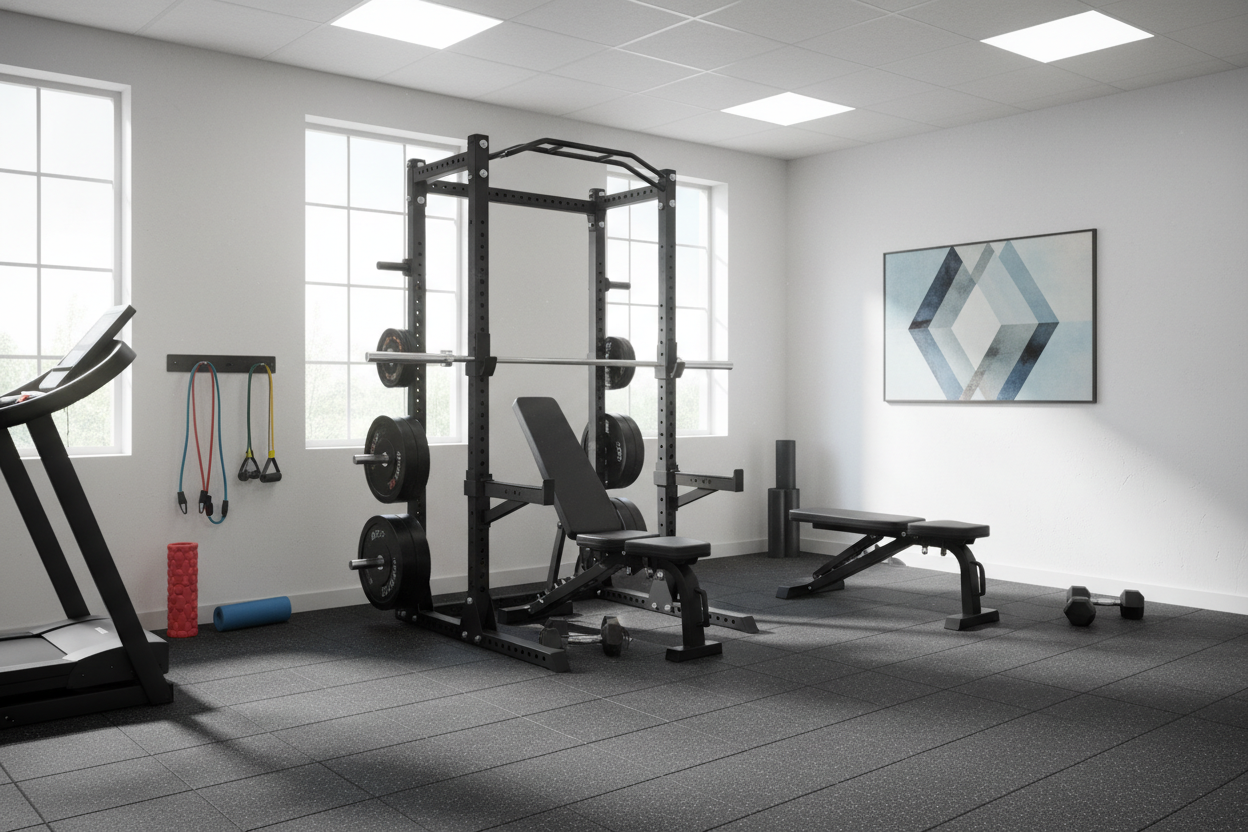
I was three reps into a heavy set of five when I felt the sway. It wasn't my legs giving out; it was the steel. I had just bought a budget olympic squat rack and bench from a big-box store, thinking I’d saved a few hundred bucks. Instead, I was watching the uprights oscillate like a blade of grass in a storm. If I didn't rack that bar immediately, I was going to be the lead story in a very embarrassing local news segment.
The Day the Uprights Began to Bend
Buying an olympic weight set with bench and squat rack seems like a shortcut to a complete home gym. It’s one box, one price, and you’re ready to lift. But here is the reality: most of those entry-level combos are made of 14-gauge steel that belongs on a patio chair, not under a 300-pound barbell.
My old rack used thin, 2x2 tubing that felt fine during assembly but turned into a tuning fork once I loaded anything over two plates. The welds were sloppy, looking more like bird droppings than structural joins. When you are pinned under a bar, you don't care about the 'sleek black finish.' You care about the thickness of the uprights and whether the manufacturer cut corners to hit a $199 price point.
Why Most Attached Benches Are a Trap
The biggest mistake I see beginners make is buying an olympic bench with squat rack where the two are bolted together permanently. It looks convenient, but it’s a ergonomic nightmare. You can't move the bench out of the way to do standing overhead presses, and you certainly can't adjust your distance from the J-hooks to find a natural bar path.
If you want to train properly, you need modularity. Investing in a freestanding heavy-duty weight bench allows you to slide the seat exactly where you need it for your wingspan. It also means you can drag that bench into the middle of the room for dumbbell work without moving the entire rack. Fused units limit your progress because they force your body to adapt to the machine's flaws rather than the other way around.
The 3 Specs You Must Check Before Buying
Before you trust your life to an olympic workout bench with squat rack, look at the spec sheet. First, check the steel gauge. 11-gauge is the gold standard for garage gyms; 14-gauge is for light duty only. If the listing doesn't mention the gauge, assume it's thin and move on.
Second, look at the J-hooks. Are they just bare metal pegs that will chew up your barbell knurling? You want lined hooks that protect your gear. Third, check the footprint. A rack with a narrow base is a tipping hazard. You want at least 42 to 48 inches of width to ensure lateral stability when you're racking a bar off-center.
I eventually swapped my flimsy setup for a dedicated rack and a solid adjustable weight bench OWB01. The difference in confidence is night and day. I no longer hold my breath when I rerack the bar; I just drop it and know the steel isn't going anywhere.
When an All-In-One Setup Actually Makes Sense
I’m not saying every combo unit is trash. If you are working in a 10x10 spare bedroom, you don't have space for a full power cage. In those cases, a compact weight bench with barbell rack can work, provided it has a wide enough base and integrated weight plate storage to act as an anchor.
The key is finding one that includes safety spotter arms. If you're lifting alone, those two metal bars are your only insurance policy. If the rack doesn't have them, don't buy it. Period.
Machines vs. Free Weights for Solo Lifters
If the idea of a free-standing barbell still makes you nervous, you might wonder if a bench squat machine actually replace your power rack. For some, the answer is yes. Guided machines offer a fixed path that prevents the bar from pinning you, which is a massive plus for solo lifters who push to failure.
However, you lose the stabilizer muscle engagement that comes with a raw olympic squat rack and bench. My advice? Get the rack, but get a good one. Spend the extra $200 now so you aren't spending $2,000 on dental work later.
How much weight can a standard olympic rack hold?
Budget racks usually top out at 300 lbs. Mid-range home units handle 500-800 lbs, while commercial-grade racks are rated for 1,000+ lbs. Always stay at least 20% under the max rating for safety.
What is the difference between 11-gauge and 14-gauge steel?
The lower the number, the thicker the steel. 11-gauge is roughly 1/8 inch thick and very rigid. 14-gauge is significantly thinner and prone to flexing under heavy loads.
Do I need to bolt my squat rack to the floor?
If it’s a lightweight rack or a slim power rack, yes. If it’s a heavy-duty combo with a wide base and plate storage, you can usually get away without bolting it, but it’s always the safest option.
Share:
Can You Actually Build Serious Strength With Power Lift Dumbbells?
I Survived a Month of Workouts With Just a 50 lb Hex Dumbbell Pair