
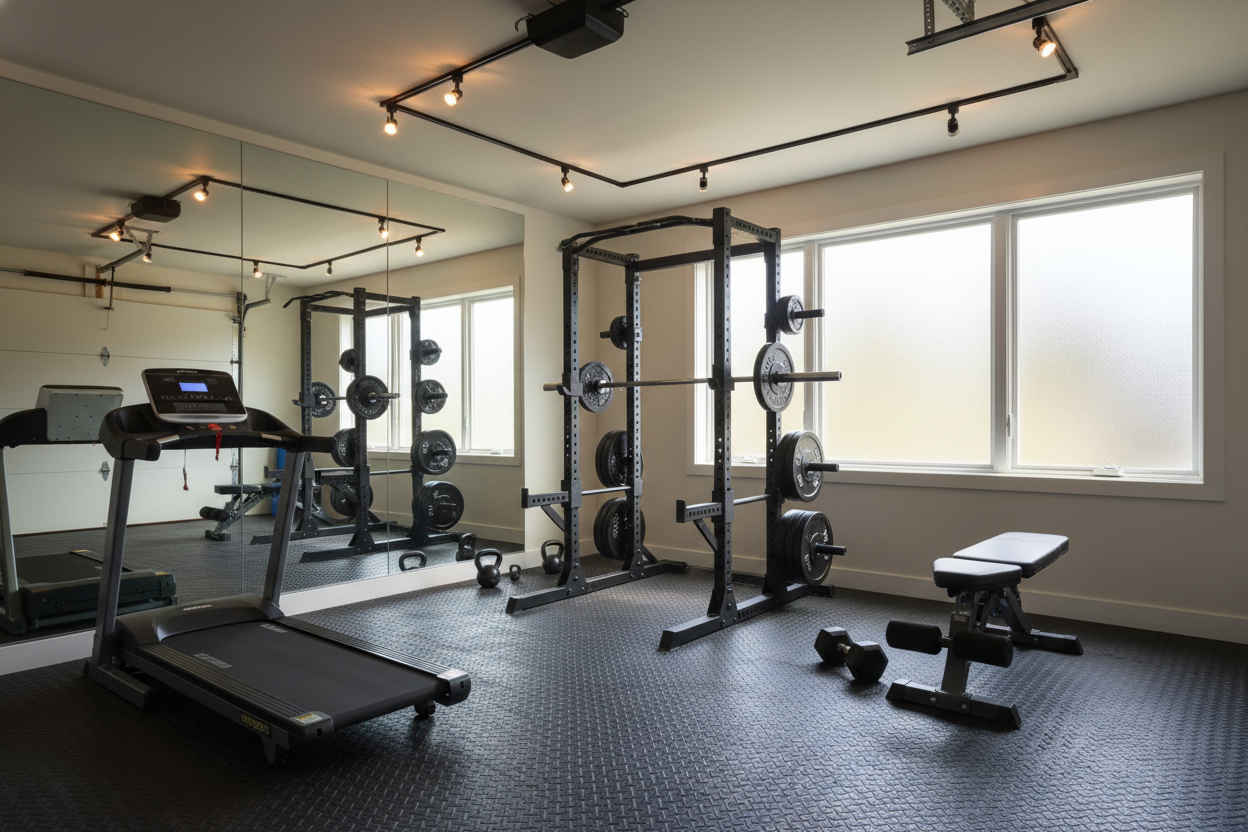
I’ve spent the last decade dropping barbells, tearing through vinyl upholstery, and watching commercial gym membership fees climb higher than my max deadlift. The dream is always the same: a private sanctuary where no one hoards the squat rack to do bicep curls. But when you start looking at professional-grade rigs, you realize you could buy a decent used car for the same price.
I set out to prove that you can build the best home gym setup under 1000 without spending your weekends scouring Facebook Marketplace for rusted iron that smells like a damp basement. You don't need a five-figure budget to get a brand-new, warranty-backed setup that can handle 500-pound squats and daily abuse.
- Prioritize the Rack: Your safety depends on the steel cage, so never buy the cheapest option on Amazon.
- Iron Over Rubber: Cast iron plates save you hundreds over fancy bumper plates.
- Flat Bench King: A rock-solid flat bench beats a wobbly, cheap adjustable bench every time.
- No Fluff: Skip the machines and cables until you have the basics mastered.
Why I Stopped Telling People to Buy Rusted Craigslist Junk
Five years ago, I’d tell every new lifter to go buy used. But the market changed. Everyone thinks their chipped, 15-year-old cast iron is worth its weight in gold now. By the time you drive two hours to pick up a mismatched set of plates and scrub the rust off with a wire brush, you’ve wasted a whole Saturday and saved maybe fifty bucks.
Buying new means you get a warranty and gear that actually fits together. There is a specific peace of mind that comes with knowing your 14-gauge steel rack wasn't modified by a guy with a DIY welder in his garage. Building a garage gym under 1000 is about being surgical with your spending, not being a scavenger.
The Golden Rule: Spend on the Anchor, Scrimp on the Accessories
If a barbell snaps, you’re looking at a broken wrist. If a rack collapses, it’s game over. These are your 'anchors.' You spend your money here because these items have moving parts or structural responsibilities. You can find reliable home gym equipment that hits the sweet spot between 'budget' and 'bulletproof' if you know where to look.
Static items—things that just sit there and be heavy—are where you save. A 45-pound plate made of iron is 45 pounds whether it costs $1.00 a pound or $3.00 a pound. When you're building a home gym 1000 budget, you buy the basic iron and put the savings into a bar with better knurling.
The Blueprint: Piecing Together a Garage Gym Under 1000
This isn't a hypothetical list. This is the exact breakdown of gear I’ve tested that fits in a 10x10 space and leaves you with enough change to buy a tub of chalk. We are focusing on the 'Big Three' lifts: Squat, Bench, and Deadlift.
The Power Rack: Your Non-Negotiable Foundation
Don't buy a half-rack or a set of independent squat stands if you plan on lifting heavy alone. You need a full cage. A solid 2x2 steel rack with a 700-lb to 1,000-lb capacity is the sweet spot. Look for 1-inch or 5/8-inch hole spacing so you can actually set your safeties at the right height for your chest. When allocating your budget effectively, expect to drop about $300 to $350 here. Anything less and the rack will walk across the floor every time you re-rack a bar.
The Barbell and Plates: Don't Cheap Out Here
The barbell is your primary point of contact. If the knurling is passive, the bar will slip. If the sleeves use cheap bolts instead of snap rings, they’ll eventually fall off. I recommend a 28.5mm multi-purpose bar with a 190k PSI tensile strength. It has enough whip for cleans but is stiff enough for heavy squats. For the plates, go with standard gray or black cast iron. You can usually score a 300-lb weight set (which includes a 'beater' bar you can use for landmine work later) for around $350-$400. That gives you plenty of weight to start your home gym for 1000.
The Flat Bench: Where Stability Matters Most
I once tried to save money with a $90 adjustable bench from a big-box store. The first time I tried to bench 225, the frame creaked and shifted two inches to the left. It was terrifying. If you are on a budget, buy a heavy-duty flat bench. A tripod-style flat bench with a 1,000-lb capacity is usually around $130. It won't wobble, and it will be way more comfortable than a cheap adjustable that has a massive gap between the seat and the backrest.
What to Completely Ignore When Money is Tight
The biggest mistake I see is people buying a 'Lat Pulldown' attachment or a cheap treadmill. Those things eat up 30% of your budget and offer 5% of the utility. If you want to get fit, you should skip the expensive cardio machines. Run outside, buy a $15 jump rope, or do burpees until you see stars. Use that money to buy an extra pair of 45-pound plates instead. Machines are for when you have a 2,000-square-foot facility and a five-figure budget.
The Final Tally: Proof You Can Lift Heavy for Less
Let’s look at the math. A solid power rack ($320), a 300-lb iron weight set with a starter bar ($380), an upgraded multi-purpose barbell ($170), and a competition-style flat bench ($130). That brings us to exactly $1,000. You have a rack that won't kill you, a bar that feels great in the hands, and enough weight to keep most people busy for at least a year of linear progression.
FAQ
Is 300 lbs of weight enough?
For most people starting out, yes. If you are already deadlifting 400+, you’ll need to snag an extra pair of 45s, which usually run about $1.20 per pound if you shop the sales.
Do I need flooring?
Yes. Don't lift on bare concrete. Go to a farm supply store and buy 4x6 horse stall mats. They are 3/4-inch thick rubber and cost about $50 each. Two of them will cover your lifting area perfectly.
Can I put this in a second-story apartment?
I wouldn't. A rack, bench, and 300 lbs of iron is a lot of concentrated weight. Plus, your neighbors will hate you the second you set a deadlift down. Keep the heavy stuff on the ground floor or in the garage.
Share:
A Minimal Home Gym Is the Ultimate Cure for Workout ADD
Is That Sam's Club Smith Machine Actually Worth the Hassle?