
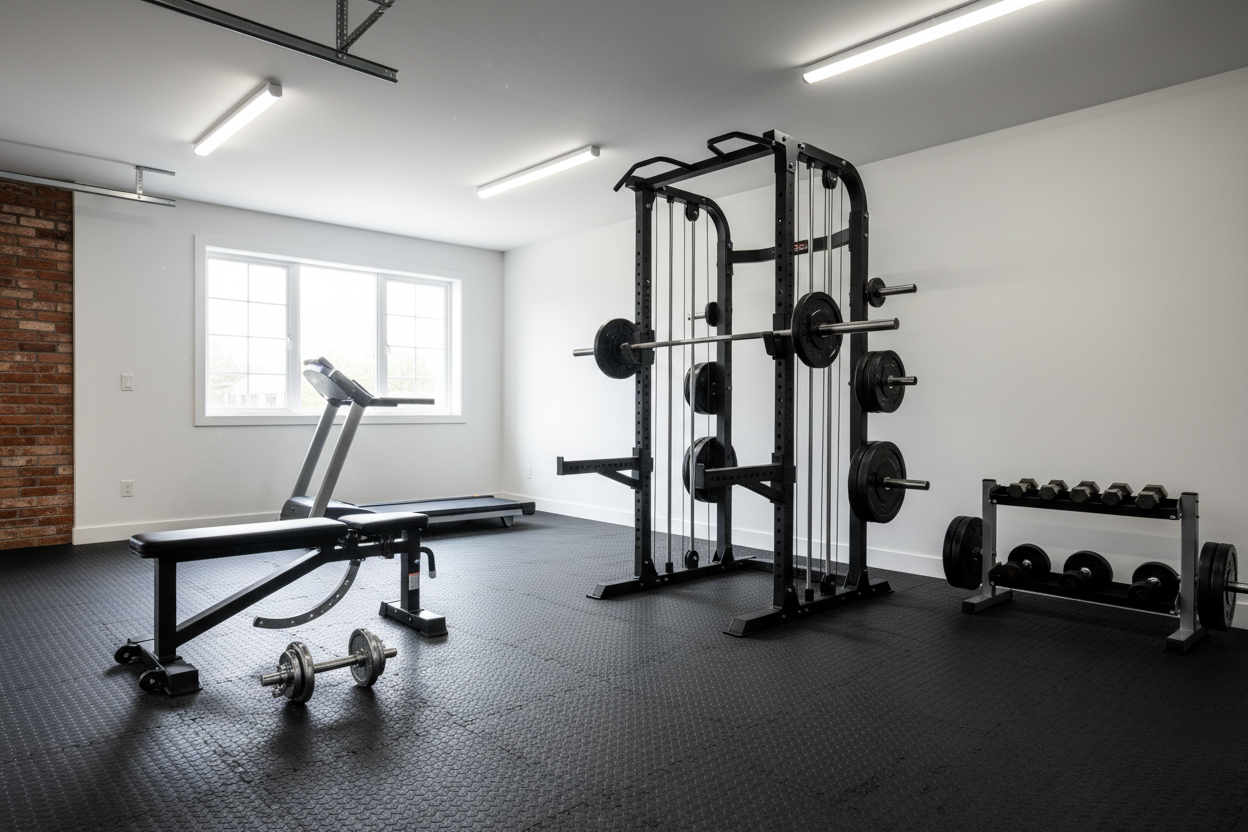
My garage was a death trap. I had a Rogue RML-390F taking up the center, a cheap cable tower shoved into a corner, and a pile of plates that seemed to migrate toward my shins every time I walked past. I was spending half my workout moving benches and untangling cable attachments. I finally snapped and decided to look into a multipower machine to see if I could reclaim my floor space without sacrificing my gains.
Quick Takeaways
- Consolidates three separate pieces of equipment into one 6x8 foot footprint.
- Seamless transitions between heavy compounds and cable accessory work.
- Built-in safety catches make 5 AM solo sessions much less sketchy.
- Assembly is a beast—budget a full Saturday and have a socket set ready.
The Breaking Point: Why My Garage Gym Needed an Intervention
I hit a wall, literally and figuratively. My garage is a standard 20x20, but once you factor in the lawnmower, the trash cans, and the mountain of holiday decorations, my 'gym' was more like a 10x12 cramped box. I was tired of the friction. Every time I wanted to do a superset, I was dragging a 75-pound adjustable bench across the concrete, stubbing my toe on the cable tower base, and wasting 15 minutes of my hour-long window just on logistics.
The frustration peaked during a leg day. I wanted to go from heavy back squats to cable pull-throughs. By the time I cleared the space and set up the pulleys, I'd lost my pump and my patience. I realized that a traditional power rack is great if you have infinite space, but for the rest of us, it can be a bottleneck. I needed a multipower gym setup that actually respected my time.
What Actually Makes a 'Multipower Machine' Different?
Don't confuse a true multipower setup with those flimsy units you see at the big-box sporting goods stores. A standard Smith machine is just a bar on a fixed vertical track. That's fine for calf raises, but it's a one-trick pony. A real multipower system is an entire ecosystem. It's the natural evolution of the Smith machine home gym station into a professional-grade rig.
We are talking about a heavy-duty frame that includes a half-rack with J-cups on the front for free-weight work, a smooth-tracking Smith bar in the middle, and dual functional trainer cable columns on the sides. Usually, these come with 200-lb or 300-lb weight stacks. It’s the difference between buying a single tool and buying the whole toolbox. You get the guided path for when your form is failing, but you still have the J-cups for when you want to move a 'real' barbell.
3 Things I Actually Loved About Consolidating My Gear
I was a skeptic. I thought all-in-one machines were for people who didn't take lifting seriously. I was wrong. After a month of heavy use, the efficiency gains were undeniable.
Supersets Are Finally Realistic
The workout flow is night and day. I can hit a heavy set of bench presses on the front of the rack and immediately spin around to hit cable crossovers using the dual columns. There is no walking across the room or fighting for floor space. Because the pulleys are integrated into the frame, the cables are always right where you need them. It turned my 75-minute workouts into 50-minute sessions because I stopped 'commuting' between stations.
Built-In Spotters for Solo Lifters
I train at 5 AM before my kids wake up. There is nobody around to spot me if I get pinned under a 315-lb squat. While I love my safety straps on a traditional rack, the fixed-path safety stops on a multipower unit give me way more confidence. After testing different fixed-path rigs, I found that having that physical 'stop' that I can engage with a flick of the wrist is a total peace-of-mind upgrade. It lets me actually push to failure on movements like the incline press without worrying about a trip to the ER.
The Downsides They Hide in the Glossy Instagram Ads
Let's be brutally honest: these things aren't perfect. First, the footprint is deep. Even though it's one machine, you need about 7 to 8 feet of depth to account for the rack, the bar path, and your bench. Don't think you can shove this into a tiny closet. Second, the assembly is a nightmare. You’re dealing with dual weight stacks, guide rods, and complex pulley routing. If you aren't handy with a wrench, pay for the professional assembly.
Also, watch out for the pulley ratio. A lot of these machines use a 2:1 ratio, meaning 100 lbs on the stack feels like 50 lbs in your hand. If you're a beast who needs 150 lbs per hand for cable rows, you might max out the stacks quickly. And finally, cheaper units use plastic pulleys that feel like dragging a sled through sand. If you don't spring for the aluminum pulley upgrade, you'll feel that annoying 'hitch' in every rep.
Is a Multipower Gym the Right Move for Your Garage?
If you are a competitive powerlifter who lives and dies by the 'big three' and needs the specific oscillation of a Texas Power Bar, keep your rack. But for 90% of us—the guys and girls looking for hypertrophy, safety, and a clean garage—the switch is a no-brainer. It’s about maximizing the square footage you actually have. If you find you still need more specialized leg work, you can always pair it with a compact leg press combo machine to fill that last corner of the gym.
FAQ
Can I use my own Olympic barbell with a multipower machine?
Most high-end models come with front-facing J-cups and spotter arms, so you can absolutely use a standard 7-foot Olympic bar for free-weight work. Just make sure the rack is rated for the weight you're moving.
Is the Smith bar on these machines always 45 pounds?
No. Most are counterbalanced to feel lighter—often around 15 to 25 lbs. Always check the manufacturer's specs so you know exactly how much weight you're actually moving.
Do I need to bolt a multipower machine to the floor?
While many of these units weigh over 600 lbs with the stacks and stay put during normal use, I always recommend bolting them down if you're doing heavy pull-ups or using suspension trainers to prevent any tipping or shifting.
Share:
How to Negotiate Package Deals at Independent Gym Shops
The Best Brand of Exercise Equipment Doesn't Actually Exist