
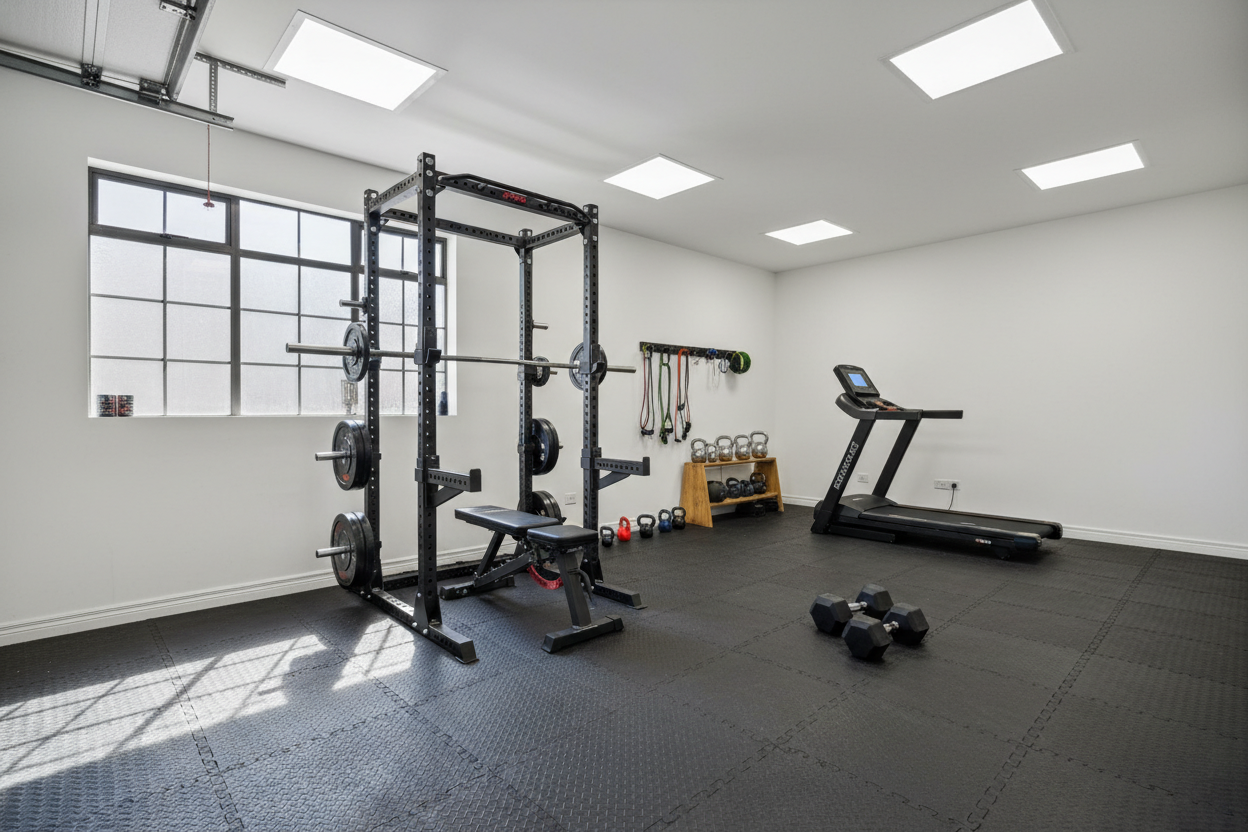
I have spent entirely too many nights staring at spec sheets, comparing the tensile strength of barbells I will likely never max out. It is a specific kind of madness that hits right around 2 AM when you are trying to decide between 11-gauge and 14-gauge steel. You start searching for what is the best at home gym equipment and end up three hours deep into a forum debate about whether 1-inch or 2-inch hole spacing matters more for your bench press safety height.
The truth is, most of us are drowning in options. We are buying gear based on what looks cool in a professional athlete’s Instagram story rather than what fits our actual life. I have owned racks that took up half my garage and ended up serving as high-end coat racks because they were too annoying to adjust. I have learned the hard way that the best equipment is the stuff that actually gets used.
Quick Takeaways
- Friction is the enemy: If it takes 15 minutes to set up a movement, you will eventually stop doing it.
- Flooring matters more than you think: Do not skip the 3/4-inch horse stall mats.
- Buy once, cry once: A cheap, wobbly bench is a literal safety hazard.
- Decide your path: Are you a minimalist strength purist or a variety-seeking bodybuilder?
You Are Drowning in Spec Sheets (And It is Ruining Your Workouts)
We have reached peak equipment saturation. You can buy a rack with laser-cut numbering, stainless steel uprights, and more attachments than a Swiss Army knife. But here is the problem: analysis paralysis is the ultimate gains-killer. I have seen guys spend six months researching the perfect knurling on a power bar while their old gym membership expires and their squat numbers plummet.
The marketing tells you that you need a 3x3-inch frame with 1,000-lb capacity. Unless you are an elite powerlifter, you probably do not. What you actually need is equipment that feels stable and does not require a master's degree in engineering to change the J-cup height. Stop looking for the 'perfect' spec and start looking for the gear that removes the excuses to skip a Monday leg day.
The Best Workout Home Gym Equipment Actually Removes Friction
Workout friction is the invisible force that keeps you on the couch. It is the three-step process of moving the lawnmower, unfolding a cheap bench, and hunting for the spring collars. The best workout home gym equipment is the gear that stays ready. If your space is cramped, a foldable rack might seem smart, but if it is a pain to deploy, you will find reasons to do cardio instead.
I realized this when I swapped my complicated cable crossover for a simple pair of adjustable dumbbells that go up to 80 lbs. Suddenly, my accessory work happened every day because the barrier to entry was zero. The Best Home Gym Fitness Equipment Is Just 3 Things if you are looking to strip away the noise and focus on what actually drives hypertrophy and strength.
So, What Is the Best At Home Gym Equipment Really?
It depends on how your brain works. I have found that most successful home gym owners fall into one of two camps. You are either a 'Swiss Army Knife' lifter who needs variety to stay engaged, or a 'Purist' who just wants to move heavy iron in a straight line.
Path A: The Swiss Army Knife Approach
If you get bored doing the same five movements, you need an all-in-one system. This is for the person who wants to hit chest flyes, lat pulldowns, and squats in the same 6x8 ft footprint. These systems are incredible for solo lifters because they often include built-in safety mechanisms that a standard rack lacks.
Investing in a Smith Machine Home Gym Station is the move here. It gives you that fixed-path safety for heavy pressing when you do not have a spotter, plus the pulley systems for the 'pump' work that makes training fun. It is about maximizing the utility of every square inch of your floor space.
Path B: The Purist's Iron Sanctuary
Then there is the classic route. This is a heavy-duty power rack, a 20kg multi-purpose barbell, and about 300 lbs of iron plates. This setup is for the lifter who follows programs like Starting Strength or 5/3/1. It is loud, it is aggressive, and it is indestructible.
When I built my first 'sanctuary,' I went with a rack that had a 48-inch internal width. It felt like a cage in the best way possible. If your goal is purely progressive overload on the Big Three (squat, bench, deadlift), do not overcomplicate it. Get a bar with a decent whip, a flat bench that does not wobble, and start adding weight to the bar every week.
The One Question to Ask Before Clicking 'Add to Cart'
Before you drop two grand on a new setup, ask yourself: 'Does this piece of gear solve a problem, or am I just bored?' I once bought a specialized leg press attachment for my rack that took 10 minutes to bolt on. I used it twice. It was a chore, not a tool. If the gear makes your life harder, it is the wrong gear.
Building a Home Gym is an evolution, not a one-time purchase. Start with the high-quality basics that match your training style. If you love the feeling of a commercial gym, go for the functional trainer. If you love the smell of chalk and old iron, go for the rack. Just make sure whatever you buy is ready to work the second you walk through the door.
FAQ
How much space do I actually need for a home gym?
For a full power rack setup, you need at least an 8x8 ft area. This gives you room for a 7-foot Olympic bar and space to load plates on the sides without hitting the wall. If you have less space, look into adjustable dumbbells and a high-quality adjustable bench.
Is 11-gauge steel really necessary?
For most people, 14-gauge is fine for light use, but 11-gauge (which is thicker) provides that 'commercial feel' and won't shift or vibrate when you rack a heavy bar. If you are squatting over 300 lbs, stick with 11-gauge for the peace of mind.
What is the most underrated piece of home gym gear?
Quality flooring. Standard 3/4-inch rubber mats protect your foundation, dampen noise, and save your joints. Do not waste money on those interlocking foam tiles; they will tear and slide the first time you try to do a burpee or a heavy pull.
Share:
The Problem With Buying an Olympic Weight Set and Rack Together
Why I Stopped Laughing at Barbell Class Exercises