
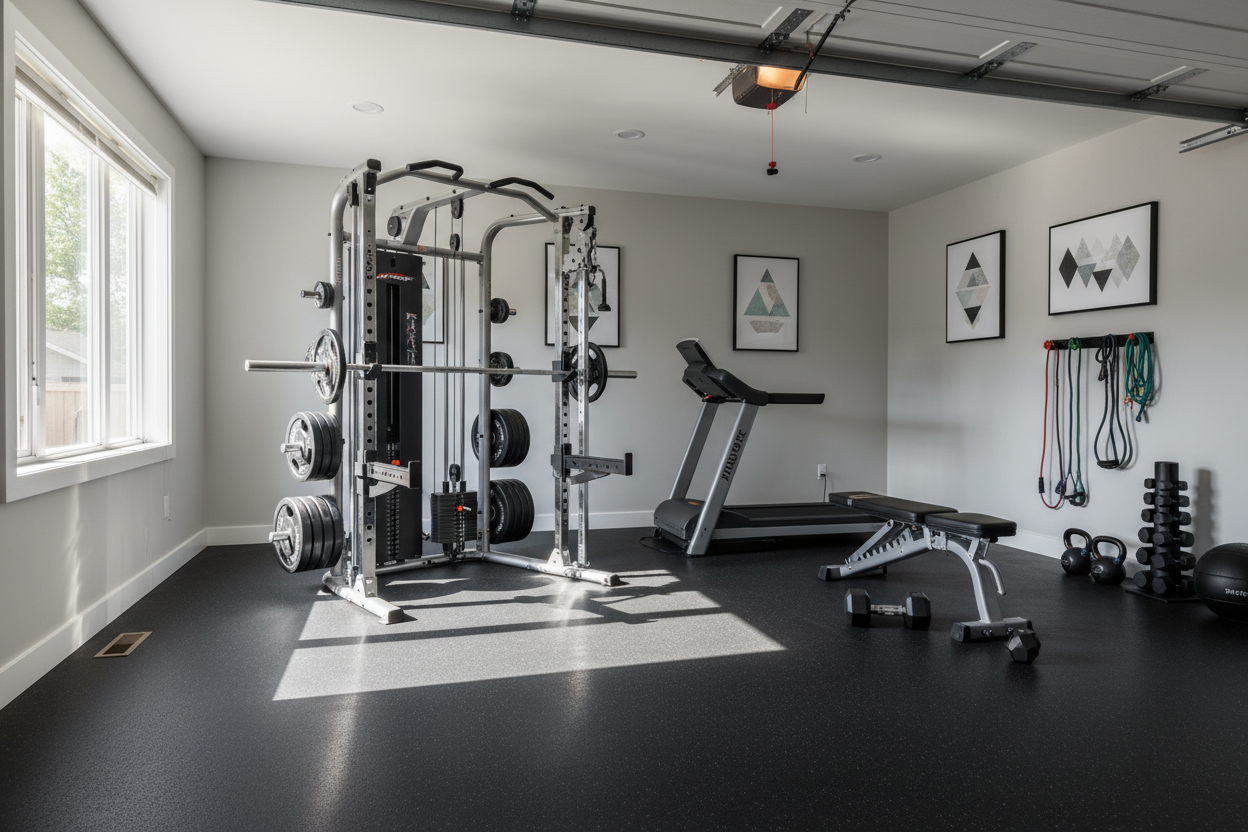
I remember the first time I canceled my $150-a-month commercial membership to build a garage gym. I bought a cheap lat pulldown off a big-box site, loaded it up with 100 pounds, and felt an immediate sense of regret. It wasn't the weight that was the problem—it was the grinding. It felt like I was pulling a bag of gravel through a straw.
The truth is, professional weight machines aren't just expensive because of the brand name. They are built with a level of mechanical precision that most home-grade gear ignores to save on shipping costs. When you step into a high-end facility, the equipment feels like it’s moving on ice. In your garage? It usually feels like a workout for your patience.
Quick Takeaways
- Commercial machines use linear bearings and machined steel guide rods; home gear uses plastic bushings and hollow tubes.
- Pulley ratios (2:1 vs 1:1) drastically change the resistance profile and 'feel' of the weight.
- Selectorized stacks offer convenience for drop sets, but plate-loaded machines are 70% cheaper if you already own iron.
- Simple maintenance like dry silicone spray can make a $500 machine feel like a $2,000 one.
The 'Buttery Smooth' Illusion (Why Your Home Gear Feels Off)
The biggest difference between a budget setup and a high-end gym room machine is friction. In a commercial gym, those guide rods are solid, polished steel. They are heavy, perfectly straight, and lubricated to a scientific degree. When the weight carriage moves, it glides on high-quality bearings that minimize the 'stick-slip' phenomenon.
Most home-grade equipment uses plastic bushings. These are essentially just plastic rings that slide along a metal pole. The moment you apply any lateral force—like pulling a cable slightly to the left—that plastic bites into the metal. That is where that jerky, uneven resistance comes from. It ruins your mind-muscle connection because you're fighting the machine's friction instead of the actual weight stack.
It's All About the Bearings and Pulley Ratios
If you look closely at a high-end weight lifting exercise machine, you'll see a pulley ratio that makes sense for the movement. A 2:1 ratio means 100 pounds on the stack feels like 50 pounds in your hand, but the travel is twice as long. This creates a smoother, more consistent tension through the entire range of motion. Cheap machines often stick to 1:1 ratios with heavy, low-quality pulleys that feel 'heavy' at the start and 'dead' at the top.
Then there is the unilateral factor. High-end equipment often uses independent levers to ensure one side of your body isn't doing all the work. For example, using an independent arm chest press machine allows you to feel that smooth, converging path that mimics dumbbells but with the stability of a fixed track. That mechanical alignment is hard to find in bolt-together kits that have 1/4-inch of 'wiggle' in every joint.
Selectorized Stacks vs. Plate-Loaded Alternatives
The dream is a full row of selectorized workout machines with weights built right in. You move a pin, and you're ready to go. This is the gold standard for high-intensity training because you can hit a failure set and immediately drop the weight by 20 pounds. Using assisted weight machine setups makes solo training significantly safer, as the weight stack acts as its own spotter.
However, for the home gym owner, a plate-loaded weight trainer machine is usually the smarter play. A selectorized 200-lb stack adds about $600 to the price and $200 to the shipping. If you already have a pile of Olympic plates, plate-loaded machines give you that commercial-grade steel frame without the 'convenience tax' of the pin-loaded stack. Just be prepared to spend more time loading and unloading between sets.
How to Hack That Commercial Gym Feel in Your Garage
You don't need to spend $5,000 to get a better feel. First, stop using WD-40 on your guide rods; it attracts dust and turns into a gummy mess. Use a dry silicone spray or Teflon-based lubricant. Wipe the rods down until they are spotless, then apply a thin coat. The difference is night and day.
Second, check your foundation. Even a professional weight machine will feel like junk if it’s sitting on uneven horse stall mats or a sloped garage floor. If the frame isn't level, the guide rods won't be vertical, and the carriage will bind. Ensure you are pressing off a heavy-duty weight bench that doesn't wobble. Stability is the silent partner of smoothness; if the base moves, the pulleys won't track straight.
Personal Experience: The $300 Mistake
I once bought a budget functional trainer because the photos looked identical to a Life Fitness unit. On paper, it had the same footprint. In reality? The pulleys were cheap nylon that squealed like a stuck pig, and the 'machined' guide rods were actually just chrome-plated industrial piping. I spent three months trying to shim it and grease it before I realized the frame itself was flexing under load. I eventually sold it for half what I paid and bought a refurbished commercial unit. Lesson learned: you can't polish a bad frame.
FAQ
Why does 100 lbs feel heavier on some machines?
It’s usually the pulley ratio. A 1:1 ratio moves the weight stack one inch for every inch you pull. A 2:1 ratio moves it half an inch. Friction in cheap pulleys can also add 10-15% of 'ghost weight' that makes the movement feel sluggish and heavy.
Can I replace nylon pulleys with aluminum ones?
Yes, and you should. Aluminum pulleys with high-quality bearings are one of the cheapest ways to upgrade a home weight trainer machine. They don't flex under heavy loads, which keeps the cable tracking perfectly in the center of the groove.
Are plate-loaded machines as good as pin-loaded ones?
In terms of muscle growth, yes. The resistance is the same. The only downside is the 'drag' of the weight carriage on the guide rods, which is sometimes more noticeable on plate-loaded units because the weight isn't perfectly centered like it is in a selectorized stack.
Share:
I Finally Decoded All Those Exercise Machines and What They Do
What 1,000 Amazon Reviews Won't Tell You About the Goplus Weight Bench