
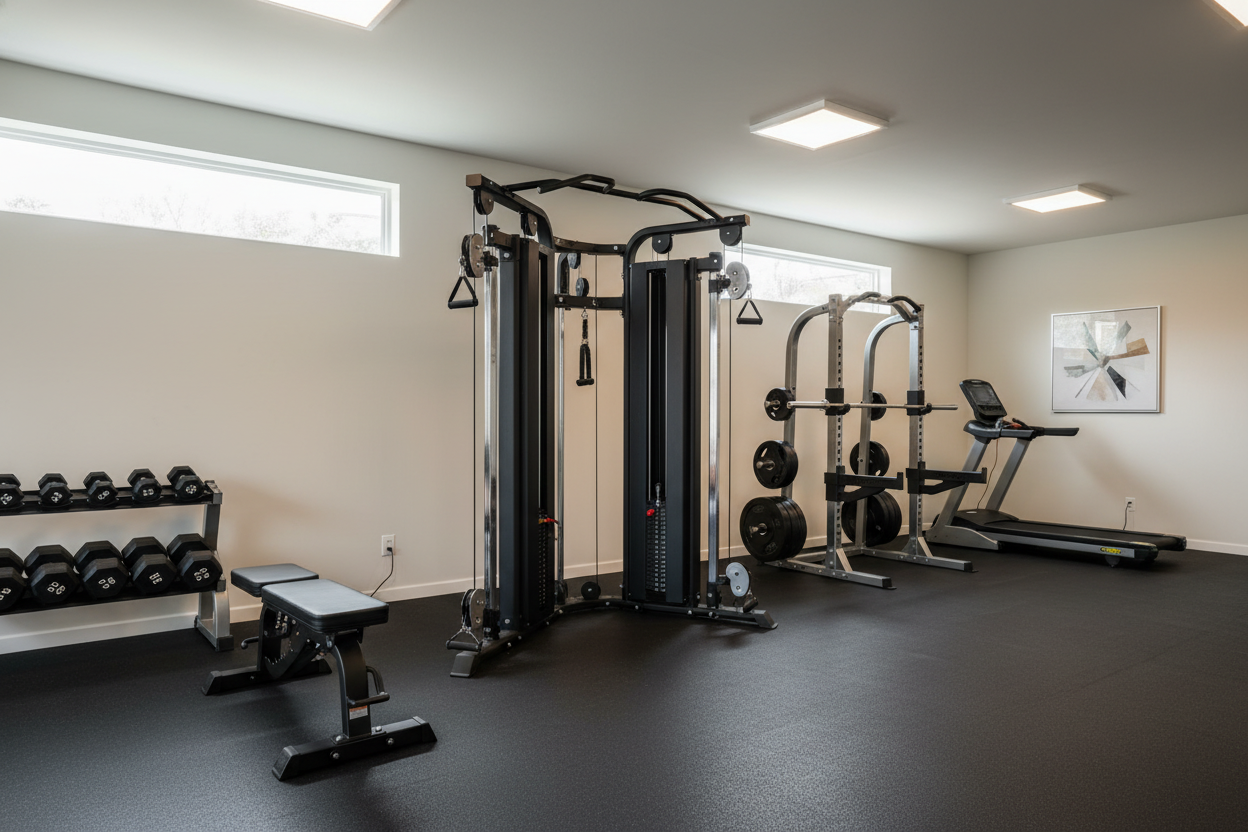
I’ve spent more hours than I’d like to admit staring at 2x3 steel uprights on my phone at 2 AM. I have bought the 'as-seen-on-TV' junk that wobbles when you breathe on it, and I have spent way too much on commercial units that took up half my garage. If you are currently hunting for the best exercise machine for home, you need to stop thinking about machines that only do one thing. The gym industry wants you to buy a treadmill this year and a rowing machine the next, but that is how you end up with a very expensive laundry rack.
- Versatility over everything: If it doesn't allow for at least 15 different movements, it's taking up too much space.
- Steel gauge matters: 11-gauge or 12-gauge steel is the standard; anything thinner feels like a toy.
- Pulley ratios: A 2:1 ratio is your friend for isolation work and smooth travel.
- Footprint: Measure your ceiling height twice—don't forget to account for your head during pull-ups.
The Single-Use Cardio Trap (And Why We Fall for It)
We’ve all been there. You see a sleek, high-tech bike with a massive screen and think that’s the ticket to consistency. It’s 'easy' to jump on. But the reality of home training is that boredom is the ultimate progress killer. Chasing the single best exercise machine for home is a trap because 'all-in-one' usually means 'master of none.' Most standalone cardio units lack the ability to provide progressive overload, which is the literal foundation of getting stronger and changing your body composition.
The best workout machine for home isn't something that just makes you sweat; it’s something that forces your muscles to adapt. When you buy a single-use machine, you're locked into one movement pattern. Within six weeks, your brain is bored and your joints are feeling the repetitive stress. You need a setup that allows you to switch from heavy compound lifts to high-volume accessory work without needing a 2,000-square-foot commercial facility.
Stop Buying Gadgets, Start Buying Versatility
When you're working with a 10x10 spare bedroom or a corner of a garage, every square inch is premium real estate. The best fitness machines are the ones that maximize that footprint. I’ve seen people cram three different 'infomercial' machines into a room and still not be able to do a proper lat pulldown. You should be looking for modularity. A piece of equipment should earn its place by serving multiple purposes.
To build a real home gym, you need to think about the 'big rocks' of training: pushing, pulling, squatting, and hinging. If a machine only lets you do one of those, it’s a gadget, not a tool. I prefer rigs that allow for plate-loaded or selectorized attachments. This allows you to start with a base unit and add on as your budget (and your strength) grows. A 3x3-inch steel upright with 1-inch holes is the industry standard for a reason—it opens the door to a world of attachments from various brands, ensuring your gym never becomes obsolete.
Why a Rack and Cables Beat Everything Else
If I had to start over from scratch, I wouldn't buy a pile of dumbbells. I’d buy a rack with a cable system. The best workout machines combine the raw power of free weights with the constant tension of cables. Free weights are great, but they have 'dead spots' in the range of motion due to gravity. Cables keep your muscles under fire through the entire lift. This is why a functional trainer or a high-end power rack with a cable crossover is the gold standard.
For many, a Smith machine home gym station is the ultimate space-saving play. I used to be a free-weight snob until I realized that for solo training, a Smith bar is a lifesaver. You can push to absolute failure on bench or squats without the fear of being pinned. When you realize the best full body home workout machine is actually a smith rig, you stop worrying about finding a spotter and start focusing on intensity. Modern Smith units have buttery-smooth linear bearings that don't have that 'clunky' feel of the old-school gym units from the 90s.
Solving the Lower Body Problem in Small Spaces
The biggest gripe I have with most 'all-in-one' setups is the leg day experience. Usually, you get a pathetic leg developer attachment that feels like it was made for a toddler. If you want to build real wheels, the best workout machine home setups need to address the posterior chain. You need high-leverage movements that don't require you to stack 800 lbs of iron just to feel a burn.
I recently integrated a dedicated hip thrust machine glute muscles building HT01 into my rotation, and it’s a night-and-day difference compared to balancing a barbell on my hips while leaning against a bench. These specialized, high-leverage attachments allow you to isolate the glutes and hamstrings with massive weight in a very small footprint. If your 'best exercise machine' doesn't let you hammer your lower body safely, keep looking.
How to Vet a Rig Before You Hit Buy
Before you drop a couple of thousand dollars, you need to look at the specs like a hawk. Don't be fooled by pretty powder coating. First, check the steel gauge. 11-gauge is the heavy-duty stuff you see in college weight rooms. 14-gauge is what you find at big-box retailers; stay away if you're a serious lifter. Second, look at the pulley cables. You want 'aircraft grade' with at least a 2,000-lb tensile strength. If the cables look thin or the pulleys are plastic instead of aluminum or high-grade nylon, they will shred within a year.
Finally, check the weight capacity. The best exercise machines for home use should be rated for at least 600–1,000 lbs on the rack and 200–300 lbs per cable stack. Even if you aren't lifting that much yet, that overhead capacity tells you the unit is built to handle the dynamic force of the weight moving. A machine rated for exactly what you lift will feel shaky and unsafe the moment you try to hit a PR.
Personal Experience: My $800 Mistake
I once bought a budget-friendly power tower because the reviews said it was 'sturdy enough.' The first time I tried to do weighted dips, the whole thing tipped forward. I ended up with a bruised ego and a hole in my drywall. I learned the hard way that when it comes to home equipment, mass is your friend. If the shipping weight of the machine is less than your body weight, it’s going to move when you use it. I eventually upgraded to a 400-lb bolt-down rack, and the confidence that comes with knowing the machine won't move is worth every extra penny.
FAQ
Is a 2:1 pulley ratio better than 1:1?
It depends on the goal. A 2:1 ratio (where 100 lbs feels like 50 lbs) gives you more cable travel and smoother movement, which is perfect for functional training and isolation. A 1:1 ratio is better for heavy movements like lat pulldowns or seated rows where you want the full weight of the stack.
Do I really need to bolt my machine to the floor?
If the machine is a slim power rack or a light functional trainer, yes. If it has a wide base or integrated weight stacks that add 400+ lbs of ballast, you can usually get away without bolting it, but bolting always provides the most stable experience.
Can I use standard plates on a Smith machine?
Most high-quality home units are designed for Olympic plates (2-inch holes). Avoid machines that use 1-inch standard plates, as they are typically lower quality and the plate selection is much more limited for heavy training.
Share:
I Ditched the Machines to Train With Just Weights on Bench
I Ignored the Top Exercise Equipment Lists (And Built This)