
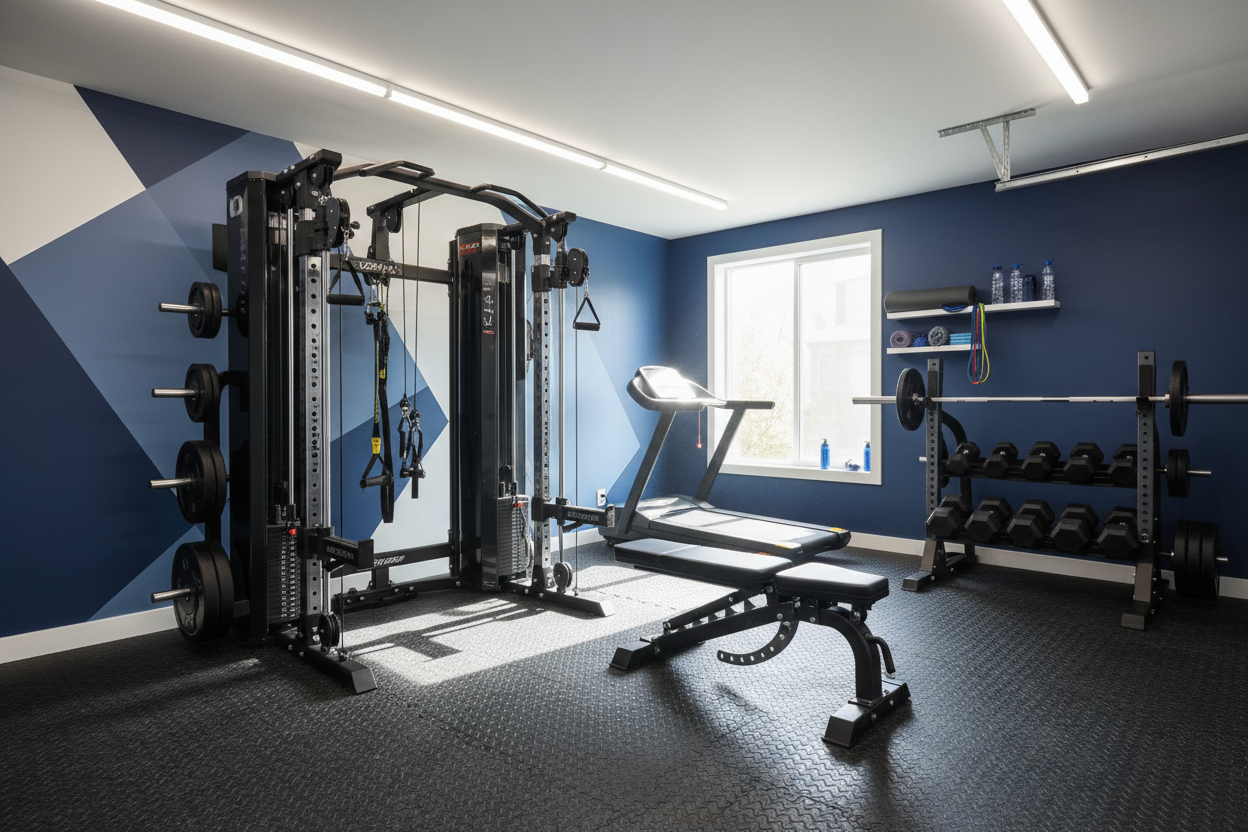
I remember the day my 'space-saving' resistance band station snapped and whipped me across the shoulder. That was the moment I realized that if I wanted the best gym machine for home, I had to stop buying toys and start buying steel. Commercial gyms charge $80 a month because their gear is heavy, and in the world of iron, weight equals stability.
- Look for 11-gauge or 12-gauge steel frames for zero wobbling.
- Dual weight stacks are essential for cable crossovers and functional movements.
- A 2:1 pulley ratio offers smoother travel and more precise weight increments.
- Account for 'working footprint'—the space you actually move in, not just the machine's base.
The Late-Night Infomercial Trap
We’ve all seen the ads. A guy with 20-inch arms claims he built them using a machine that folds under a bed and uses plastic tension rods. It’s a lie. Most equipment marketed as the best home gym machine relies on unstable frames that shake the moment you load more than 100 pounds. These machines often use fixed-path pressing arms that force your joints into unnatural angles, which is a fast track to a rotator cuff injury.
A real best gym at home setup needs to mimic the physics of a commercial facility. If the machine feels like it might tip over when you’re doing lat pulldowns, it’s not a gym—it’s a hazard. You need mass. Heavy-duty steel doesn’t just last longer; it provides the consistent resistance curve necessary for actual hypertrophy.
What Actually Makes a Machine Worth the Floor Space?
When you’re hunting for the best home resistance gym, you need to look past the shiny paint. Check the cables. Cheap machines use nylon pulleys that drag and stutter. You want aircraft-grade cables with at least a 2,000-lb tensile strength and aluminum pulleys with sealed bearings. If the movement isn't buttery smooth, you won't use it.
The frame should be at least 2.5-inch by 2.5-inch steel. Anything thinner will flex under load. I look for machines that offer a 2:1 pulley ratio. This means 100 pounds on the stack feels like 50 pounds of actual resistance, which sounds counterintuitive until you realize it gives you double the cable travel. That extra length is what allows for lunges, woodchops, and functional movements without the weight stack slamming into the top of the frame.
Why Dual Weight Stacks Are Non-Negotiable
Single-stack machines are the hallmark of budget gear. They limit you to bilateral movements, meaning your dominant side will always take over the load. To build a balanced physique, you need independent dual stacks. This allows for true isolateral training. You can do chest flies, cable crossovers, or even standing rows where each arm works independently. It forces your core to stabilize the weight, turning a simple machine lift into a full-body engagement.
The Solo Lifter's Safety Net
If you train alone in a garage, you probably skip the heavy triples because you don't have a spotter. This is where a built-in Smith machine home gym station becomes a literal lifesaver. By integrating a guided barbell system into the cable frame, you get the best of both worlds. You can push your squats and bench press to absolute failure, knowing a quick flick of the wrist will hook the bar safely into the steel pegs. It’s the ultimate insurance policy for the heavy hitter.
The Dimensions Lie: Static vs. Working Footprint
Marketing photos are deceptive. They show the machine tucked neatly in a corner, but they don't show the 7-foot Olympic bar hanging off the sides or the bench pushed three feet back for leg extensions. This was one of the biggest lessons I learned when I built the best weight home gym in my own house. You have to measure your 'working footprint.'
If a machine is 5 feet wide, you actually need 9 feet of clearance to load plates onto the sleeves comfortably. If you have a low ceiling, that pull-up bar at the top might become a decorative coat rack because you can't get your chin over it without hitting the drywall. Always add at least two feet to every manufacturer dimension before you click buy.
The Verdict: Stop Buying Toys and Buy Steel
The best at-home gym system isn't the one that folds into a closet; it's the one that makes you want to train. Look for a heavy-duty hybrid that combines a functional trainer with a power rack or Smith system. To truly round out the setup, you'll eventually want a dedicated weight bench chest press machine to handle the heavy auxiliary work that cables just can't replicate. Buy once, cry once. Invest in a machine that weighs more than you do, and it will likely outlast your lifting career.
My Biggest Mistake
I once bought a 'universal gym' from a big-box store because it was on sale for $400. Within three months, the plastic coating on the cables started peeling, and the stack would get stuck halfway through a rep. I spent more time lubing the guide rods than I did lifting. I ended up selling it for $50 on Craigslist and buying a real 11-gauge steel unit. Don't be like me. Start with the heavy stuff.
FAQ
Do I need a professional to assemble these?
If you're handy with a socket wrench and have a Saturday to kill, you can do it. But these things weigh 400 to 600 pounds, so bring a friend. Don't try to move the crates alone.
Are cable machines better than free weights?
Not better, just different. Cables provide constant tension throughout the entire movement, whereas free weights have 'dead zones' at the top or bottom. A good home machine should ideally offer both.
How do I maintain the cables?
Keep the guide rods clean. Wipe them down with a dry cloth and apply a tiny bit of silicone spray every few months. Never use WD-40; it attracts dust and turns into gunk.
Share:
I Skip 90% of the Back Exercise Machines at Gym (Here is Why)
Why Your Smith Machine Squats for Glutes Only Burn Your Quads