
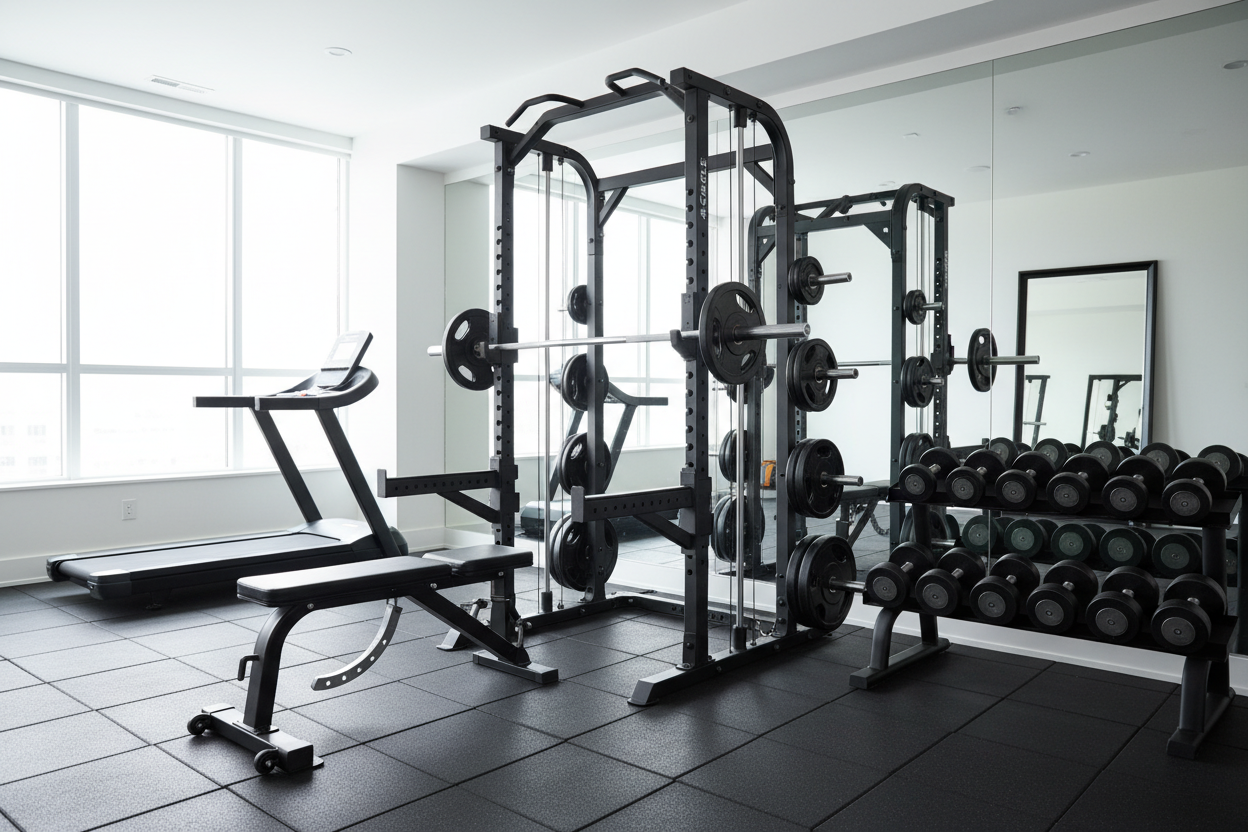
I spent years avoiding the rack in the corner of the gym because I thought it was just for bodybuilders who liked to ego lift. Then I actually looked at the biomechanics. If you are stepping into a Smith machine and setting up like you would for a standard barbell back squat, you are leaving massive gains on the table. Most people treat this rig like a free-weight substitute, but the fixed bar path is actually its biggest strength—if you know how to manipulate your body around it.
Quick Takeaways
- Feet need to be 12-18 inches in front of the bar, not directly under it.
- A vertical shin angle is the secret to shifting tension from the knees to the hips.
- You must hinge at the hips; staying perfectly upright is a quad-killer.
- Controlled eccentrics (3 seconds down) will build more glute mass than heavy triples.
The Accidental Quad Workout
The biggest frustration with smith machine squats for glutes is that the machine naturally wants to turn you into a piston. Because the bar moves on a fixed track, your body defaults to a position where your knees travel forward. This is great if you want massive teardrop quads, but it is a disaster if you are trying to build a posterior chain. When your knees track far past your toes, your quads take over the entire lift.
To stop this, you have to stop fighting the machine and start using the stability it provides. Since you do not have to balance the bar, you can lean back into it. This allows for a glute focused smith machine squat that simply is not possible with a barbell without falling flat on your face. You are essentially using the bar as a kickstand.
How to Actually Target Glutes on Smith Machine Squats
To master the glute squat smith machine variation, you need to rethink your footprint. Start by unlacking the bar and stepping forward. You want your feet far enough out that at the bottom of the rep, your shins are completely vertical. This reduces the demand on the knee joint and forces the hips to do the heavy lifting. This is the foundation of how to target glutes on smith machine squat setups.
Keep your feet shoulder-width apart or slightly wider, and turn your toes out about 15 degrees. This opening of the hips allows you to sink deeper into the pocket, which is where the glutes are under the most stretch. If you feel your heels lifting, your feet are still too close to the machine. Move them out another two inches.
Step Your Feet Forward (No, Further Than That)
The 'feet forward' stance is what makes squats on smith machine for glutes so effective. In a free-weight squat, your center of gravity must stay over your mid-foot. On a Smith machine, the machine handles the balance. By placing your feet forward, you create a massive lever arm at the hip. This maximizes hip flexion. When you descend, think about sitting back into a chair that is just slightly too far behind you. Your shins should stay perpendicular to the floor throughout the entire movement.
The Hinge: Why an Upright Torso Ruins the Lift
If you stay perfectly upright, you are doing The Foot Placement Secret to the Smith Machine Squat for Quads. For a glute focused squat smith machine setup, you need a slight forward lean in your torso. Do not mistake this for rounding your back—keep your spine neutral, but hinge at the hips. This 'hinge' pre-stretches the gluteus maximus before you even hit the bottom of the rep. It is the difference between a mediocre leg day and a targeted glute session.
Wait, Are You Just Doing a Hack Squat?
There is a fine line between smith machine squat glute focus and an accidental hack squat. If you keep your back pinned flat against an imaginary wall and just slide down, you are hitting quads. To keep it glute-centric, your hips must move back as the bar moves down. I have seen people try to mimic a No Room for a Leg Sled? My Hack Squat on Smith Machine Setup, which is fine for hypertrophy, but it is not the most efficient way to hammer the glutes.
If you find yourself constantly gravitating toward that sliding motion, you might actually be better off using a Compact 30 Degree Leg Press Hack Squat Combo Machine Lm L5. But if the Smith machine is what you have, focus on the 'sit back' rather than the 'slide down.' Weight distribution should stay firmly in your heels. If you can move your toes inside your shoes at the bottom of the rep, you are doing it right.
Programming the Movement Without Overtraining
When adding smith squats for glutes to your routine, do not treat them like a 1-rep max movement. The Smith machine is a hypertrophy tool. I recommend 3-4 sets in the 8-12 rep range. Focus on a 3-second descent, a 1-second pause at the bottom to kill momentum, and an explosive drive upward. Pair these with a hinge movement like a Romanian Deadlift to ensure you are hitting the glutes from both the lengthened and shortened positions.
My Personal Experience with Smith Squat Form
I used to be a barbell purist. I thought the Smith machine was 'cheating' until I developed a nagging lower back injury that made back squats impossible. I switched to smith machine squat form for glutes out of necessity. My biggest mistake early on was trying to go too heavy too fast. I loaded up 315 lbs and my form broke down—my hips would shoot up first, and my lower back would take the load. I dropped the weight to 185 lbs, focused on the 'feet forward' stance and the vertical shin angle, and my glute soreness the next day was unlike anything I had felt with a barbell. It taught me that tension matters way more than the number on the plates.
FAQ
How far forward should my feet be?
Usually 12 to 18 inches in front of the bar. The goal is to have vertical shins at the bottom of the squat. If your knees are still tracking forward, move your feet out further.
Does the bar path matter?
Some Smith machines have a slight angle (usually 7 degrees). If yours is angled, always face the machine so that the bar moves down and slightly away from you as you squat. This mimics the natural hinge better.
Can I do this for high reps?
Absolutely. Smith machine squat glutes respond incredibly well to high-volume sets of 15-20 reps, especially at the end of a workout when your stabilizers are too tired for free weights.
Share:
I Finally Found the Best Gym Machine for Home (It Weighs 400lbs)
How to Tell if an Olympic Weight Set With Bar Is Total Junk