
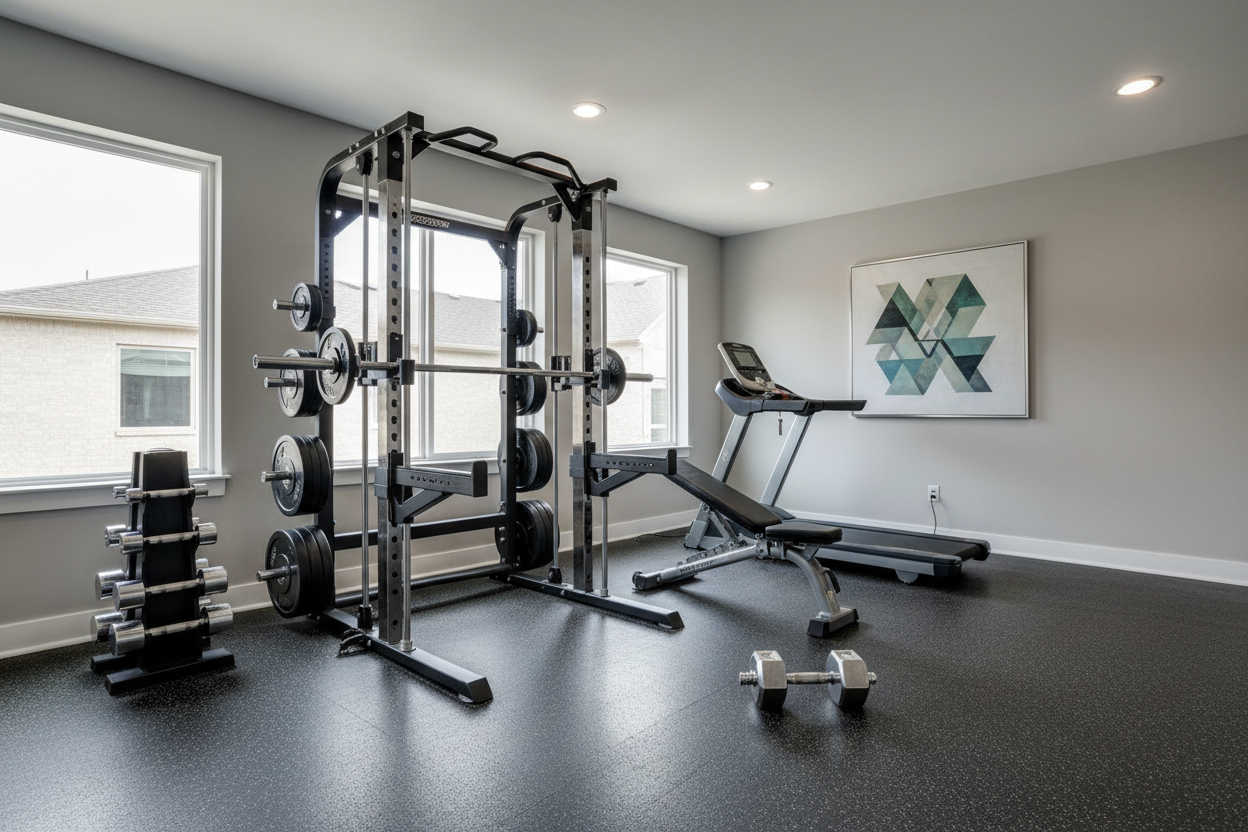
I have spent the last decade in a love-hate relationship with Smith machines. They are great for hypertrophy, but that locked-in vertical path always felt like I was squatting inside a coffin. Last month, I finally got my hands on a smith machine that moves forward and back to see if it actually fixes the 'robotic' feel of traditional rigs.
It is a weird sensation at first. You expect the bar to stop you from leaning, but it glides with you. It is essentially a 3D track system designed to mimic the natural bar path of a barbell while keeping the safety of a self-spotting hook system.
Quick Takeaways
- Expect a much more natural bar path for squats and lunges compared to a 1D vertical track.
- Maintenance is doubled; you have four guide rods to clean and lubricate instead of two.
- The horizontal bearings add a slight 'wobble' that purists might find distracting during heavy sets.
- It takes up more floor space—usually about 48 inches of depth just for the track movement.
What the Heck is a 3D Track System Anyway?
Most of us are used to the standard fixed-track smith machine where the bar only goes up and down. A moving smith machine adds a second set of linear bearings on a horizontal plane. This means the entire vertical carriage moves along the floor (or a top rail) while the bar moves up and down.
Think of it like a plotter or a 3D printer. The bar follows your body's natural movement. If you lean forward an inch during a squat, the bar moves an inch with you. It is technically a free moving smith machine, but it still has the safety catches that make Smith machines appealing for solo lifters.
The Squat Test: Does It Feel Like Real Barbell Weight?
The short answer: almost, but not quite. When you squat with a barbell, the weight moves in a slight S-curve. On a smith machine that moves, you can actually hit that curve. I loaded up 315 lbs—roughly 80% of my max—to see if the horizontal friction would mess with my balance.
The linear bearings are surprisingly smooth, but they aren't magic. There is a tiny bit of inertia you have to overcome to get the bar moving forward or backward. It doesn't feel 'heavy' like a barbell does in terms of stabilization, because the bar still can't tilt side-to-side. You get the horizontal freedom, but you lose the need to balance the load laterally. For some, that is the best of both worlds; for me, it felt like squatting on ice.
Where a Smith Machine That Moves Actually Shines
While squats are the main selling point, I found that lunges and rows are where this 3D track really earns its keep. On a fixed bar, a walking lunge is impossible. On this rig, you can actually travel. It is one of the few moves actually worth your time on this specific piece of equipment.
Bench pressing also feels significantly better on your shoulders. A natural bench press moves from the mid-chest toward the face in a J-curve. A standard Smith forces a straight line that can wreck your rotator cuffs over time. With the forward-and-back movement, that J-curve is back on the menu. It is a massive relief for anyone with old lifting injuries.
The Hidden Downsides of the Horizontal Glide
Here is the reality check: more moving parts means more things that can go wrong. Those marketing pictures of smith machine rigs always show them looking pristine in a sunlit studio. In a dusty garage, those horizontal floor tracks are magnets for dog hair, dirt, and dropped chalk.
If you don't keep the rods wiped down with a silicone-based lubricant, the horizontal glide starts to stutter. I noticed that when I went over 400 lbs, the carriage had a slight 'clunk' when switching directions. It is not a dealbreaker, but it is a reminder that you are still using a machine, not a piece of raw iron. Also, keep in mind these units are usually 10-20% wider and deeper than a standard rack to accommodate the dual-track hardware.
The Verdict: Is the Extra Cost Justified?
If you have the budget and you are dead-set on a Smith machine being your primary heavy hitter, the 3D movement is a legitimate upgrade. It saves your joints and allows for more athletic movements. However, if you are looking for a versatile home gym centerpiece, I usually tell people to stick with a high-quality all-in-one fixed path trainer.
The traditional fixed path is more stable for heavy shrugs and calf raises, and frankly, it is easier to maintain. You are paying a premium—often $500 to $1,000 more—for that horizontal movement. For most garage gym owners, that money is better spent on a better set of plates or a high-end barbell. But if you have shoulder issues or just hate the 'locked-in' feel, this is the only way to fly.
FAQ
Is a 3D smith machine safer than a barbell?
Yes, because you can still twist the bar at any point to hook it into the safety pins. You get the freedom of movement without the fear of getting pinned under a heavy set of squats.
Can you do pull-ups on a moving smith machine?
Most of these units have a dedicated pull-up bar at the top that is fixed to the frame, not the moving carriage. Don't try to do pull-ups on the bar itself while it is unlocked, or you'll go for a ride you didn't ask for.
Does the bar weight more on these machines?
Usually, the bar on a 3D Smith machine is counterbalanced or weighs a standard 45 lbs. However, because of the friction in the dual-track system, it might feel slightly 'heavier' on the transition than a standard 20-lb Smith bar.
Share:
I Finally Found a Space Saver Exercise Machine That Won't Wobble
Are Functional Trainer Home Gyms Really Worth the Garage Space?