
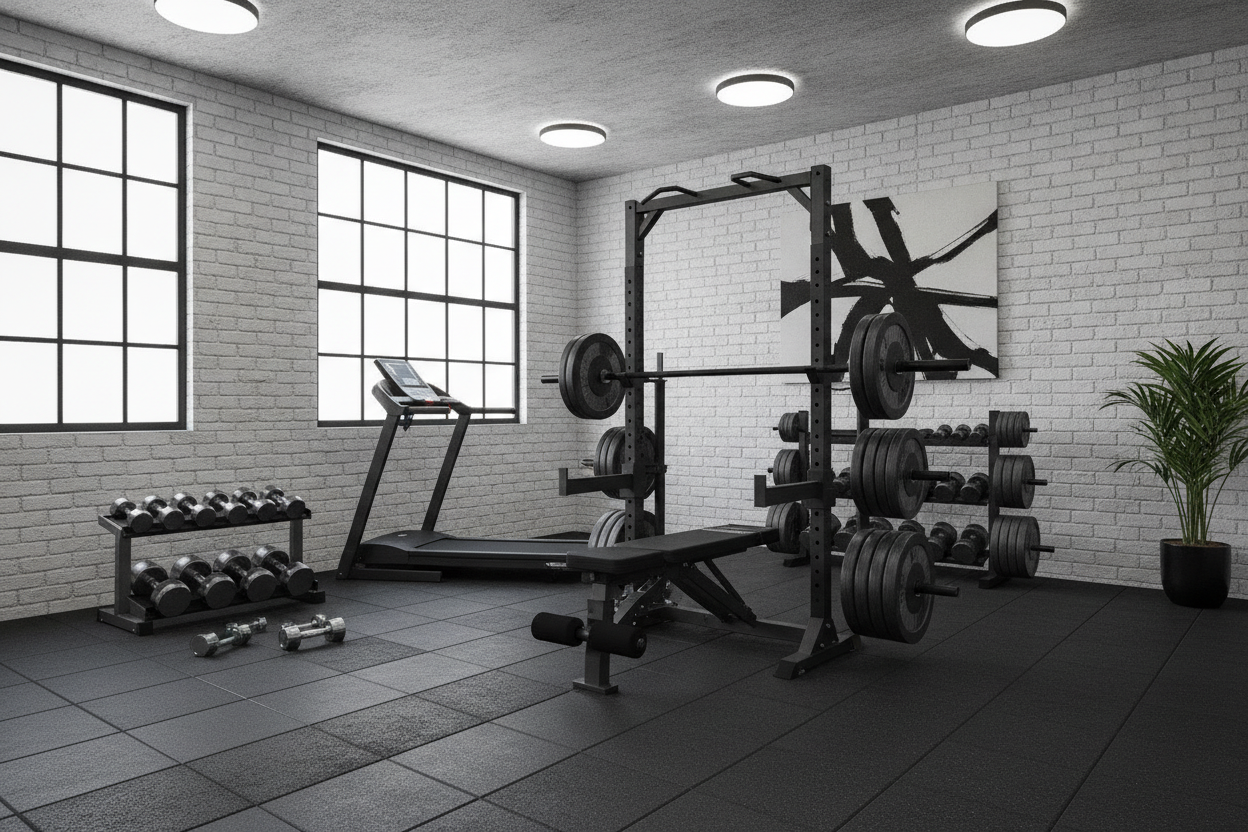
I was three weeks into a new program, training alone in my garage at 11:00 PM. I’d just bought a budget bench press holder because I wanted something I could tuck into the corner when I was done. It looked fine on the product page, but physics doesn't give a damn about marketing photos. On my final set of five, I hit the rack a little too hard on the re-rack, and the entire right upright started a slow-motion tilt backward. I barely caught the bar before the whole setup collapsed onto my concrete floor.
Quick Takeaways
- Independent stands are prone to 'walking' or tipping during aggressive re-racks.
- Look for a base depth of at least 20 inches per stand to prevent leverage accidents.
- 11-gauge steel is the gold standard; avoid flimsy 14-gauge 'bargain' stands.
- Connected frames are infinitely safer than two separate uprights for solo lifters.
The Deceptive Appeal of Independent Uprights
The lure of a two-piece bench bar holder setup is obvious. They are cheap, they ship in a small box, and they don't take up half your garage like a full power rack. When you first unbox them, they feel sturdy enough. You bolt the feet on, adjust the height, and think you've hacked the system. You saved two hundred bucks and four square feet of floor space.
But that mobility is exactly what makes them dangerous. Because there is no structural link between the left and right sides, each upright is fighting gravity and horizontal force all by itself. When you're fresh, you can place the bar down gently. When you're gassed, you don't place the bar—you throw it.
Physics 101: Why Your Barbell Bench Press Stand Wobbles
Stability is all about the footprint and the center of gravity. Most budget stands use a small U-shaped base that is way too narrow. When you are weighing your actual bar and plates, you realize that 225 lbs or 315 lbs creates massive horizontal momentum the moment you push back toward the J-cups. If that stand isn't heavy enough or deep enough, it becomes a giant lever.
A quality barbell bench press stand needs mass. If the upright weighs 15 lbs and you're slamming 200 lbs against the top of it, the stand is going to lose that fight every time. I’ve seen cheap stands 'walk' three inches across a stall mat during a single session just from the vibration and slight nudges of loading plates.
The 'Tip Factor' When Reracking Exhausted
This is where things get ugly. When you're grinding out a final rep, your form breaks down. You aren't thinking about a 'vertical' drop; you're thinking about getting that weight off your chest and onto the steel. You end up shoving the bar back hard. Without a rear crossmember connecting the uprights, that energy has nowhere to dissipate. It just tips the stand over.
Unlike a barbell bench press compared to guided machines, there is no safety track to catch you. If one stand tips and the other stays upright, the bar will slide, the plates will dump, and you’ll be pinned under a lopsided piece of heavy metal. It is a terrifying way to find out your gear wasn't up to the task.
How to Pick Uprights That Won't Try to Kill You
If you absolutely must use independent stands, stop looking at the price tag and start looking at the specs. You want an H-base design, not a U-base. An H-base has steel extending both in front of and behind the upright, which provides a much better counter-balance. Look for a base depth of at least 24 inches.
Check for bolt-down tabs. If you can't bolt them to a platform or the floor, they aren't truly 'heavy duty.' Honestly, for most people, I recommend skipping the individual sticks and looking at connected multi function bench press setups. Having that single piece of steel connecting the two uprights at the bottom changes the safety profile from 'risky' to 'rock solid.'
Safer Alternatives for the Solo Garage Gym Lifter
If you have the space, a half-rack is always the better play. It gives you the same open feel as a stand but with the structural integrity of a cage. If you’re truly worried about training alone—and you should be if you’re pushing heavy weight—consider a dedicated chest press rack with lever arms. Lever machines give you the chest pump without the risk of a bar crushing your windpipe if a stand fails.
I eventually sold my independent stands on Craigslist for fifty bucks. The peace of mind I got from switching to a connected frame was worth every penny of the upgrade. Don't wait for a 'near miss' to realize your gear is the weakest link in your training.
FAQ
Can I just put sandbags on the base of cheap stands?
You can, but it's a band-aid. It helps with 'walking,' but it doesn't fix a narrow center of gravity or thin steel that can flex under load. It's better to buy a stand that is engineered to stay upright on its own.
Are independent stands okay for squats?
Only if you are incredibly disciplined with your walk-out and re-rack. If you stumble or have to dump the bar backward, those stands are going to fly. A real rack is always safer for heavy squats.
What steel gauge should I look for?
Avoid 14-gauge steel like the plague for anything holding a barbell. Look for 11-gauge (3mm thick). It's heavier, stiffer, and won't warp or vibrate as much when you drop the bar into the cups.
Share:
Why the Best Life Fitness Cybex Machines Are Actually 10 Years Old
I Bought Used Dumbbells for Years. Here's Why I Finally Stopped.