
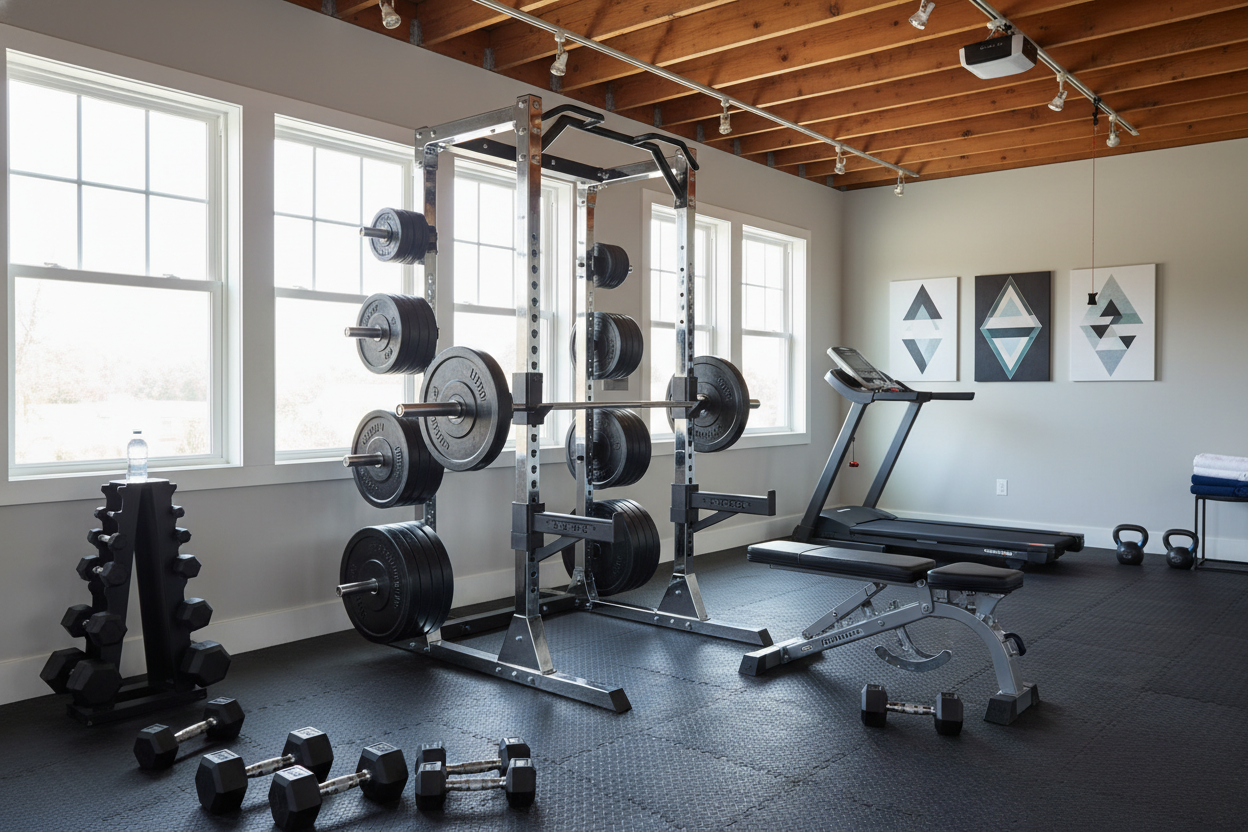
I have spent too many late nights scrolling through budget equipment listings, trying to convince myself that a $300 rig can perform like a $3,000 commercial unit. Last month, I finally bit the bullet on a highly-rated but suspiciously affordable olympic weight machine for my garage. The boxes arrived, the steel looked shiny enough, and for a second, I thought I’d beaten the system.
Then I actually started training on it. The first 135 pounds felt fine. The second plate felt okay. But once I crossed the threshold of real weight, the reality of budget manufacturing started to scream—literally. If you are tired of your local commercial gym raising prices and want to build a home sanctuary, you need to know where the steel meets the road before you waste your stimulus check on a glorified coat rack.
- Budget machines often use 14-gauge steel which flexes under loads exceeding 250 lbs.
- Plastic bushings create massive friction that ruins your mind-muscle connection.
- Independent arm mechanics are essential for preventing strength imbalances.
- A machine is only as stable as the bench you use with it.
The 400-Pound Stress Test
The unboxing experience was the peak of my excitement. Everything was wrapped in plastic, the powder coating looked decent, and the assembly took about two hours of wrench-turning. It looked the part. I started with a basic chest press, loading a single 45-pound plate on each side. It moved. It was quiet. I felt like a genius for saving a couple of grand.
By the time I reached 315 pounds, the vibe changed. The uprights, which I later measured to be thin 14-gauge steel, began to bow inward like a drawn archer's bow. Every time I pressed the weight up, I could hear the hardware groaning. It reminded me of when I was trying to calculate the Freemotion Smith machine bar weight just to be precise with my logbook. On a real machine, you worry about the math; on a cheap rig, you worry about the structural integrity of the frame snapping mid-set.
At 400 pounds, the machine wasn't just flexing; it was vibrating. The guide rods were no longer parallel because the base was twisting under the uneven distribution of the plates. It becomes impossible to focus on your pectorals when you are wondering if a weld is about to give way and drop two bills onto your ribcage. That is the moment I realized that 'rated for 500 lbs' usually means 'will not literally explode at 500 lbs,' not 'will provide a good workout at 500 lbs.'
Why Cheap Steel Hates Real Iron
Physics is a cruel mistress. When you load plates onto an olympic weight machine, you are creating a massive amount of leverage against the pivot points and the frame. Most budget manufacturers save money by using 2x2 inch tubing made of 14-gauge steel. In the world of serious lifting, that is basically tinfoil. You want 11-gauge steel, which is significantly thicker and heavier. It provides the mass needed to damp vibration and keep the frame rigid.
The moment arms on these machines are often poorly designed. If the pivot point is held together by a thin bolt and a couple of washers rather than a heavy-duty axle, the whole arm will wiggle side-to-side. This lateral play is more than just annoying; it changes the mechanics of the lift. Instead of a smooth arc, you end up fighting to keep the handles from drifting. If you are moving serious iron, the machine should feel like an extension of the floor, not a swaying bridge.
The Moving Parts That Will Betray You First
The difference between a 'meh' machine and a 'holy crap' machine is almost always in the bearings. High-end commercial units use linear ball bearings that slide over case-hardened steel rods. They are virtually frictionless. Budget machines, however, love to use plastic or nylon bushings. These are essentially just plastic sleeves that rub against the metal rods.
I have tested plenty of gear, and I always look to see if it stays smooth under heavy weight like the higher-end Smith machines we have put through the ringer. This budget rig failed that test miserably. As the weight increases, the pressure on those plastic bushings increases, creating 'stick-slip' friction. You push, nothing happens, then it suddenly jerks forward. It is the fastest way to tear a rotator cuff I can think of.
The Friction Trap of Plastic Bushings
Let's get technical for a second. Plastic bushings have a static friction coefficient that is much higher than their dynamic friction. This means it takes more force to get the weight moving than it does to keep it moving. When you are at the bottom of a press—your weakest point—you have to overcome that extra 'stickiness' just to start the rep. It makes the weight feel 20% heavier at the start and lighter at the top. It completely ruins the resistance profile of the exercise.
How to Buy a Plate-Loaded Machine Without Getting Burned
If you are ready to stop playing around with toy-grade equipment, you need a checklist. First, look for independent arms. A single bar connecting both sides is a sign of a cheap build. Something like the independent arms Z1 Pro is a much better choice because it forces each side of your body to carry its own weight. This prevents your dominant side from compensating and leads to much better hypertrophy over time.
Second, check the weight horns. They should be angled slightly upward so plates don't slide off during a vigorous set. Third, look at the footprint. A machine with a tiny base is a tipping hazard. You want a wide, heavy base with pre-drilled holes so you can bolt it to your platform or floor. If the manufacturer didn't even think to include bolt-down points, they didn't intend for you to use it for heavy lifting.
Your Base Needs to Match Your Load
It is a common mistake: people spend their entire budget on a fancy plate-loaded machine and then use a $50 adjustable bench they found at a big-box store. If you are doing a chest press or a shoulder press inside a rig, your back is pressed against that bench. If the bench flexes or the legs aren't stable, your power output drops instantly. You cannot fire a cannon from a canoe.
Invest in a heavy-duty weight bench that is rated for at least 800 pounds of combined weight (you plus the plates). Look for a wide back pad and a tripod or wide-base design that doesn't wobble. When I swapped my cheap bench for a real one, my stability on the olympic weight machine improved instantly. It turns out I wasn't weak; my equipment was just moving under me.
Final Verdict: Save Up or Stick to Barbells
At the end of the day, a bad machine is worse than no machine at all. If you can't afford a rig with 11-gauge steel and real bearings, you are better off sticking to a basic power rack and a barbell. The barbell doesn't have bushings to fail or thin frames to flex. But if you have the space and the budget, a high-quality plate-loaded machine is a luxury that can take your physique to the next level. Just don't expect a bargain-bin find to handle 400 pounds with grace.
FAQ
Does the bar weight matter on a plate-loaded machine?
Yes, but it is usually much lighter than a standard 45-lb barbell. Most machine 'bars' or arms weigh between 10 and 25 lbs. Always check the manufacturer specs so you can track your total volume accurately.
Can I lubricate plastic bushings to make them smoother?
You can use a dry silicone spray, but it is a temporary fix. Never use WD-40 or grease, as they attract dust and hair which will eventually turn into a thick paste that makes the friction even worse.
How do I know if my machine is 11-gauge or 14-gauge steel?
If the manufacturer doesn't proudly state '11-gauge steel' in the description, it is almost certainly 14-gauge or thinner. You can also tell by the weight of the shipping boxes; 11-gauge steel is significantly heavier.
Share:
Why the Best At Home Exercise Equipment for Women Isn't Pink
Why That $150 Adjustable Bench With Weights Is a Terrible Idea