
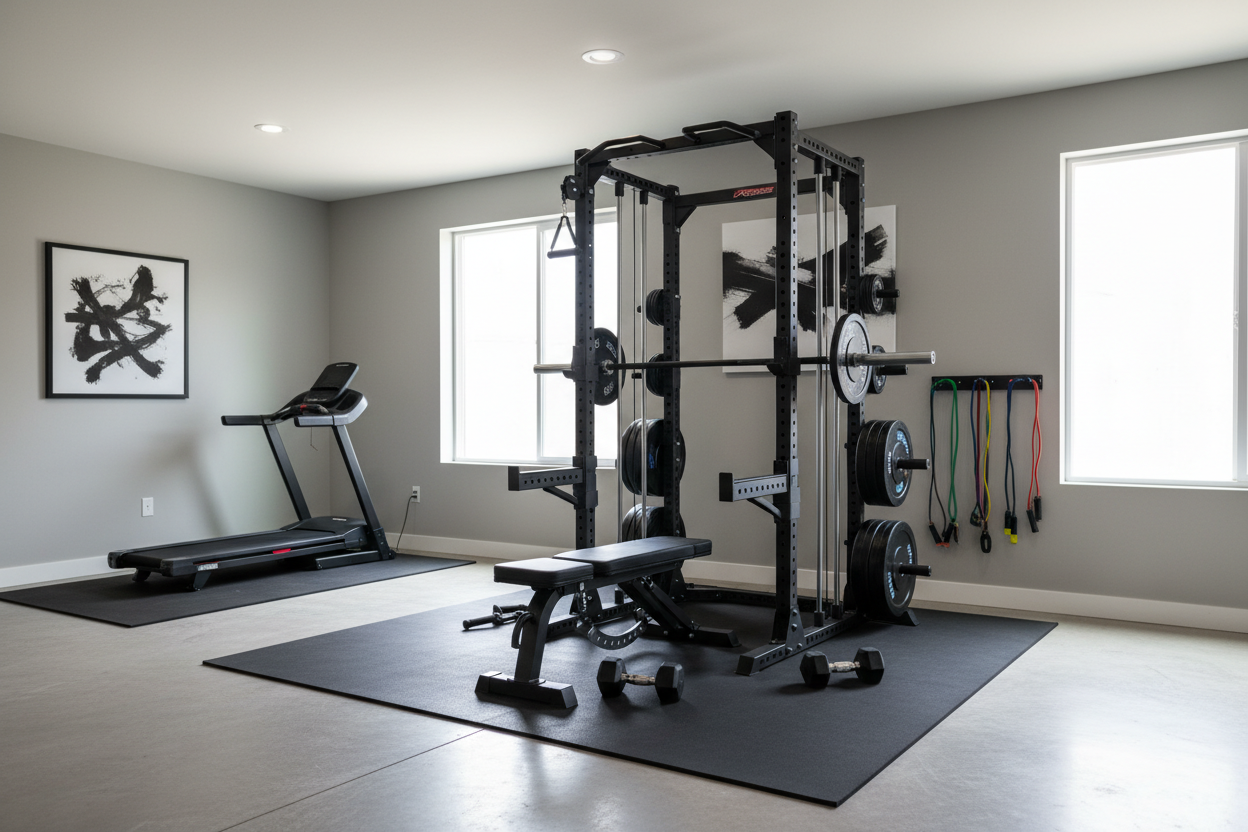
I remember the day I finally cut the cord with my local big-box gym. It felt like a breakup where I got to keep the house but lost all the cool furniture. I stood in my empty garage, looking at a single barbell and a pair of rusty plates, wondering how I’d ever get a decent pump without the common workout machines I’d relied on for a decade. The transition from a commercial floor to a 200-square-foot concrete slab is a mental hurdle as much as a physical one.
Quick Takeaways
- A power rack is a modular hub, not just a cage for squats.
- Cables and pulleys provide the mechanical tension you miss from fixed machines.
- Foot placement and bracing are the secrets to replicating leg presses.
- Avoid 'single-use' machines if you have less than a three-car garage.
The Commercial Gym Hangover (Why We Miss Fixed-Path Gear)
There is a specific comfort in sitting down at a machine, pinning a weight, and just pushing. You don't have to stabilize, you don't have to worry about a bar crushing your windpipe, and you can reach true muscular failure safely. When I first started my home gym, I went on a shopping spree for cheap, standalone isolation stations because I didn't think I could grow without them. I eventually had to admit I would regret buying most of my gym machines at home because they were flimsy, took up too much space, and did exactly one thing poorly.
We miss typical gym machines because they provide 'constrained movement.' Your brain doesn't have to balance the load, so it can focus entirely on the muscle fiber recruitment. But you don't need a 400-pound piece of welded steel to get that. You just need a way to stabilize your body against a fixed point. Most popular gym machines are essentially just pulleys or levers attached to a seat. Once you realize that, your power rack becomes a transformer.
Hacking the Leg Press and Hack Squat
The leg press is usually the hardest thing to let go. It’s the king of most popular gym equipment for quad hypertrophy. However, a dedicated leg press takes up about 35 square feet and costs a fortune to ship. If you want that exact feel, a smith machine home gym station is the ultimate workaround. By placing your feet forward on the floor and leaning back against the bar, you can mimic a hack squat perfectly. The fixed path of the Smith machine removes the stability requirement, letting you hammer your quads until they smoke.
If you don't have a Smith machine, you can use a 'landmine' setup. Shove one end of your barbell into a corner (or a dedicated landmine attachment) and hold the other end at your chest. This creates a natural arc that mimics a hack squat. Another trick? Use heavy resistance bands looped over the top of your rack and under your feet. This changes the resistance curve, making the weight heavier at the top where you're strongest—just like a high-end plate-loaded leg press. It’s about the tension, not the seat.
Recreating the Lat Pulldown and Seated Cable Row
The lat pulldown is easily one of the most used exercise equipment pieces in any commercial facility. You don't need a standalone tower for this. I added a high/low pulley attachment to my rack for about $200. The key to making it feel like the commercial version is bracing. In a gym, you have those foam pads that lock your thighs down. At home, I use my safety bar on the rack. I set it to hip height, slide my legs under it, and suddenly I have the leverage to pull 200+ pounds without my butt leaving the bench.
For seated rows, the setup is even simpler. Use a low pulley and brace your feet against the uprights of your rack or a heavy dumbbell. The most common gym machines for back work are just pulleys with different handles. If you own a close-grip triangle, a wide bar, and some D-handles, you can replicate almost every back machine ever made using just one cable station. It’s about the angle of pull, not the brand of the machine.
The Pec Deck Illusion: Better Alternatives for Chest Flys
I used to think the pec deck was irreplaceable. There’s something about that deep stretch and peak contraction that dumbbells can't quite hit because the tension drops off at the top. But I've learned to ignore most top rated home gym equipment that claims to be 'essential' for chest isolation. A dedicated fly machine is a massive waste of space for most people.
Instead, use adjustable pulleys. If you set your rack's pulleys to chest height, you get the same constant tension as a pec deck. If you don't have dual pulleys, use resistance bands. Anchoring a band to each side of your rack and performing 'banded flys' actually provides a better contraction at the top than most typical gym machines because the resistance increases as the band stretches. It’s cheaper, takes up zero floor space, and honestly feels more natural on the shoulders.
What About Cardio? (Skipping the Massive Elliptical)
When people build a home gym, they often try to buy the most used gym equipment from the cardio floor—usually a massive commercial treadmill or a clunky elliptical. Unless you are a high-level marathoner, these are mistake number one. They are loud, they break often, and they become expensive clothes hangers within six months. You don't need a 300-pound motor taking up half your room.
I switched to a foldable upright exercise bike with magnetic resistance and never looked back. It gives me the same heart rate elevation as an elliptical but tucks into a corner when I'm done. Most common gym equipment for cardio is built for 18 hours of daily use; in a home setting, that’s overkill. You want something low-maintenance and quiet enough that you can actually hear your music or the TV without cranking the volume to 100.
Bottom Line: Stop Trying to Build LA Fitness in Your Garage
The biggest mistake I made early on was trying to recreate a commercial floor plan. I wanted the rows of most common gym machines because that’s what I was used to. But the reality is that common workout machines are designed for the masses—they have to be simple enough for a total novice to use without a coach. In your own space, you can be more efficient. Focus on building a functional home gym that prioritizes versatility over single-use stations.
A solid rack, a good barbell, and a cable system can do 95% of what a $50,000 commercial gym can do. You’ll save money, you’ll have more room to breathe, and you’ll actually learn the mechanics of the movements instead of just being a passenger in a machine. Stop buying gear for the person you were at the big-box gym and start buying gear for the athlete you’re becoming in your garage.
FAQ
Can I build muscle without machines?
Absolutely. Muscle doesn't have eyes; it only knows tension and load. Whether that tension comes from a $5,000 Hammer Strength machine or a barbell with some bands, the hypertrophy response is the same if you train close to failure.
What is the most essential piece of equipment to replace machines?
An adjustable cable pulley system. It’s the only thing that truly replicates the constant tension of commercial machines. If you have a rack, look for a bolt-on plate-loaded pulley kit.
Is a Smith machine worth the space?
If you are a bodybuilder who trains alone, yes. It’s the safest way to replicate the 'fixed-path' feel of common gym machines like the hack squat or overhead press without needing a spotter.
Share:
How to Spot Fake Weight Limits on Home Leg Press Machines
Why Buying a Barbell Set With Weights Usually Ends in Regret