
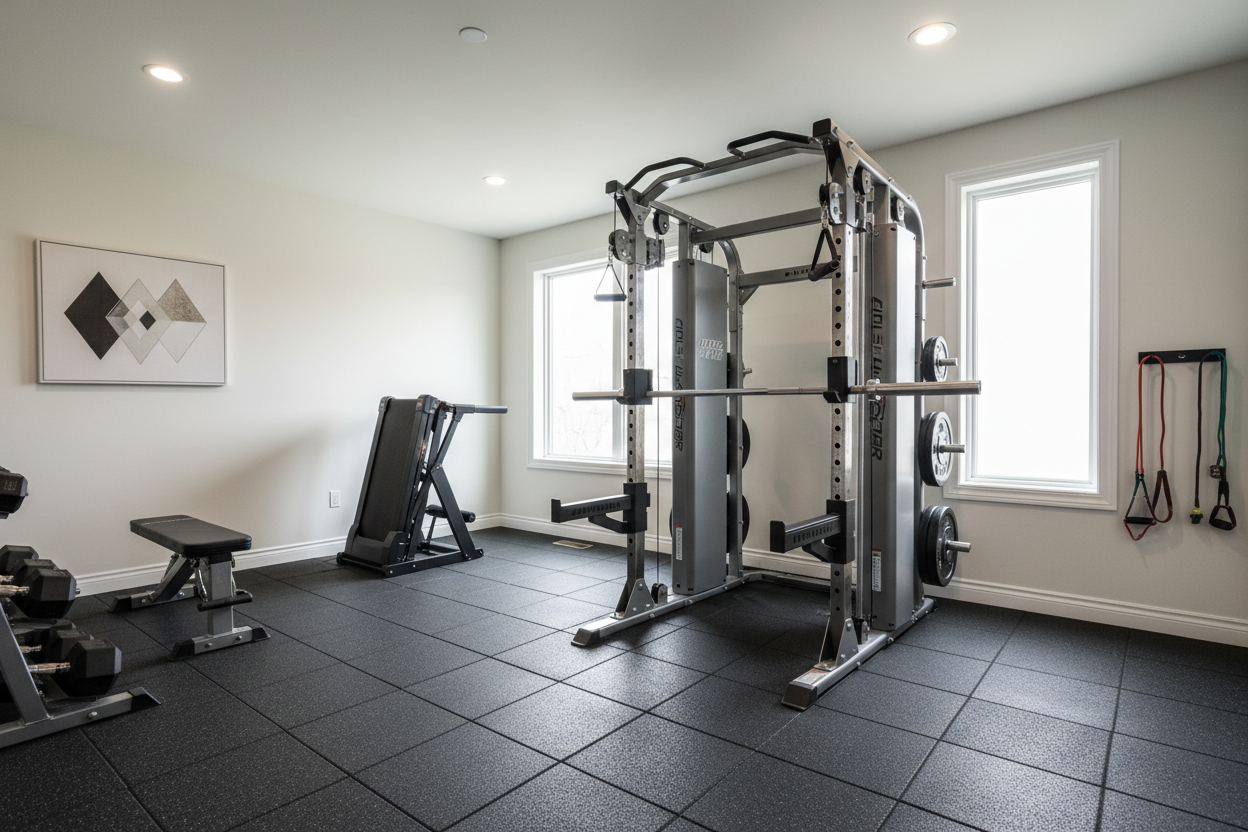
I remember the exact moment I hit my breaking point. I was trying to squeeze past a standalone lat pulldown machine just to reach my squat rack, and I tripped over a stray 45-pound plate. My garage gym looked like a scrap yard for iron. I had the gear, but I had zero space to actually move. That’s when I realized that hunting for the best overall workout machine wasn't just about convenience—it was about reclaiming my sanity and my floor space.
Quick Takeaways
- Space efficiency is the biggest win; one footprint replaces five machines.
- Look for a 1:1 cable ratio if you want the weight to feel 'real' and heavy.
- Smith machine hybrids offer the best safety for solo lifters pushing to failure.
- Quality costs more upfront but saves thousands in the long run versus buying individual pieces.
The Trap of Building a Gym One Piece at a Time
Most of us start with a basic squat stand. Then we realize we need cables for triceps and face pulls, so we buy a wall-mounted unit. Then we want a dedicated lat pulldown because the wall unit feels flimsy. Before you know it, your 'gym' is a cluttered mess of mismatched steel, and your car is permanently relegated to the driveway. This 'Franken-gym' approach is a budget killer.
The problem is that standalone pieces are rarely efficient. Every new station adds four more uprights and another footprint that eats into your walking path. I spent two years adding 'one more thing' until I couldn't even perform a walking lunges. I had to admit that my modular dream was actually a logistical nightmare.
What Actually Qualifies as the Best All Around Fitness Machine?
If you're looking for the best all around fitness machine, you have to be ruthless about specs. Most 'all-in-one' units you see on late-night TV are garbage. They use thin 14-gauge steel that wobbles when you're doing pull-ups and plastic pulleys that get 'stiff' after six months. You need a machine that handles a 300-lb load without sounding like a screeching owl.
A critical question many lifters face is does the best all in-one workout machine actually exist? For it to count, it needs three things: a 1:1 cable ratio so the weight stack doesn't feel like half-weight, a smooth-gliding Smith bar, and high-quality bearings. If the cables are jerky, your mind-muscle connection is dead on arrival. You want that commercial-gym 'butter' feel at home.
Why I Eventually Caved and Bought a Smith Machine Combo
I used to be a barbell purist who looked down on anything with a fixed path. I was wrong. When you're training alone in a garage at 6:00 AM, a Smith machine is a literal lifesaver. It allows you to push your squats and presses to absolute failure without the fear of getting pinned under a heavy bar. It’s also the ultimate space-saving hack because it integrates those safety rails directly into the frame.
I eventually landed on the All In One Smith Machine With Cable Crossover S1 V4. The reason this specific type of best all round exercise machine works is that it doesn't just give you a Smith bar. It gives you dual cable stacks and a functional trainer setup in the same footprint. I went from having four different stations to just one. My floor space tripled, and my workout quality didn't drop a single percentage point.
You Still Need Free Weights (But Less Than You Think)
Don't get me wrong; I still love my barbell work. The beauty of a high-end multi-station is that the front uprights usually have J-cups. You can still do your heavy Olympic lifting or standard bench press off the front of the rack. The machine just handles everything else—the accessories, the isolations, and the heavy-volume finishers that usually require five different machines at a big-box gym.
I found that I only needed one high-quality barbell and a set of plates. The machine's built-in cable stacks handled 80% of my accessory work. I stopped hunting for individual cable attachments and started focusing on the actual lifting. It simplified my programming and my life.
The Best All Round Exercise Machine Will Hurt Your Wallet (Once)
Let’s talk money. A commercial-grade multi-station isn't cheap. You might see a price tag of $2,000 or $4,000 and flinch. But do the math: a good power rack is $800, a functional trainer is $1,500, a lat pulldown is $1,000, and a Smith machine is another $1,200. You're already over $4,500, and you’ve used up 100 square feet of space.
Buying a single premium unit is the 'buy once, cry once' philosophy in action. You have to remember that the best all in one exercise machine isn't an infomercial toy. It’s a heavy-duty investment. When I finally sold off my individual pieces, I actually broke even and ended up with a much higher-quality setup that fits in a 6x8 foot corner of my garage.
Personal Experience: The 'Binding' Issue
My biggest mistake was originally buying a cheap, plate-loaded all-in-one from a big-box store. The Smith bar would 'bind' or catch if I didn't push up perfectly evenly with both hands. It was frustrating and dangerous. When I upgraded to a unit with linear bearings and a solid guide rod system, the difference was night and day. Don't skimp on the moving parts; that's where the cheap machines fail first.
FAQ
Is a 1:1 or 2:1 cable ratio better?
A 1:1 ratio means 100 lbs on the stack feels like 100 lbs in your hand. A 2:1 ratio feels like 50 lbs. For heavy lat pulldowns and rows, 1:1 is superior. For functional movements and rehab, 2:1 is often preferred for finer weight increments.
Can I do heavy squats on an all-in-one machine?
Yes, provided it has external J-cups on the front uprights. You can squat freely outside the rack or use the internal Smith bar for high-volume, quad-focused variations.
How much ceiling height do I need?
Most commercial-grade all-in-one machines stand between 82 and 84 inches tall. Always measure your ceiling, especially if you have a low basement or a garage with hanging door openers.
Share:
What Is Best Exercise Equipment If You Can Only Pick One Thing?
The Truth About Rack Attachments for Smith Machine Lifts