
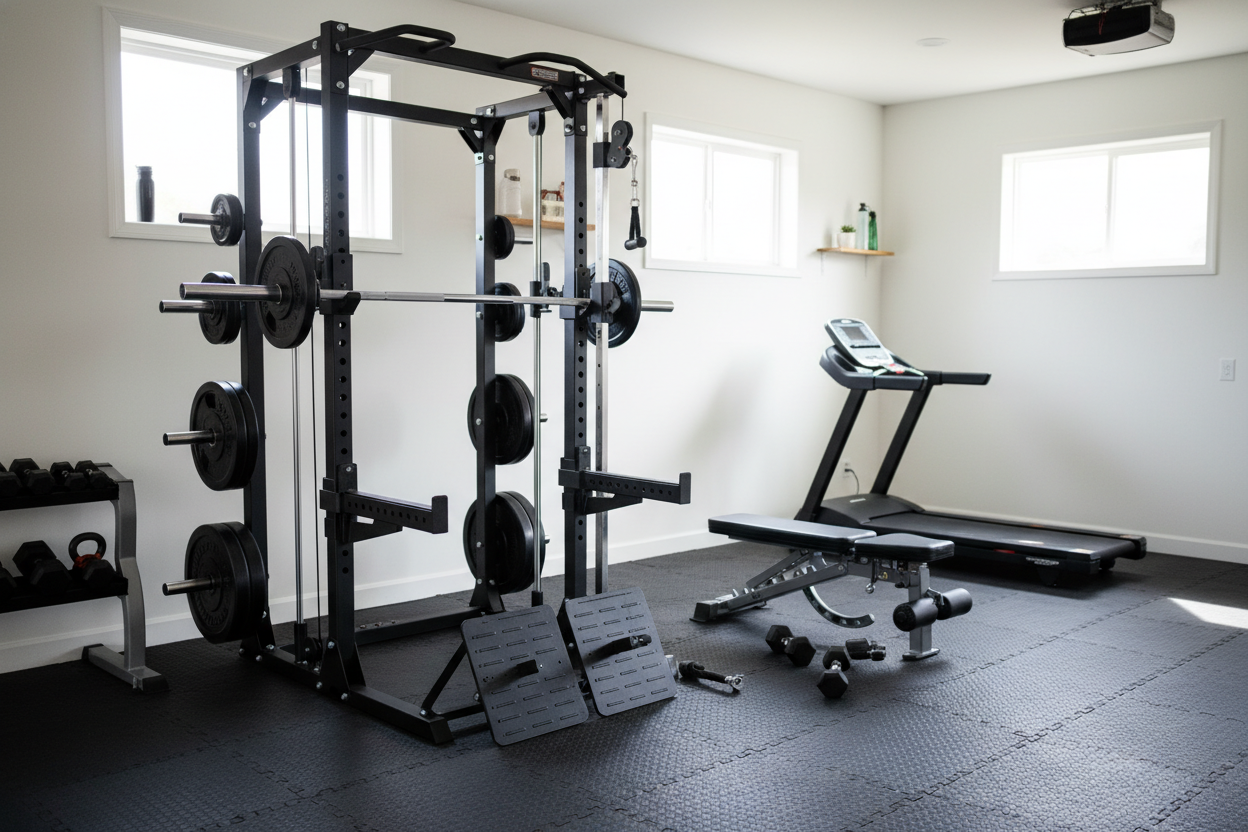
You are staring at your garage gym, and the math just is not adding up. You want the deep quad burn of a Smith machine hack squat and the safety of a fixed path for heavy shoulder presses, but your floor space is already maxed out. You have got a power rack, a pile of plates, and maybe enough room left to breathe if you suck in your gut. This is usually when the late-night scrolling starts, leading you to the idea of attachments for smith machine lifts.
The Home Gym Dilemma: Floor Space vs. Muscle Isolation
The struggle is real. Most of us started with a basic rack because it is the versatile king of the gym. But eventually, you miss the isolation. You want to push to absolute failure without worrying about a 300-pound barbell crushing your windpipe. A standalone Smith machine usually demands a 50-square-foot footprint once you account for plate loading. In a standard two-car garage, that is prime real estate you probably do not have.
Enter the smith machine attachment for power rack setups. The promise is simple: bolt a pair of guide rods and a specialized carriage to your existing uprights, and suddenly your rack is a dual-purpose beast. It sounds like the holy grail of space-saving engineering. You get the fixed-path benefits for your accessory work without selling your firstborn to afford a commercial-grade dedicated unit.
I have been down this road. I have tried to DIY solutions with pipe and grease, and I have bolted heavy-duty kits onto 11-gauge steel. The question is always the same: does a smith machine rack attachment actually feel like the real thing, or is it a clunky compromise that will collect dust? If you are running a serious program like 5/3/1 or Hypertrophy Specific Training, every piece of gear needs to earn its keep. You do not want a wobbly add-on ruining your mind-muscle connection during a heavy set of Bulgarian split squats.
Quick Takeaways
- Space Saver: Uses your existing rack footprint, saving roughly 25-30 square feet.
- Stability is Key: Only works well if your rack is bolted to the floor or has an extended base.
- Bearing Quality: Look for linear bearings over plastic bushings if you want a smooth travel.
- Compatibility: Brand loyalty matters here; 3x3 racks with 1-inch holes are the standard for high-end kits.
What Exactly Is a Rack Attached Smith Machine?
A rack attached smith machine is not just a bar between two poles. It is a modular system designed to integrate with your existing uprights. Usually, this involves two vertical guide rods that sit just inside or outside your rack frame. A specialized barbell with integrated hooks and bearings slides up and down these rods. When you are done, you flick your wrists, and the hooks catch on a series of lockout points—just like the big machines at the commercial gym.
Most of the high-end options you see today are built as a smith machine attachment for 3x3 rack systems. If you own a rack from Rogue, REP, or Sorinex, you are looking at heavy-duty 11-gauge steel with 5/8-inch or 1-inch holes. The smith machine add on bolts directly into those holes. Some versions use a 'swing-away' design, allowing you to move the guide rods out of the way when you want to do traditional free-weight barbell work. This is a massive win for versatility.
The magic is in the bearings. Cheap units use plastic bushings that feel like sliding a rusty pipe through sand. The good ones use high-quality linear bearings that glide. When you are comparing these to standalone Smith machine setups, the main difference is the frame. A standalone unit is built specifically for that one movement, whereas an attachment relies on the rigidity of your power rack. If your rack is not rock solid, the Smith attachment will feel 'crunchy' under load because the guide rods will not stay perfectly parallel.
The Good: Why a Bolt-On Setup Makes Perfect Sense
The most obvious win for a power rack smith machine attachment is the cost. A commercial-grade Smith machine can easily run you $2,000 to $4,000. A high-quality smith machine attachment for rack systems usually clocks in at a fraction of that, even for the premium models. You are essentially paying for the moving parts and the bar, not a whole new steel frame. That leaves more money in your budget for things that actually matter, like more calibrated plates or a better bench.
Then there is the versatility. A squat rack smith machine attachment allows you to transition from heavy free-weight squats to Smith machine calf raises or shrugs in about sixty seconds. For those of us who train in small spaces, the ability to flip the script without moving to a different station is huge. I have found that having the Smith option right there makes me more likely to actually do my accessory work. No more skipping the high-rep lunges because I do not feel like setting up another station.
Safety is the silent partner here. If you train alone in your garage at 5:00 AM, the smith machine power rack attachment is your best friend. The built-in safety stoppers mean you can take a set of bench presses to absolute failure. If you stall, a quick turn of the wrist saves your chest. It provides a level of confidence that is hard to replicate with just spotter arms, especially when your ego starts telling you to add another 20 pounds to the bar.
The Bad: Where Drop-In Attachments Fall Apart
Now for the reality check. Not every smith machine attachment for squat rack use is a winner. The biggest headache is brand compatibility. You might think a 3x3 rack is a 3x3 rack, but hole spacing and hardware sizes vary wildly. Trying to fit a rogue smith machine attachment onto a rack from a different manufacturer can be a nightmare of misaligned holes and shimmed bolts. I have spent hours with a drill and a file trying to make 'universal' parts fit, and it is never worth the frustration. If you have a REP rack, get the rep fitness smith machine attachment. Do not try to mix and match unless you are a wizard with a welder.
Another issue is rack wobble. A rack attached smith machine puts unique lateral forces on your uprights. If your rack is not bolted to the floor, you are going to feel the whole thing shift when you re-rack a heavy load. That movement causes the guide rods to flex slightly, which leads to 'binding.' Binding is that jerky, stuttering feeling you get when the bar does not want to slide. It ruins the lift and can be dangerous if it happens mid-rep. I have seen guys complain about 'bad bearings' when the real problem was just a rack that was not anchored properly.
Lastly, consider the bar path. Most attachments are vertical. While some standalone machines have a slight 7-degree angle to mimic a natural bar path, most rack add-ons are straight up and down. This is fine for many movements, but it can feel awkward for benching if you are used to a natural arc. In my experience testing different Smith machine rigs, the smoothness of the travel is the number one dealbreaker. If there is even a hint of friction, you will end up hating the piece of equipment within a month. Do not cheap out on the bearing quality.
Standalone All-in-Ones vs. Rack Attachments: The Final Verdict
So, should you pull the trigger on a smith machine power rack attachment? If you already own a high-quality 3x3 rack and you are tight on space, the answer is usually yes—provided you buy the attachment designed specifically for your brand. It is a brilliant way to expand your training options without the footprint of a whole new machine. It turns your rack into a functional trainer hybrid that can handle everything from rehab work to heavy bodybuilding sets.
However, if you are starting from scratch and you know you want a Smith machine, cables, and a rack, you might be better off looking at dedicated multi-training stations. These 'all-in-one' units are engineered from the ground up to ensure the Smith bar is perfectly integrated with the cable system and the safeties. They often feel more 'dialed in' than a rack that has had five different attachments bolted onto it over three years.
The bottom line: buy the attachment if you have a rock-solid rack and want to save space. Upgrade to a dedicated unit if you want the smoothest possible experience and have the room to spare. I personally use a rack-attached version because I refuse to give up my deadlift platform space, and after bolting my rack to the concrete, the performance is about 95% of what I would get from a standalone unit. Just remember: measure your hole spacing twice, bolt your rack down, and do not be afraid to spend the extra cash for real linear bearings.
FAQ
Will a Smith machine attachment fit my 2x3 rack?
Most premium attachments are built for 3x3 uprights. While some 2x3 options exist, they are less common and often less stable. Always check the specific pin size (5/8 or 1 inch) before buying, as a 1-inch pin will not fit through a 5/8-inch hole without a lot of regret and a drill bit.
How hard is it to install a rack-attached Smith machine?
If you can build a LEGO set, you can do this. It usually takes about an hour. The hardest part is ensuring the guide rods are perfectly vertical and parallel. If they are off by even a fraction of an inch, the bar will bind. A level and a tape measure are your best friends here.
Can I still use my J-cups with the Smith attachment on?
It depends on the design. Many 'swing-away' or side-mounted attachments stay completely out of the way. However, some internal-mount versions might limit where you can place your J-cups. Always check the 'working area' specs to ensure you aren't sacrificing your primary barbell lifts for the sake of an add-on.
Share:
I Sold My Squat Stand to Find the Best Overall Workout Machine
Are Adjustable Dumbbells Steel Sets Worth the Clunky Plates?