
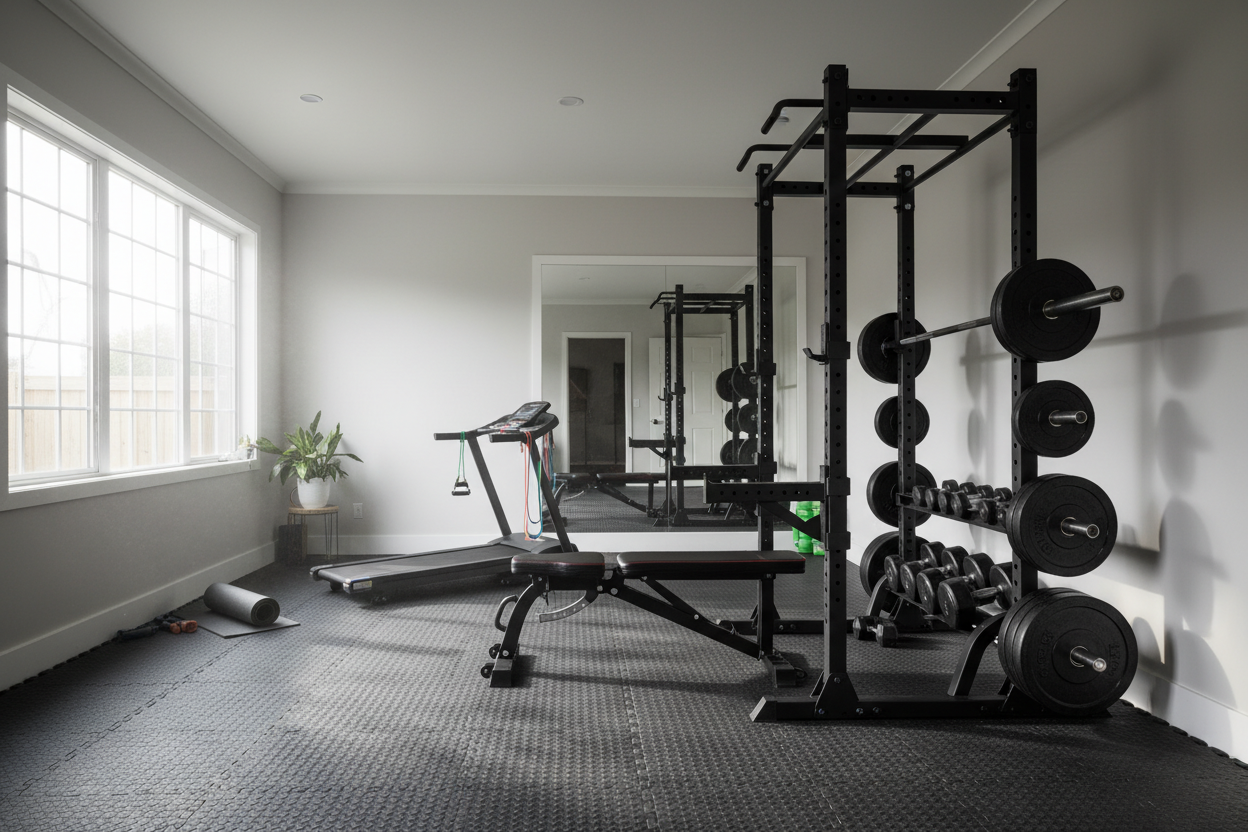
I remember staring at a 3,000-dollar shopping cart for a power rack and a set of urethane-coated plates and thinking, 'This is a mortgage payment.' I closed the tab. I decided right then to spend the next twelve months training exclusively with cheap at home workout equipment to see if I’d actually lose my gains or if the fitness industry is just one giant marketing grift.
I’ve spent years in commercial gyms and high-end garage setups. I know what a 1,000-dollar barbell feels like. But for a full year, I traded the premium knurling for budget-friendly steel and mystery-brand resistance bands. The results weren't what I expected, and my bank account definitely thanked me.
Quick Takeaways
- Cast iron is cast iron; as long as the weight is accurate within 2-3 percent, the brand name on the plate doesn't build more muscle.
- Avoid any 'all-in-one' machine that uses plastic pulleys or thin nylon cables; they will snap during a heavy set of face pulls.
- Resistance bands are the most underrated tool for high-volume accessory work when you can't afford a full dumbbell rack.
- Stability is the one thing you can't compromise on—lightweight racks are a recipe for a trip to the ER.
The 5,000 Dollar Garage Gym Myth
Social media has done a number on our collective sanity. You scroll through Instagram and see these pristine, climate-controlled garages filled with custom-color powder-coated racks and laser-cut logos. It makes you feel like you can't even start a basic strength program without a commercial-grade facility at your disposal.
The truth is, your muscles don't have eyes. They don't know if the 45-pound plate you're deadlifting has a fancy logo or if it’s a rusted piece of scrap you found on Marketplace. The cheapest home workout equipment often provides the exact same mechanical tension as the stuff that costs five times as much. I spent 12 months hitting PRs on a rack that wobbled slightly if I racked the bar too fast, and guess what? The muscle grew exactly the same.
Defining 'Cheap' vs. 'Dangerous Metal Traps'
There is a massive difference between the best budget exercise machines and what I call 'danger gear.' When you are looking for the best budget exercise equipment, you have to look at the gauge of the steel and the weight capacity. If a squat rack weighs less than you do, do not put 300 pounds on it and stand underneath.
You can save money on aesthetics, but you shouldn't save money on structural integrity. This is why the best machines are incredibly heavy; they need that mass to keep from tipping when you're at the limit. I’ve seen cheap functional trainers that feel like they’re made of soda cans. If the best budget exercise machine you’re looking at has a 200-pound weight limit and you weigh 190, keep looking. Your safety is worth more than the fifty bucks you're trying to save.
The Core Free Weights That Survived Daily Abuse
The backbone of my year-long experiment was a set of standard cast iron plates and a basic 7-foot Olympic bar. When you are building a functional home gym, these are the pieces that should eat most of your budget. I found that best cheap at home workout equipment usually consists of 'dumb' objects—things that don't have moving parts.
I used a set of unbranded resistance bands for all my lateral raises and tricep extensions. They cost twenty dollars and haven't snapped yet. I also picked up a pair of adjustable dumbbells that go up to 52.5 pounds. While the clicking mechanism feels a bit 'plastic-y' compared to a set of solid steel dumbbells, they saved me about 800 dollars in rack space. The knurling on my budget barbell was aggressive enough to tear skin, which is exactly what you want for heavy pulls, even if the chrome finish started to flake after six months.
Getting Your Heart Rate Up Without Spending a Grand
You do not need a 2,000-dollar treadmill with a built-in tablet and a monthly subscription fee to get a sweat going. In fact, most of those high-end screens are obsolete in three years anyway. I handled my cardio by sticking to the basics: a jump rope and a simple foldable upright exercise bike.
The bike isn't going to win any design awards, but the magnetic resistance is smooth enough for steady-state sessions while I watch a movie. It’s the best home workout equipment budget move you can make because it folds up and hides in a closet when you aren't using it. If you have a driveway, a 15-dollar speed rope will give you a more intense workout than any 'smart' machine ever could. Don't pay for the screen; pay for the sweat.
The Final Verdict on My 12-Month Experiment
After a year of using the best affordable at home workout equipment, I can confidently say I’m not going back to the big box gyms. Did things break? Yeah, a cheap bench started to squeak like a haunted house, and I had to tighten the bolts on my rack every few weeks. But the best and cheapest exercise equipment I bought—the iron plates and the pull-up bar—will likely outlive me.
The biggest lesson I learned is that the drive to train matters infinitely more than the brand name on your gear. If you have 500 dollars, buy a used barbell, some iron, and a basic bench. That’s all you need to get stronger than 90 percent of the population. Stop waiting for the 'perfect' setup and just start lifting on whatever you can afford.
FAQ
Is cheap workout equipment safe?
It depends on the load. For high-impact or high-weight items like squat racks, check the steel gauge (11 or 14 gauge is standard). For 'dumb' items like plates and bands, cheap is usually perfectly safe.
What is the first thing I should buy on a budget?
A solid adjustable bench and a pair of dumbbells. You can hit every muscle group in your body with just those two items in a 6x6 foot space.
Does budget equipment have a lower resale value?
Actually, the opposite is often true. High-end gear loses 40 percent of its value the second it leaves the showroom. Used iron plates almost always sell for 50 cents to a dollar per pound, regardless of how old they are.
Share:
I Tested the Cheap Weight Machines Amazon Pushes to the Top
Why That Cheap Workout Exercise Machine Feels Like Garbage