
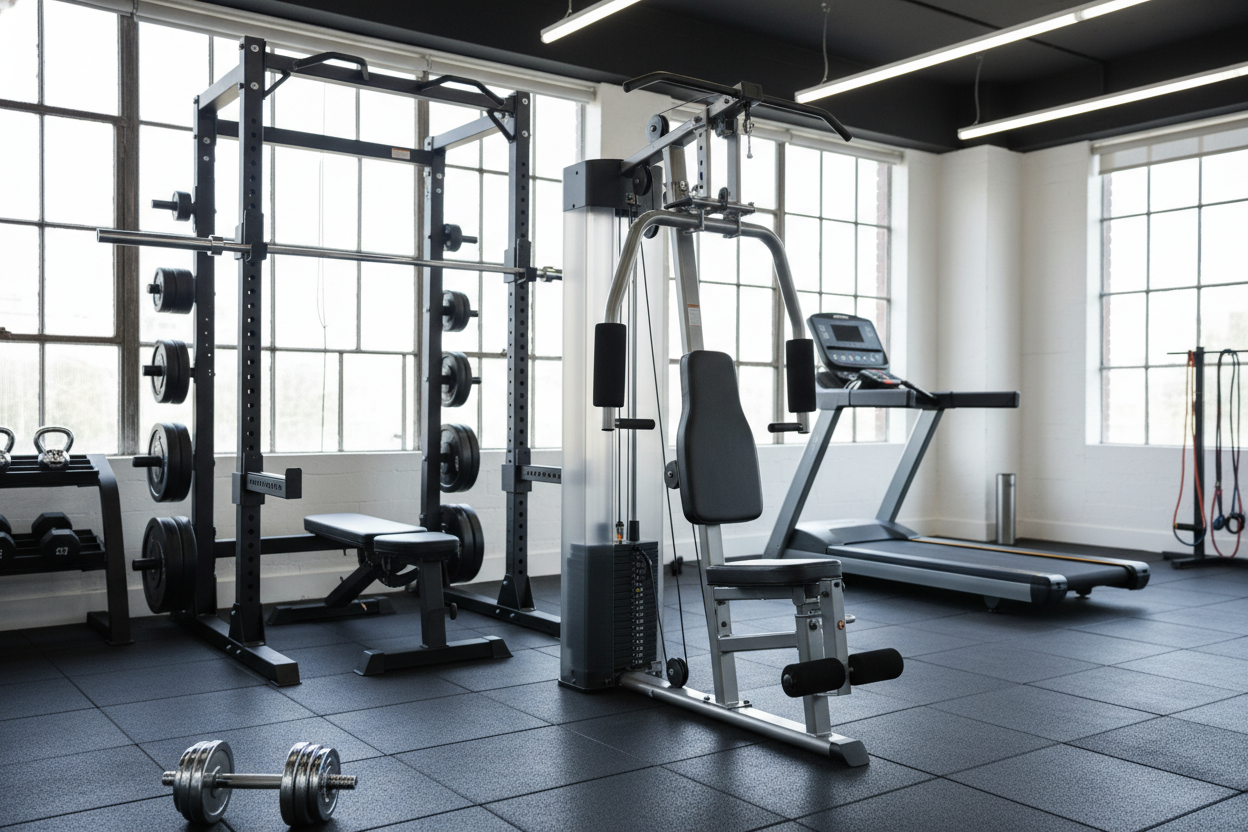
I remember the first time I bought a budget workout exercise machine from a big-box store. It looked great in the photos, but the moment I loaded two 45-pound plates on it, the whole thing groaned like a rusty gate. It didn't just feel cheap; it felt like it was actively trying to ruin my rotator cuffs. If you have ever finished a set and felt more pain in your joints than your muscles, you know exactly what I am talking about.
- Fixed-axis machines force your joints into unnatural paths that cause impingement.
- Independent arms allow for natural convergence, which mimics free-weight mechanics.
- Commercial-grade bearings are the difference between a smooth rep and a jerky mess.
- Cheap machines often have 'dead spots' where tension completely disappears.
The Difference Between Commercial Engineering and Cheap Steel
Commercial gear is designed to survive thousands of reps a day without flinching. A high-end exercise machine for gym use utilizes precision-sealed bearings and counterbalances that make the weight feel 'live' from the first inch of the movement. Most exercising machines for home rely on friction-heavy nylon bushings or, heaven forbid, just a bolt acting as an axle.
When you use a machine with poor tolerances, you are fighting the equipment as much as the weight. That jerky, stuttering feeling during the eccentric phase isn't just annoying; it ruins your mind-muscle connection. If the resistance curve isn't smooth, your nervous system can't efficiently recruit the target muscle fibers.
The Fixed-Axis Trap: Why Your Shoulders Are Screaming
The biggest issue with a basic home gym exercise machine is the fixed axis. Human joints do not move in perfectly straight lines or simple circles. When you perform a chest press, your hands naturally want to move inward as you extend. If a machine forces you to stay on a rigid, wide path, that force has to go somewhere—usually straight into your shoulder capsule.
I have seen lifters develop chronic 'bench press shoulder' simply because they were too stubborn to ditch a $200 press that forced them into a bad position. These budget rigs are often built for a 'standard' body type that doesn't actually exist, leaving anyone taller than 6 feet or shorter than 5 feet 6 inches in a biomechanical nightmare.
Why Independent Arms Change Everything
This is where iso-lateral movement becomes a necessity rather than a luxury. Using a chest press machine independent arms allows each side of your body to move through its own natural arc. This mimics the freedom of dumbbells but gives you the stability of a machine so you can push to absolute failure safely.
When the arms can converge or move independently, you eliminate the 'strong side dominance' that happens with welded bars. You can't let your dominant side take over the lift, and your joints are free to find the path of least resistance while your muscles take the brunt of the load.
How to Vet a Home Exercise Station Before Buying
Before you drop cash on a home exercise station, look at the pivot points. Are they using bolts as axles? That is a massive red flag. You want to see actual ball bearings. Also, check the leverage curve. If the weight feels like 100 lbs at the bottom and 20 lbs at the top, the cam design is garbage. I have written before about the red flags to look for when you are hunting for deals on exercise weight machines for home.
Don't ignore the footprint either. A machine that wobbles when you are at 80% intensity is a hazard. Look for 11-gauge steel frames and a base that is wide enough to prevent tipping. If the machine weighs less than the amount of weight you plan to put on it, you are asking for trouble.
When Fixed Paths Actually Make Sense
I am not saying every fixed path is a disaster. There is a time and place for a guided vertical plane, specifically for heavy hypertrophy work. A Smith machine home gym station is a perfect example. Because the bar moves on a fixed track, you can position your feet further forward to target the quads or use it for heavy shrugs without worrying about balance.
The key is that a Smith machine is a deliberate tool for a specific goal, not a limitation of a poorly designed chest press. It allows you to move massive weight without the stability requirements of a barbell, which is great for finishing off a muscle group at the end of a workout.
Making the Call for Your Own Garage
Choosing gear isn't about finding the most expensive piece of steel on the market. It is about finding the single best exercise machine for home that fits your specific body and training style. If you are tired of feeling beat up by your equipment, it might be time to consider upgrading your home gym with gear that actually respects human biomechanics.
I once bought a '5-in-1' station that promised to do everything. The leg extension hit my shins at the wrong angle and the pec deck felt like it was trying to dislocate my arms. I kept it for six months, barely used it, and eventually sold it for a fraction of the price just to get my floor space back. Specialized, well-built gear beats a 'do-it-all' pile of junk every single time.
FAQ
Is a cable machine better than a plate-loaded machine?
Cables offer constant tension throughout the entire range of motion and more versatility. Plate-loaded machines usually allow for heavier absolute loading and have a more 'raw' feel that many powerlifters prefer.
How much space do I really need for a home station?
Most multi-stations require at least an 8x8 foot area. You need to account for the 'working area' around the machine so you can load plates and move freely without hitting walls.
Can I build muscle on cheap machines?
Yes, but the injury risk and the 'clunky' feel often lead to people skipping workouts. It is much easier to stay consistent when the equipment feels smooth and doesn't cause joint pain.
Share:
I Survived a Year Using Cheap At Home Workout Equipment
How to Squeeze a Complete Weight Set Into a 1-Car Garage