
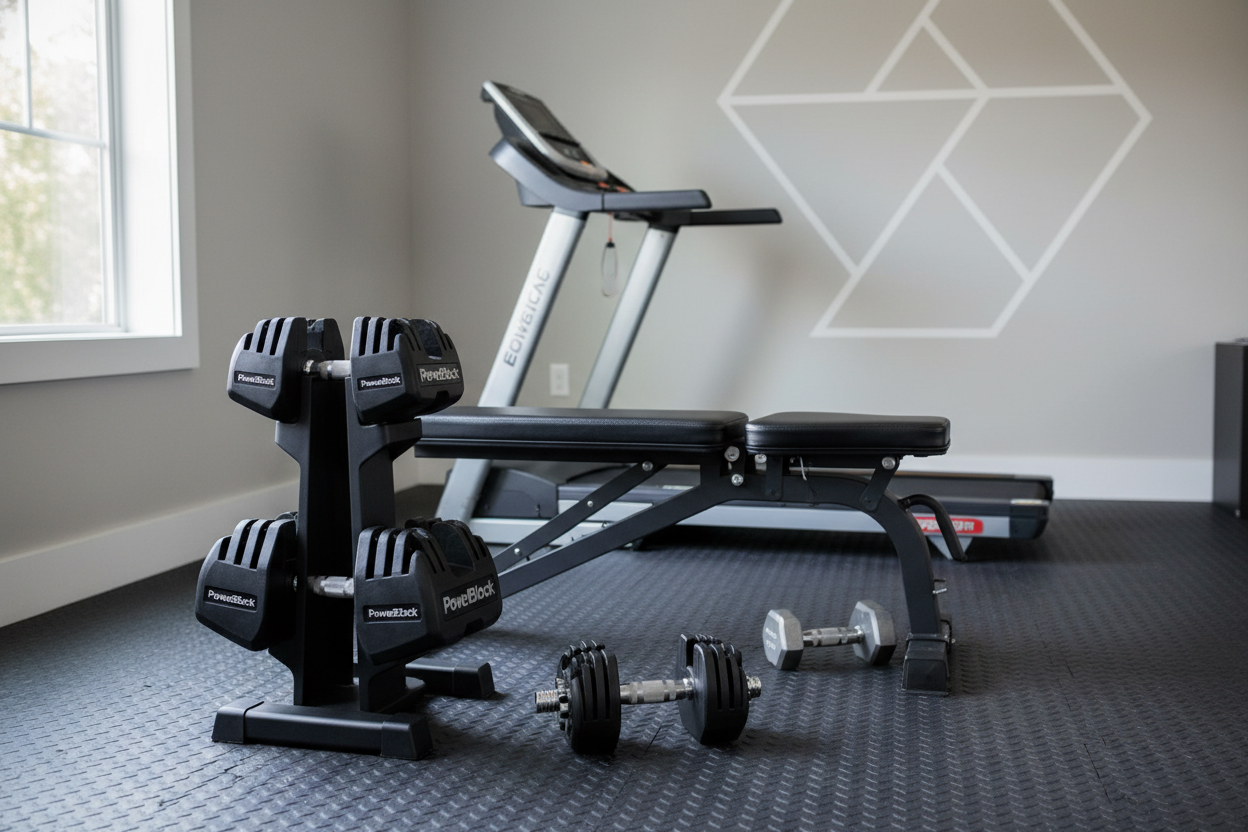
I remember the first time I realized my garage was more of a cluttered storage unit than a temple of iron. I was tripping over mismatched hex weights and realized I needed to consolidate or quit. That is when I finally pulled the trigger on the powerblock personal trainer adjustable dumbbell set. It felt like a massive investment at the time, but I was tired of the clutter and the constant hunt for a matching pair of 25s.
Quick Takeaways
- The magnetic selector pin is faster than any dial system I have tested.
- The squared-off shape prevents weights from rolling away on uneven garage floors.
- The 50lb cap is perfect for accessory work but might feel light for heavy benching.
- The 'cage' design offers surprising wrist protection once you get used to it.
Why I Decided to Test This Specific Block Model
There is a reason the powerblock personal trainer set 5 to 50 pounds per dumbbell has been a staple in home gyms for decades. While newer companies are trying to reinvent the wheel with fancy motorized selectors or sleek chrome finishes, this model sticks to a design that just works. I wanted to see if a product designed in the 90s could still compete with the high-tech options flooding my social media feed. It is easy to get distracted by shiny new gear, but for most of us, reliability beats aesthetics every single day.
This set is often the entry point for serious lifters. It is priced lower than the expandable 'Elite' or 'Commercial' lines, making it the go-to recommendation for people who want quality without spending a mortgage payment. I have used these for everything from high-volume shoulder presses to heavy Bulgarian split squats. The weight increments are logical, and the balance feels centered, which is more than I can say for some of the cheaper knock-offs I have tried that felt like holding a vibrating brick.
Budget lifters often ask me if they should save up for the 90lb sets or start here. My philosophy? If you are doing mostly hypertrophy work or you are tight on space, 50lbs covers about 80% of your needs. I put these through a six-month gauntlet to see if the plastic components would crack or if the selector pin would lose its 'stick.' Spoiler: they are tougher than they look.
The 'Cage' Design: Love It or Hate It?
The first thing everyone notices about powerblock personal trainer weights is the cage. Unlike traditional dumbbells, your hand is essentially encased in a series of padded support bars. If you have massive forearms or you like to wear thick wrist wraps, this might feel a bit tight at first. I found that it actually helped my form on overhead presses because the bars act as a physical cue to keep my wrists stacked and neutral. You cannot really 'cheat' and let the weight flop back.
However, I will be honest: doing certain movements like goblet squats or two-handed overhead extensions feels weird. You have to grip the outer bars rather than the handle itself, which changes the leverage. It is not a dealbreaker, but it is a quirk you have to accept. Compared to a standard round or hex weight, the weight distribution is extremely condensed. This makes the dumbbells feel smaller and more manageable during tight movements like lateral raises.
The handle itself is rubberized and comfortable. I have spent hours sweating on these, and I never felt like my grip was slipping. Some people complain that the bars hit their inner wrists during curls, but I found that adjusting my grip by just a half-inch solved that issue. If you are coming from a lifetime of using iron hex weights, expect a one-week learning curve before the 'cage' feels like home. Once you cross that bridge, you might actually prefer the protected feeling it gives your hands during heavy sets.
How Fast Do They Actually Change Weight?
Speed is where this set absolutely crushes the competition. If you are running a program with drop sets or short rest periods, you do not want to be fumbling with threaded collars or spinning a dial that gets stuck. The magnetic selector pin on the powerblock personal trainer is brilliantly simple. You pull the pin out, slide it into the color-coded slot for your desired weight, and lift. It takes about three seconds. I have timed myself against the Adjustable Dumbbells Ab01, and while dial systems are also fast, there is something more tactile and foolproof about the PowerBlock pin.
The pin is made of a flexible, high-strength composite. I was worried it would snap, but it is designed to bend rather than break. The magnets are strong enough that the pin stays seated even if you are moving the weights aggressively. I have done explosive snatches and cleans with these, and the pin did not budge. The color-coded chart on the handle is easy to read, even when you are mid-workout and your brain is foggy from a lack of oxygen.
One minor annoyance: the 'adder weights.' Inside the handle are two 2.5lb chrome cylinders. To get to specific weights (like 27.5 or 32.5 lbs), you have to open a manual lock on the handle, slide the cylinders in or out, and lock it back up. It adds about 15 seconds to the process. If you are a stickler for exact 2.5lb jumps, it is a bit of a chore. Most days, I just leave them in and stick to the 5lb jumps provided by the main plates.
Durability After Heavy Drops
Let's talk about the 'no-drop' rule. Every adjustable dumbbell manufacturer tells you not to drop their product. If you are the type of lifter who loves to toss weights from shoulder height after a PR, you should probably stick to a Rubber Hex Dumbbell Set Ds01. Adjustable sets have moving parts, and moving parts can break. That said, I have accidentally 're-racked' these pretty hard and dropped them from about six inches onto rubber stall mats more times than I can count. They are still perfectly functional.
The plates are made of steel with a powder coat finish. They clank a bit, which I actually enjoy—it makes the garage feel like a real gym. The side rails are the most vulnerable part, as they are made of a heavy-duty plastic. In my testing, they have held up to scratches and minor impacts without any structural failure. I have seen sets that are ten years old with chipped paint and rusted pins that still work exactly like they did on day one. That is the kind of longevity you want when you are building a home gym.
The main thing to watch out for is the selector pin alignment. If you drop the weights and bend the side rails, the pin might become difficult to slide in. I have found that as long as you are using rubber flooring and not being intentionally reckless, these will last a lifetime. They feel significantly more 'solid' than the dial-based adjustables that have a lot of internal plastic gears. There is less to go wrong here, which is why they have such a high resale value on the used market.
Are They the Right Choice for Your Garage?
The big question is whether 50 pounds is enough. For many lifters, it is. If your training consists of high-rep accessory work, lateral raises, curls, and tricep extensions, these will be your best friend. But let's be real: if you are a seasoned lifter, you are going to outgrow a 50lb dumbbell for chest presses and rows very quickly. I eventually found myself reaching for heavier options for my main lifts. I actually wrote about this transition in my post about how I Upgraded to a 5 75 Dumbbell Set (Here Is What Surprised Me).
If you are just starting out or you have limited space, this set is a slam dunk. It replaces 16 pairs of dumbbells in the space of two. That is a massive win for a garage gym where every square foot is precious. You are getting a piece of equipment that is made in the USA, has a proven track record, and holds its value. If you eventually decide you need more weight, you can sell these for 80% of what you paid and put that toward a heavier set.
Bottom line: the PowerBlock Personal Trainer set is the 'work truck' of the fitness world. It is not the prettiest, and it has some quirks, but it starts every morning and gets the job done without complaining. It is a reliable, fast, and compact solution for anyone who wants to stop buying individual weights and start actually training.
Personal Experience: My 'Oops' Moment
I once tried to change the weight in a dark garage during a power outage (don't ask). I didn't realize the pin wasn't fully seated across both rails. When I lifted the weight, half the plates stayed on the stand and the other half tilted dangerously. It was entirely my fault for rushing, but it taught me to always listen for that 'click' and do a quick visual check. These things are safe, but they still require you to pay attention. Also, keep the adder weights in a specific spot—I lost one of mine in a move and spent three weeks using a rolled-up sock to balance the handle until the replacement arrived.
FAQ
Can I drop PowerBlocks?
No. While they are built like tanks, the selector pins and side rails can bend or break upon impact with hard surfaces. Always use rubber matting and lower them with control.
How loud are they during use?
There is some 'plate chatter' because the weights are stacked loosely. It is not loud enough to wake up the neighbors, but they aren't silent like urethane-coated dumbbells.
Are these better than dial dumbbells?
It depends on what you value. PowerBlocks are generally more durable and faster to change, but dial dumbbells often have a more traditional 'round' feel that some lifters prefer.
Share:
Is the Weider 2980 X Home Gym System Actually Any Good?
I Wasted $1K on Garage Exercise Equipment (Buy This Instead)