
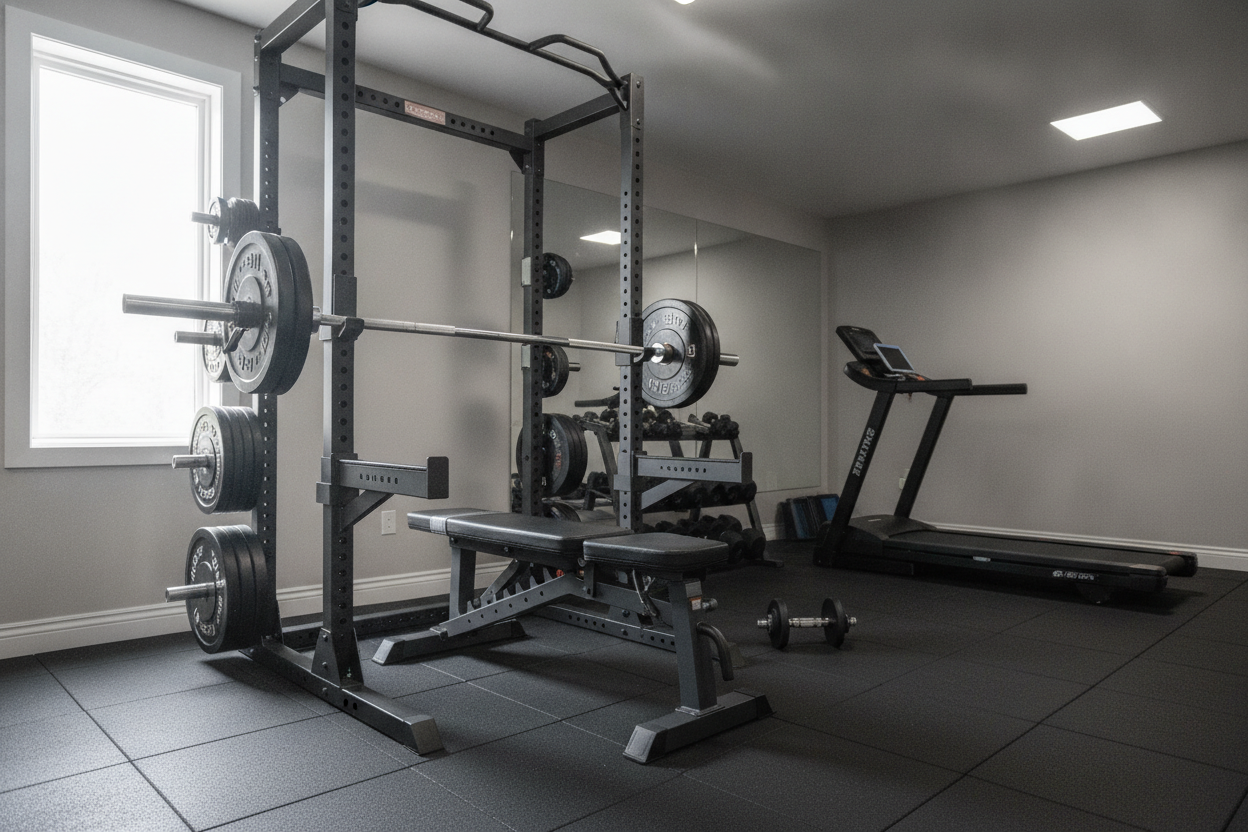
I was chasing a PR on a Tuesday night in my garage. 300 pounds was loaded on a budget rack I bought because the price looked right and the shipping was free. As I pushed through the sticking point and went to re-rack, I realized my mistake. The uprights were so narrow my hands were practically touching the metal. One side caught, the other didn't. That moment of pure, unadulterated panic—the bar tilting toward my face while the frame groaned—is why I finally bought a heavy duty olympic weight bench.
Quick Takeaways
- Standard-width racks are a safety hazard for anyone with broad shoulders or heavy lifting goals.
- True 11-gauge steel is the baseline for equipment that won't flex under a 3-plate bench.
- A 48-inch outside-to-outside width is mandatory for proper hand placement.
- Industrial-grade J-cups and safety spotters are insurance policies for your ribcage.
The Day My Standard-Width Rack Betrayed Me
We've all been there. You're looking at your bank account and thinking, 'Does a piece of steel really need to cost five hundred bucks?' I thought I could outsmart the market with a narrow, standard-width bench. It looked fine in the photos. But photos don't show you the lateral sway when you sit down with two plates on each side.
The scare happened on my third set. My grip was wide—where it should be for a powerful chest drive—but that meant my hands were outside the uprights. When I went to re-rack, I had to 'aim' the bar into the cradles. Under fatigue, my aim was off. The bar hit the top of the upright, the whole unit shifted three inches, and I nearly dumped 300 pounds of iron onto my neck. I spent the next ten minutes sitting on my garage floor, heart hammering, realizing I had been risking my life to save a couple hundred dollars. A heavy-duty olympic weight bench isn't a luxury; it's the difference between a successful session and a trip to the ER.
Standard vs. Olympic Width: The Measurement That Matters
If you take nothing else away from this, remember the number 48. A true Olympic-sized rack has uprights spaced about 48 inches apart. This allows you to use a full-sized 7-foot Olympic barbell and, more importantly, gives you the 'runway' to rack the bar without clipping your fingers or the uprights themselves.
Cheap, 'standard' benches are usually 36 inches wide. This forces you to grip the bar inside the uprights. If you have any kind of shoulder width, this grip is a nightmare. It puts your elbows in a compromised position and destroys your power output. Worse, it makes the whole setup top-heavy. When you're using a true heavy duty weight bench, you can maintain a natural, wide grip that protects your rotator cuffs and allows for maximum pec recruitment. I noticed an immediate 10% jump in my bench just by moving to a wider rack because I wasn't terrified of the equipment failing me mid-rep.
The Anatomy of a Frame That Won't Fold
Let's talk about steel gauge because most manufacturers hide this in the fine print. Lower numbers are thicker. Most 'big box' store benches use 14-gauge steel. It feels like a soda can once you put real weight on it. I look for 11-gauge steel. It’s the industry standard for commercial gyms and serious home setups. It doesn't flex, it doesn't vibrate, and it certainly doesn't buckle.
Weight capacities are the other big lie. A bench rated for 600 pounds might hold that weight statically, but what happens when you drop a 300-pound bar three inches onto the J-cups? That’s dynamic load, and it’s a lot higher than the static weight. I’ve seen cheap frames literally twist under a heavy eccentric move. It’s the same reason I warned people when I snapped a cheap frame on a different setup; thin steel is a liability. You want reinforced J-cups with UHMW plastic liners to protect your bar's knurling and a base that spans at least 4 feet to prevent tipping. If the welds look like someone smeared toothpaste on the joints, send it back.
Should You Buy an Attached Rack or Separate Pieces?
This is the classic home gym debate. A fixed Olympic bench—where the bench is bolted to the uprights—is incredibly stable. It’s not going anywhere. However, it’s a one-trick pony. You can't move the bench out to do squats or overhead presses in that space. If you have a dedicated 'bench day' station, fixed is the way to go for that rock-solid commercial feel.
If you're tight on space, you might prefer a heavy-duty power rack paired with a versatile adjustable weight bench. This gives you the freedom to roll the bench out for dumbbell work or move it into the rack for heavy triples. The downside? You have to spend time lining the bench up perfectly every time. For me, the stability of a fixed unit won out. I wanted that 'locked-in' feeling where the bench and the rack are one single, unmoving unit of iron. It changed my confidence under the bar completely.
When Is It Time to Finally Trash Your Starter Setup?
If you’re asking the question, you probably already know the answer. Check your current setup for 'the wiggle.' Sit on the bench and shift your weight side to side. If the uprights move more than half an inch, you’re in trouble. Look at the J-cups—are they starting to bend downward? Are there visible stress marks in the paint around the bolt holes? These are the early warning signs of metal fatigue.
Don't wait for a near-miss like mine to upgrade. If you've progressed past the 225-lb milestone, you've outgrown the entry-level gear. Browsing a heavy-duty weight bench collection will show you what real equipment looks like: massive footprints, thick powder coating, and high-density foam that doesn't bottom out. Your safety is worth the investment. It’s a lot cheaper than a hospital bill and a lot more conducive to hitting that next PR.
FAQ
Is an Olympic bench too wide for a small garage?
It usually takes up a 4x5 foot footprint. While larger than a 'standard' bench, the safety trade-off is worth the extra foot of floor space. Just measure your 7-foot bar clearance first.
Can I use a 6-foot bar on an Olympic bench?
No. Most 6-foot bars have a shorter sleeve-to-sleeve distance. You need a full 7-foot Olympic bar so the collars sit outside the wide uprights.
Why does the pad thickness matter?
Cheap pads use soft foam that compresses to the wood under weight. A heavy-duty pad uses high-density foam that supports your shoulder blades, giving you a solid platform to drive from.
Share:
I Traded 6 Bulky Racks for an All In One Home Gym System
Does the Form Fit Workout Bench Survive Heavy Dumbbells?