
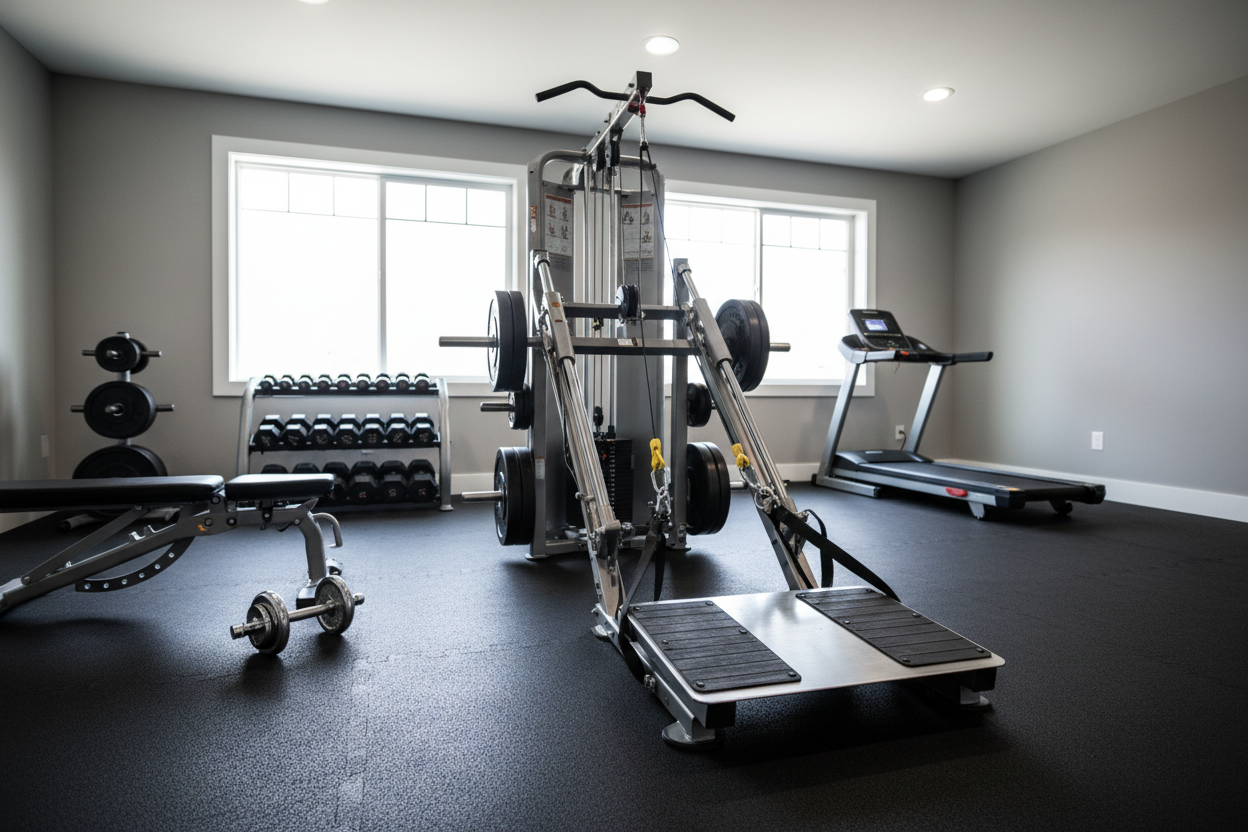
I remember the day I realized my dream of owning a full-sized 45-degree leg press was dead. I measured my garage for the third time, hoping the concrete had somehow expanded. It hadn't. A standard sled takes up about 40 square feet once you account for the footprint and the room needed to load plates. For most of us, that's half the gym.
Instead of giving up on heavy quad work, I started experimenting with a cable leg press. It is not just a compromise for the space-starved; it is a legitimate way to build wheels without sacrificing your entire floor to a single-purpose behemoth. If you have a pulley system, you have a leg press.
- Space Efficiency: Uses your existing cable footprint instead of an 8-foot sled.
- Constant Tension: Cables do not let the muscle relax at the top of the rep.
- Safety: Easier to bail on a cable stack than a 600-pound carriage over your chest.
- Unilateral Focus: Perfect for fixing strength imbalances in your quads.
The Garage Gym Dilemma: Massive Sleds vs. Your Floor Space
The traditional leg press is a floor-space hog. Even the 'compact' ones usually require a massive runway for the weight carriage to move. In a tight garage, that means you're choosing between a leg press and a squat rack. Most of us choose the rack, leaving our accessory work feeling a bit thin.
This is why the leg press cable machine hack has become a staple for home lifters. You are leveraging the vertical stack you already own to perform a horizontal movement. It solves the footprint problem while providing a different stimulus than a barbell. You get the volume without the spinal loading.
How to Actually Set Up a Leg Press on Cable Machine Pulleys
To get a proper leg press on cable machine setups, you need stability. Start by placing a flat bench perpendicular to your cable tower. If your tower is light, bolt it down or weight the base; you do not want the machine tipping toward you when you drive through your heels.
Lower the pulley to the bottom setting. If you are doing unilateral work, a Wall Mounted Cable Station With 140Lbs Weight Stack Wm2 V4 is a beast because it stays flush against the wall, giving you a rock-solid anchor point. Lie on the bench, place your foot against a footplate attachment or a heavy-duty D-handle, and drive. Ensure your hips stay glued to the bench to avoid 'butt wink' at the bottom of the range.
Does a Leg Press With Cable Machine Tension Feel Different?
Gravity is a funny thing. On a 45-degree sled, the weight gets 'easier' as you lock out because of the angle. When you perform a leg press with cable machine resistance, the tension is constant. The pulley is pulling back with the same force whether your knees are at your chest or fully extended.
This constant tension makes the top half of the movement feel significantly harder than a traditional sled. It is a different profile entirely. If you are curious about how these mechanics change when using hybrid gear, check out Does A Smith Machine With Pulley Actually Replace A Cable Tower for a breakdown of pulley ratios and resistance curves. You will likely find that 100 pounds on a cable stack feels heavier than 100 pounds on a sled.
The Attachments You Need for a Cable Machine Leg Press
You cannot just grab a standard handle and hope for the best. To move real weight on a cable machine leg press, you need a broad surface area for your foot. A dedicated footplate attachment is the gold standard, but a heavy-duty nylon strap or a wide D-handle can work if you are wearing stiff-soled shoes.
I have seen people try to use thin stirrup handles, and it is a recipe for a bruised arch. Stop calling it Stop Calling It That Cable Thing Real Exercise Equipment And Names and get the right gear. Look for wide-platform attachments or ankle straps that allow you to loop the cable directly over the midfoot for a more secure press.
When You Should Stop Rigging and Buy a Combo Unit
There comes a point where your strength outgrows a single pulley. If you are maxing out a 200-pound stack and the bench is sliding across the floor, it is time to stop rigging and start upgrading. You can only sandbag a DIY setup for so long before it becomes a safety hazard or a bottleneck to your gains.
If you are serious about heavy leg days but still have no room for a sled, an All In One Smith Machine With Cable Crossover S1 V4 is the move. It gives you a built-in leg press plate that works with the Smith bar, plus the cable towers for accessory work. It is the ultimate way to get a leg press machine cable experience without needing a 2,000-square-foot commercial facility.
Personal Experience: My Biggest Cable Fail
A few years back, I tried to rig a footplate using a piece of 2x4 and some paracord attached to my low pulley. I thought I was a genius. Three reps in, the wood snapped, and the cable snapped back, nearly taking out my shins and the drywall behind me. The lesson? If you are going to press heavy, use steel. Don't trust your ACLs to a DIY project you found on a forum at 2:00 AM. Buy the actual attachments.
FAQ
Is a cable leg press as good as a real leg press?
It provides more constant tension but usually offers less total weight capacity. It is excellent for hypertrophy and high-rep finishers, but a dedicated sled is better for absolute max strength.
Will a cable leg press tip my machine over?
If your machine isn't bolted down or weighted with sandbags, yes. Always test the stability with light weight before you try to move the whole stack.
Can I do this with a resistance band?
You can, but the resistance profile is the opposite of what you want—it gets harder at the top and provides almost no tension at the bottom. Stick to cables for a more consistent lift.
Share:
What Nobody Tells You About the Best Home Gyms Under $500
How to Buy a Craigslist Smith Machine Without Getting Ripped Off