
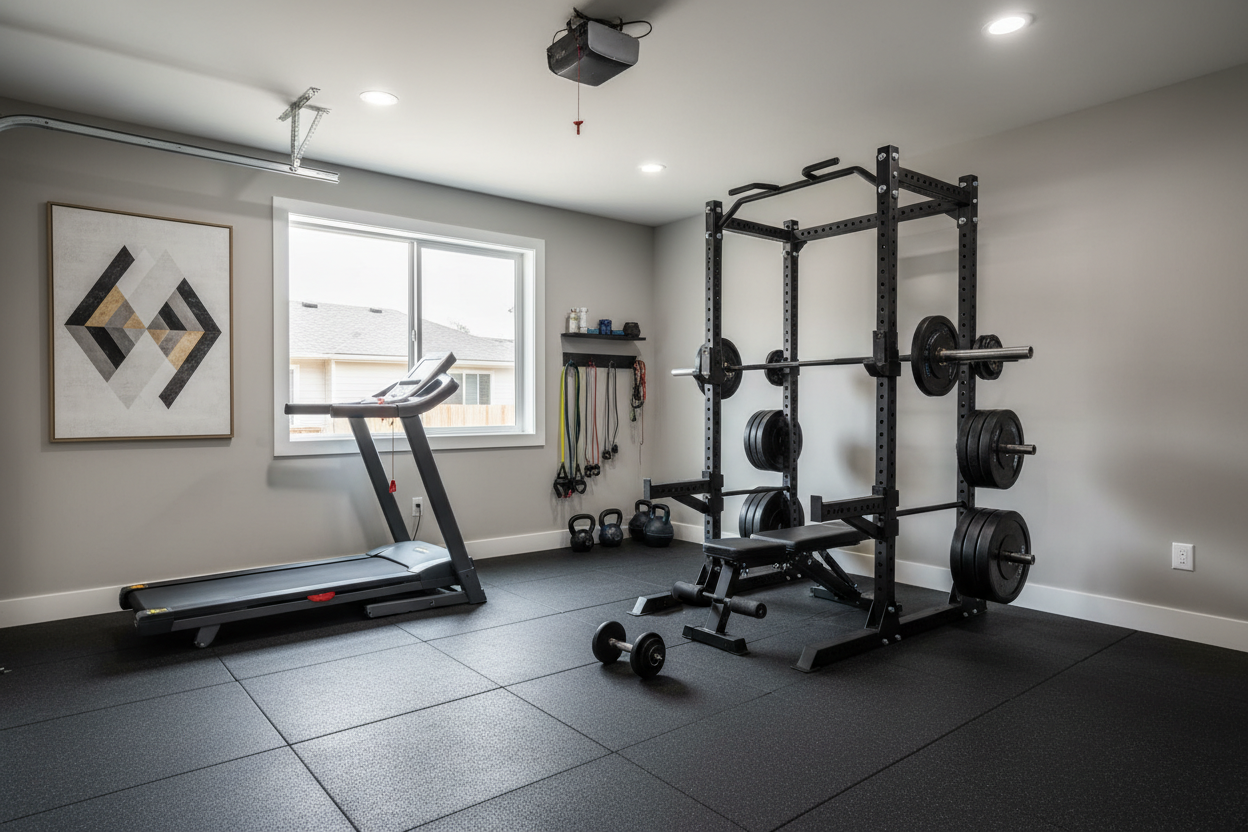
I remember the first time I tried to park my truck in the garage after buying a dedicated leg press machine. I couldn't. I had essentially traded my vehicle's shelter for a 200-pound hunk of steel that I only used for four sets once a week. It was a rookie move. Finding the best gym equipment for home isn't about recreating a commercial gym; it's about curating a space where every square inch earns its keep.
If you're scrolling through equipment listings at midnight, it's easy to get distracted by shiny, single-purpose machines. But unless you're living in a 5,000-square-foot mansion, you need to think like a minimalist and train like a beast. The goal is to build a setup that evolves with your strength without forcing you to move house.
Quick Takeaways
- Prioritize a power rack or half rack as your primary footprint.
- Ditch the flat bench for a high-capacity adjustable version.
- Look for 'hybrid' machines that combine cables with free weights.
- If a piece of gear only does one exercise, it's a luxury you probably can't afford.
The Square Footage Trap: Why Your Garage Feels Like a Closet
Most people ruin their home gyms by thinking they need a machine for every muscle group. They buy a dedicated bicep curl station, a leg extension, and a pec deck. Before they know it, they're performing a tactical shimmy just to reach their dumbbells. This is the square footage trap.
The most effective home gym equipment is the stuff that stays out of the way until you need it. You want gear that has a small footprint but high utility. Think about the 'utility-to-space' ratio. A set of adjustable dumbbells takes up two square feet but replaces an entire wall of fixed weights. That is how you win the space war.
When you stop buying machines that only do one thing, you suddenly have room to actually move. You can jump rope, do burpees, or actually finish a deadlift without hitting the water heater. Respect the floor space, and it will respect your gains.
The True Foundation: Finding the Most Versatile Exercise Equipment
If you have the room for one large item, make it a power rack. It is the undisputed anchor of any serious lifter's garage. A solid rack allows you to squat, bench, press, and pull-up in a contained 4x4 or 4x6 area. It’s the ultimate versatile gym equipment because it’s a safety net and a storage unit all in one.
I’ve tested the fancy digital mirrors and the wall-mounted AI trainers, but I always go back to heavy iron over smart fitness screens. Why? Because iron doesn't need a software update to let you squat 405. It doesn't have a monthly subscription fee. It just works, forever.
When choosing a rack, look for 3x3 inch 11-gauge steel. It’s the gold standard. You want something that won't wobble when you rack a heavy bar. The best weightlifting equipment should feel like it's bolted to the Earth's core, even if it's just bolted to your concrete floor.
Why Your Bench is Your Most Important Multi-Tasker
A lot of guys try to save $100 by buying a cheap flat bench. Don't be that guy. A flat bench is a one-trick pony. It’s fine for powerlifting, but it’s the most versatile workout equipment killer in a small gym.
Instead, invest in a heavy-duty adjustable weight bench. By adding incline and decline settings, you’ve just tripled the number of exercises you can do. You can hit upper chest, do seated shoulder presses, or even use it for chest-supported rows to save your lower back.
Look for a bench with a ladder-style adjustment—it's faster to change between sets. You also want a narrow back pad (around 11-12 inches) so your shoulder blades can move naturally during presses. If it has wheels and a handle, even better. Being able to tuck it into the corner of the rack when you're done is a massive space-saver.
Can One Machine Actually Do Everything?
The 'all-in-one' machines used to be junk. They were flimsy, the cables were sticky, and the pulleys felt like they were filled with sand. But things have changed. A compact smith machine home gym station can now replace a rack, a functional trainer, and a pull-up bar in a single footprint.
These rigs are often the most versatile home gym equipment for people who want the safety of a Smith bar but the freedom of cable crossovers. You can go from a heavy Smith squat to a high-to-low cable fly in about ten seconds. For hypertrophy-focused training, that kind of efficiency is hard to beat.
Just make sure the pulley ratio makes sense for you. A 2:1 ratio is great for functional movements and rehab, while a 1:1 ratio is better if you're trying to move heavy weight on lat pulldowns. Don't settle for plastic pulleys; demand aluminum or high-grade nylon with sealed bearings if you want that commercial-gym smoothness.
My Golden Rule for Adding New Gear
Before I click 'buy' on anything new, I apply my three-exercise rule. If a piece of versatile exercise equipment doesn't allow me to perform at least three distinct, high-value movements, it doesn't get a spot on my floor. A landmine attachment? Yes—rows, presses, rotations. A dedicated calf raise machine? No—I can do those on a plate.
When you are building a complete home gym, you are the curator. Every item is an investment in your performance. If you fill your space with junk, your workouts will feel cluttered and uninspired. Keep it lean, keep it heavy, and keep it versatile.
Personal Experience: The GHD Blunder
I once spent $600 on a massive Glute Ham Developer (GHD). I loved the burn it gave my hamstrings, but the thing was the size of a small cow. It sat in the middle of my gym, and I tripped over the footplate every single morning. Eventually, I realized I was sacrificing 15 square feet for one exercise. I sold it at a loss and bought a Nordic curl strap that fits in my gym bag. I actually train my hamstrings more now because I'm not annoyed by the equipment's footprint. Learn from my mistake: floor space is your most valuable asset.
Frequently Asked Questions
What is the most versatile workout equipment for a tiny apartment?
A pair of adjustable dumbbells and an adjustable bench. You can perform hundreds of movements in the space of a yoga mat. If you have a door frame that can support it, add a pull-up bar and you're set.
Is it better to buy a full rack or a half rack?
If you have the depth, a full power rack is safer for solo lifting. If you're tight on space, a half rack or a folding wall-mount rack provides 90% of the utility while leaving the center of your room open for other movements.
Do I really need a Smith machine?
Need? No. But if you train alone and want to push to failure on squats or presses without a spotter, a Smith machine or a rack with high-quality spotter arms is a literal lifesaver. Modern hybrid stations give you the best of both worlds.
Share:
How to Pick an At Home Workout Machine You Won't Hate in 6 Months
The Best Equipment for Home Gym Gains Doesn't Plug Into a Wall