
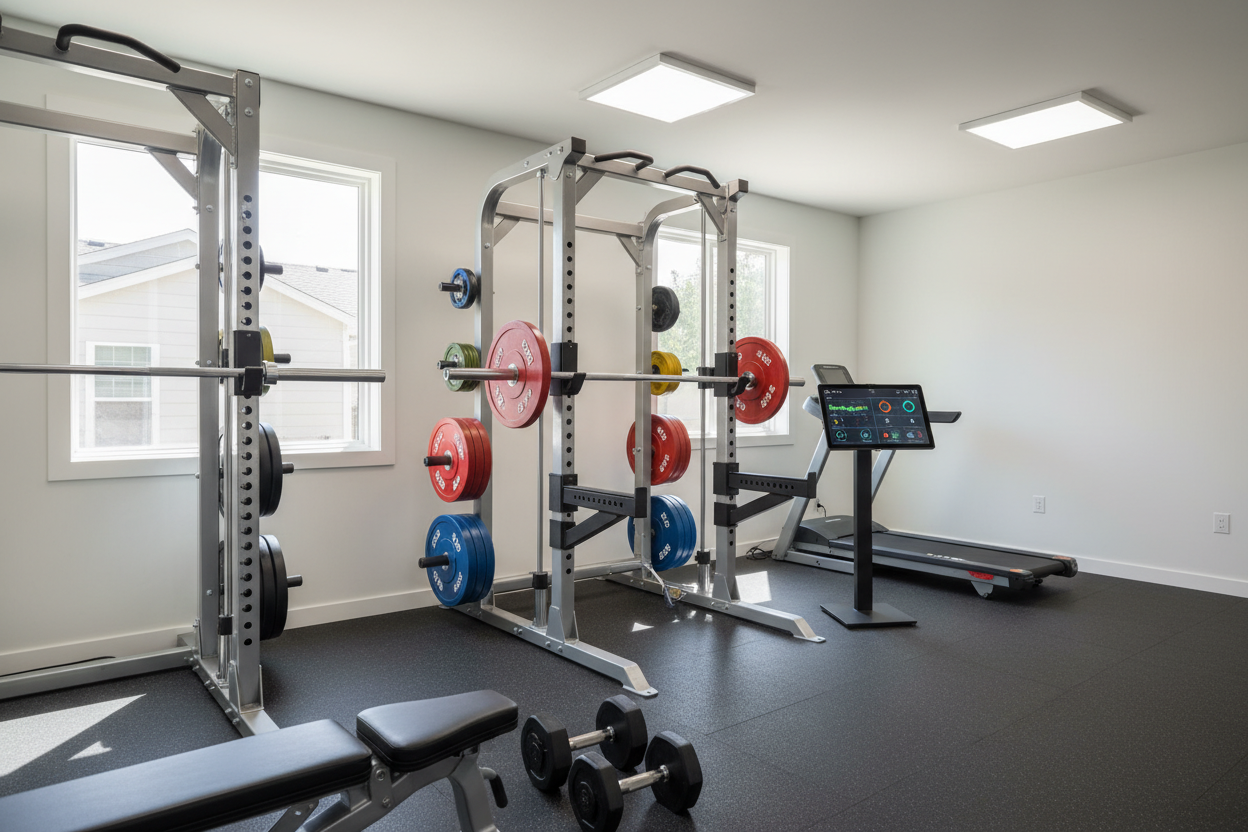
I remember the first time I moved from the squat rack to a high-end commercial Smith machine for some high-rep hack squats. I loaded three plates aside, thinking I was about to move some serious weight, only to realize the bar felt like it was filled with helium. If you have ever stood there staring at the frame wondering how much is a smith machine bar actually contributing to your total, you are not alone.
The confusion is real. You are trying to track your progress, but your logbook looks like a mess because the 'weight' changes every time you swap gyms. It is time to stop guessing and look at the actual mechanics of these rigs.
Quick Takeaways
- Most commercial Smith machine bars have a starting resistance of 15 to 25 pounds.
- Counterbalanced machines can reduce the effective bar weight to nearly zero.
- Residential or 'cheap' Smith machines often have no counterbalance, meaning the bar weighs a true 30 to 45 pounds.
- Friction from the guide rods adds a 'perceived weight' that is hard to calculate but easy to feel.
The Frustrating Myth of the 45-Pound Barbell
We are conditioned to believe that any Olympic-sized bar weighs 45 pounds. In a power rack, that is a law of nature. But the Smith machine is not a barbell; it is a machine. The moment that bar is hooked into a track, the rules of physics change.
The smith machine weight you feel in your hands is rarely the actual weight of the steel bar. Because the bar is fixed to a carriage and guide rods, manufacturers use pulleys and weights to make the bar easier to move. This is why you can smash a bench press PR on a Smith machine and then struggle with 135 pounds on a flat bench the next day. The 'empty' bar feels suspiciously light because it was designed to be accessible to everyone, not just the heavy lifters.
The Hidden Mechanics: Why It Does Not Weigh What It Looks Like
Behind those plastic shrouds or inside the steel tubing, most commercial rigs hide a counterbalance system. This usually involves a cable and a weight stack (or heavy iron blocks) that pulls upward on the bar. This is the primary reason the weight of a smith machine bar varies so wildly between brands.
Then you have to deal with the friction. Even the smoothest linear bearings create drag. If the gym owner hasn't lubed the rails in six months, that bar might feel 5 pounds heavier on the way up and 5 pounds lighter on the way down. When I was testing the real bar weight in Smith machine racks, I found that the same model of machine could feel completely different just based on how much dust was on the guide rods.
The Big Reveal: What Is the Weight of a Smith Machine Barbell?
If you want hard numbers, here is the breakdown based on my testing of dozens of rigs. Most Life Fitness and Hammer Strength machines sit in the 15 to 20-pound range. They are counterbalanced enough to be light but heavy enough to stay on the hooks. If you find yourself on a specialized unit, like the Freemotion Smith machine bar weight, you might be looking at a starting resistance as low as 0 to 10 pounds.
On the flip side, home-grade units or older 'pro-style' racks often have no counterbalance at all. On these machines, what is the weight of a smith machine barbell? It is usually a standard 30 to 45 pounds of raw steel. If you feel like you are working hard with just the bar, you probably are.
Does the Starting Resistance Actually Matter for Growth?
Here is the truth: your quads do not have a built-in scale. They only understand mechanical tension. If you are chasing hypertrophy, the absolute number in your logbook is less important than the trend of that number over time. If you squat 225 today and 235 next month on the same machine, you grew.
The obsession with 'true weight' usually comes from an ego-driven need to compare Smith machine lifts to free weight lifts. Stop doing that. They are different tools. A Smith machine allows you to stabilize the load and push to absolute failure without a spotter, which is where the real growth happens anyway.
My No-Stress Method for Tracking Fixed-Path Lifts
I used to be the guy bringing a luggage scale to the gym to weigh the bar. I looked like a lunatic, and honestly, it didn't help my gains. Now, I use a much simpler method: I only count the plates. If I have two 45s on each side, I log it as '180 + Bar.' If I move to a different gym, I just accept that the baseline has shifted and start a new 'cycle' of progression.
If you are lucky enough to have your own Smith machine at home, you have the advantage of consistency. You know exactly what that bar weighs because it never changes. For everyone else, pick a number—15 or 20 pounds—and stick to it religiously. Consistency is the only metric that actually builds muscle.
FAQ
Is a Smith machine bar always 45 lbs?
Almost never. In commercial gyms, the bar is usually counterbalanced to weigh between 15 and 25 pounds. Only uncounterbalanced home units typically hit the 45-pound mark.
Why does the Smith machine feel easier than free weights?
The machine handles the stabilization for you, and the counterbalance system reduces the effective weight of the bar. You are only fighting gravity, not the wobble of the bar.
How can I find the exact weight of my gym's bar?
Look for a small sticker on the frame; many manufacturers list the 'starting resistance' there. If it is not there, try the 'bathroom scale' trick: place a scale on the floor, put a sturdy box on it, and rest the bar on the box to see the reading.
Share:
The Only Gym Machine for Upper Body Worth Its Footprint
Why You Feel So Weak When Using Weight Machines