
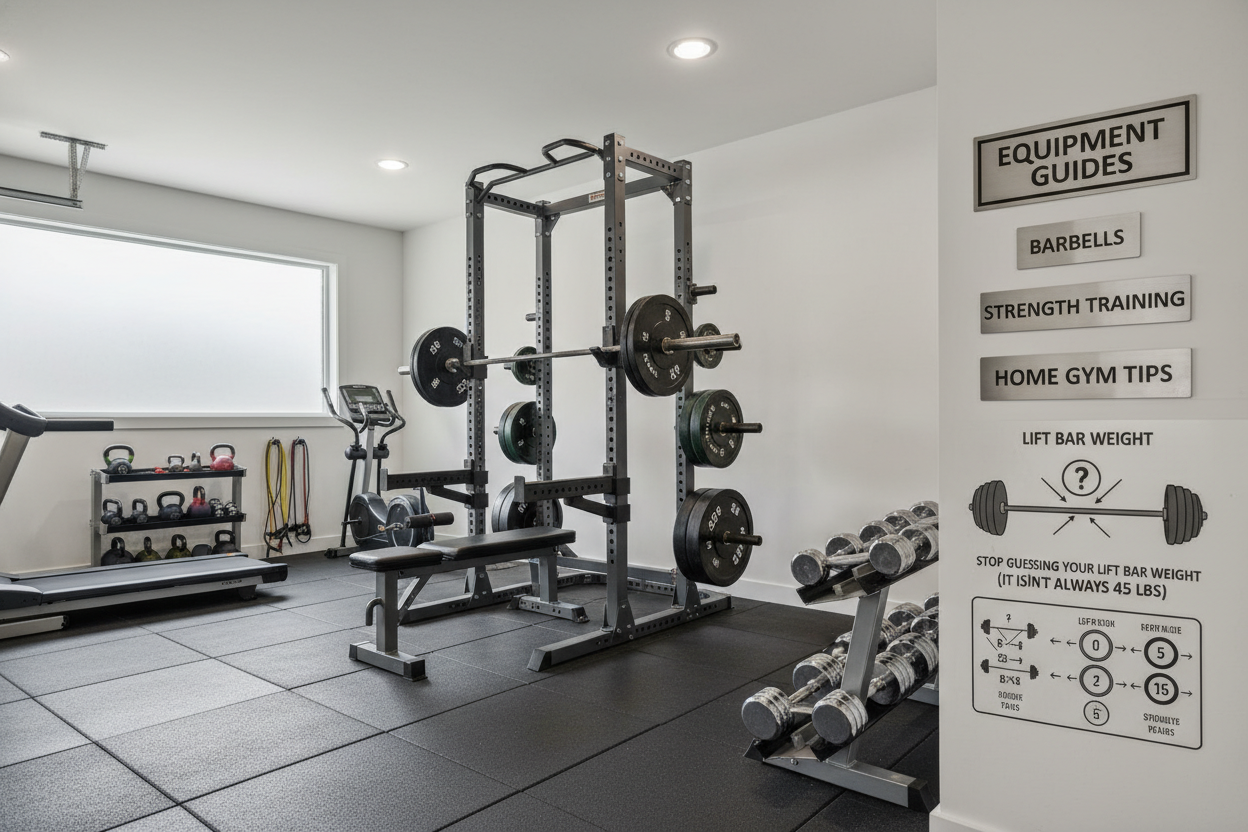
I was three weeks into a linear progression program when I realized my 'heavy' days felt strangely light. I swapped my garage gym bar for the one at the local commercial spot and suddenly, 225 felt like a house. That is when I realized my cheap lift bar weight was not the 45 pounds I had been logging in my app for a month. If you are serious about getting stronger, you have to stop treating every piece of steel like it is a uniform constant.
- Most men's Olympic bars are actually 20kg (44.1 lbs), not 45 lbs.
- Women's bars are almost always 15kg (33 lbs).
- Cheap 'standard' 1-inch bars can weigh as little as 12 to 15 pounds.
- Smith machine bars are often counterbalanced to weigh significantly less than free bars.
The 45-Pound Myth: Why We All Suck at Gym Math
The fitness industry has spent decades training us to think in 45-pound increments. Two plates? That is 225. Four plates? 405. It is clean, it is easy, and it is frequently wrong. When you assume every weight lift barbell is 45 pounds, you are likely sabotaging your progressive overload without knowing it. If your home gym bar is a budget 18-pound stick and you hit a 'PR' at the local powerhouse gym, you might find yourself pinned under a load you thought you had mastered.
Precision matters because strength is a game of inches and ounces. If you are trying to add 5 pounds to your bench every week, but your bar weight is a mystery, you are not actually following a program—you are just guessing. I have seen '45-pound' bars weigh in at 42 pounds and others at 47. Over a year of training, that variance ruins your data and stalls your gains.
The Real Weights of the Steel You Are Actually Lifting
Not all steel is created equal. The weight of your bar depends entirely on its purpose, its diameter, and the quality of the manufacturer. A bar designed for world-record deadlifts has different specs than the one bundled with a cheap bench press set from a department store.
The Olympic Power Bar (The Gold Standard)
If you are in a high-end commercial gym or a serious CrossFit box, you are likely using a 20kg bar. That is 44.1 pounds. While we call it a '45-pound bar' for the sake of easy math, the 0.9-pound difference adds up. If you are a woman using a 15kg bar, that is 33 pounds. These bars are built to tight tolerances, so you can usually trust the 20kg/15kg stamps on the end caps. High-quality brands like Rogue or Eleiko rarely miss by more than a few grams.
EZ Curl Bars and Specialty Tricep Bars
This is where the math goes off the rails. EZ curl bars are the wild west of equipment. I have owned curl bars that weighed 12 pounds and others that hit 25 pounds. Because there is no 'International Curl Federation' setting standards, manufacturers just do whatever they want. If you are tracking your accessory work, do not just write down the plate weight. Actually weigh the bar once so you know your starting point.
The Trap of Fixed Machines and Counterbalances
Machine bars feel different because they are different. You cannot compare a free-weight bench press to a Smith machine and expect the numbers to line up. The real Matrix bench press bar weight is often lighter than you think because the carriage and bearings are designed for smooth travel, not specific poundage.
Then you have the 'ego lifter' machines. The Freemotion Smith machine bar weight is notoriously light because of its counterbalance system. You might feel like a god pressing 315 on a Smith machine, but if the bar is counterbalanced to feel like 15 pounds, you are moving significantly less mass than you would with a standard barbell. Always check the sticker on the frame; most commercial machines list the 'effective' bar weight right there.
Home Gym Sizing: Standard vs. Olympic Bars
If you are building a budget setup, you will run into 'Standard' bars. These have 1-inch ends and do not fit Olympic plates. These are almost never 45 pounds. Most are 5 or 6 feet long and weigh between 15 and 25 pounds. If you are looking at all-in-one weight bench setups, they often include these lighter bars to keep the shipping costs down and the footprint small.
Olympic bars have 2-inch sleeves and are the industry standard for a reason. They are stiffer, they hold more weight, and the weight is predictable. If you are buying for a home gym, buy an Olympic bar first. It is the only way to ensure your 'gym math' actually translates to the real world if you ever decide to compete or train at a different facility.
How to Bulletproof Your Logging Moving Forward
Stop guessing. If you are training at home, take your bar and stand on a digital bathroom scale. Subtract your body weight. Now you have a 'true' number. If you are at a commercial gym and the bar feels 'off,' look at the end caps. If there is no branding and no weight marking, it is probably a cheap 40-pound knockoff.
The most important thing is consistency. If you always use the same bar, the exact weight matters less than the fact that it is the same every time. But the second you switch equipment, you need to account for that lift bar weight. Log the total weight—bar plus plates—every single time. Your future self will thank you when you are trying to figure out why your bench press plateaued.
Personal Experience: The 38-Pound Surprise
A few years ago, I bought a '7-foot Olympic bar' from a local liquidator for $50. It looked fine, but my squats felt suspiciously easy. I finally pulled the scale out of the bathroom and weighed it. The bar was 37.4 pounds. For months, I had been 'PR-ing' with weights that were nearly 8 pounds lighter than I thought. I had to swallow my pride and deload my entire program. It was a massive reality check on why cheap gear often costs you more in progress than you save in cash.
FAQ
Do all barbells weigh 45 pounds?
No. Most high-quality men's bars are 20kg (44.1 lbs). Women's bars are 15kg (33 lbs). Cheap home gym bars can be anywhere from 15 to 40 pounds.
How much does a Smith machine bar weigh?
It varies wildly. A non-counterbalanced bar is usually 25-35 lbs. A counterbalanced bar can feel as light as 6 to 15 lbs. Check the manufacturer's label on the machine.
Does the weight of the collars matter?
If you are using heavy competition collars, they are 2.5kg (5.5 lbs) each. Standard spring clips are negligible, but if you are using massive muscle clamps, they can add a pound or two to the total lift.
Share:
The Unspoken Problem With Full Body Workout Equipment for Home
The Secret to the Best Weight Room Isn't Buying More Iron