
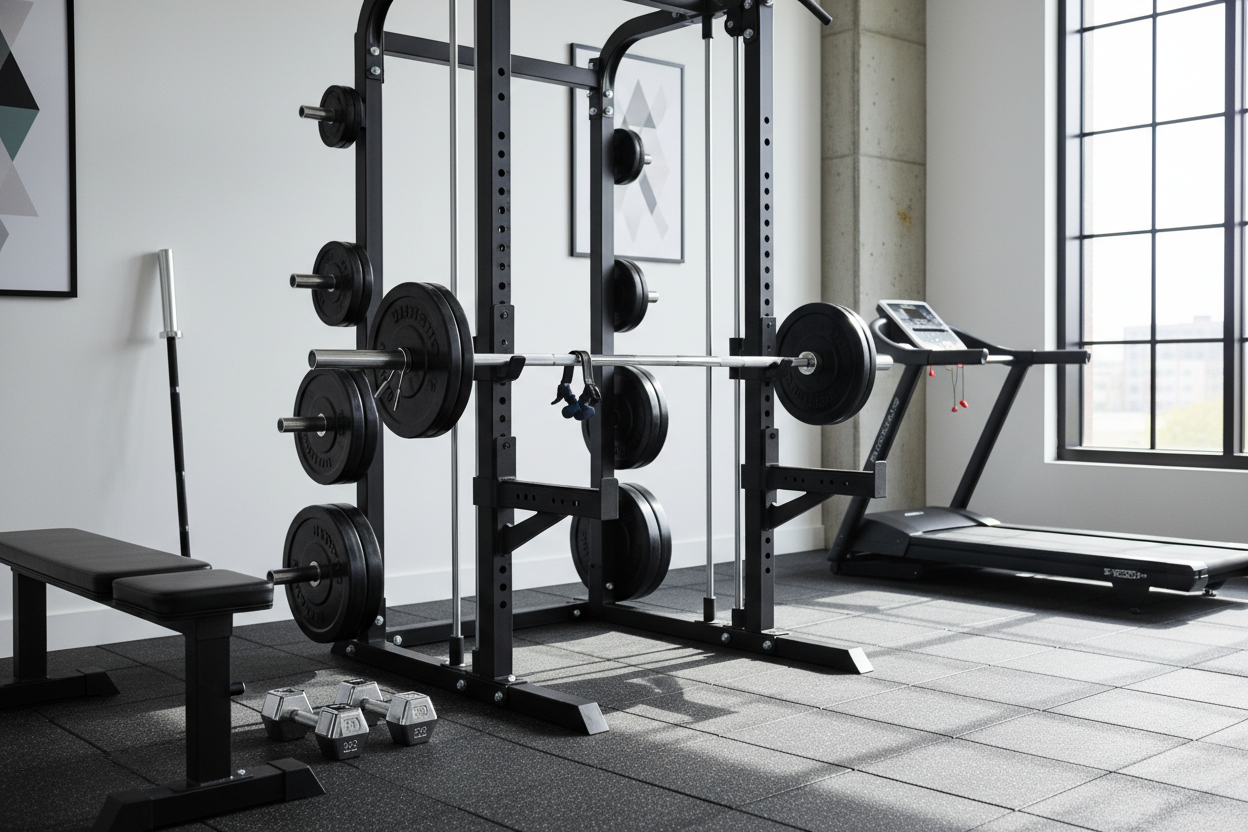
I remember the first time I hopped under a commercial smith barbell after a six-month powerlifting block. I went for a standard bench press setup, unhooked the bar, and immediately felt like my wrists were being snapped backward. It wasn't the weight—I was only warming up—it was the mechanics. If you have ever felt like your grip is 'off' or your joints are screaming on a fixed-track rig, it is because you are fighting the machine's anatomy.
Quick Takeaways
- The shaft of a smith machine bar rotates, while a standard Olympic bar uses rotating sleeves.
- Unracking requires a wrist-rolling motion that often leaves your joints in a compromised, extended position.
- Knurling on these bars is typically 'passive' and smoother to accommodate high-volume commercial use.
- Counterweights can make a 50-lb carriage feel like it weighs 10 lbs, messing with your perceived exertion.
It's Not Just You (Why the Bar Feels Weird)
Validation is the first step to better lifting. When you grab a free-weight barbell, you are in control of the bar's path in three dimensions. On a fitness smith station, that path is locked. You aren't just moving weight; you are interacting with a mechanical slide.
This fixed path means any slight misalignment in your grip or elbow position cannot be self-corrected mid-rep. The bar won't move for you, so your joints have to. That 'weird' feeling is your body trying to find a natural groove in a completely unnatural environment.
The Backward Anatomy of a Smith Machine Barbell
On a real Olympic bar, the sleeves spin so the plates don't create centrifugal force that rips the bar out of your hands. The center shaft stays relatively still in your grip. A smith machine barbell flips this logic. The 'sleeves' are often welded to a carriage that slides on a track, and the entire center shaft is designed to rotate so you can hook and unhook the weight.
Many modern home smith machine setups use high-end linear bearings to make this rotation smoother, but you are still gripping the part of the machine that is meant to move. This means every time you shift your hand, you risk slightly engaging the locking hooks. It is a fundamental shift in how you maintain tension through your palms.
Why Your Wrists Are Taking a Beating
The biggest injury trap is the unrack. To get a smith machine bar off the pegs, you have to roll your wrists back. Most lifters start the set in this 'cranked back' position. If you start a heavy bench press with your wrists in full extension, you are asking for tendonitis.
You have to learn the 're-grip.' Unhook the bar, hold the weight for a split second, and then neutralise your wrists before you start the descent. It sounds like a small fix, but it is the difference between a productive chest day and a week of wearing wrist wraps at your desk.
The Passive Knurling Problem on a Fitness Smith Rig
Most commercial smith bar machine setups have what I call 'polite' knurling. It is designed not to tear the hands of casual gym-goers. For anyone used to a sharp power bar, this feels like trying to grip a wet pool noodle. There is no 'bite,' which leads to your hands slowly drifting wider during high-rep sets.
If your rig has this slick finish, don't be afraid to use chalk or even a bit of athletic tape. You need to be locked into the bar because you can't use 'bar whip' or subtle tilts to keep the weight centered like you would with a free-weight barbell.
Counterweights and the Phantom Mass Illusion
The visual of a smith machine barbell is deceiving. The carriage and bar assembly might actually weigh 60 lbs, but because of internal pulleys and counterweights, the starting resistance might only be 15 lbs. I spent twenty minutes with a luggage scale figuring out the actual bar weight on a commercial rig once because the 15-lb sticker felt like a lie.
This 'phantom mass' makes it hard to track progress if you switch between different brands of machines. Always test the 'zero' weight before you start stacking plates. Don't assume every smith bar is the standard 45 lbs.
How to Actually Grip a Smith Bar Machine
For pressing, I actually recommend a slightly wider grip than your standard bench. Since you don't have to balance the bar, a wider grip allows you to keep your forearms vertical throughout the movement. If you are using all-in-one cable crossover rigs, you might find the bar is even thinner than a standard 28mm Olympic shaft, which makes a full-wrap grip even more important for stability.
Consider a 'suicide grip' (thumbless) only if you are an experienced lifter and the machine has safety stoppers properly set. Otherwise, stick to a full wrap and focus on keeping the weight over the heel of your palm, not your fingers.
My Honest Mistake
Years ago, I tried to do heavy 'Power Shrugs' on a Smith machine. I didn't set the safety pins. Mid-set, my wrist rolled forward, the hook caught the peg unevenly, and the bar slammed down on one side, nearly shearing the bolt off the carriage. I learned two things: always set your safeties, and never trust a Smith machine hook to stay out of the way if your grip technique is sloppy.
FAQ
Is a smith machine bar 45 pounds?
Rarely. Most are counterweighted to feel between 10 and 25 lbs, though some heavy-duty home units have no counterweight and can feel closer to 50 lbs.
Can I use fat grips on a smith barbell?
You can, but be careful. Increasing the diameter makes it much harder to rotate the bar to lock it back into place, which can be dangerous if you reach failure.
Why does my smith machine bar feel 'sticky'?
It usually means the guide rods need cleaning and lubrication. Use a dry silicone spray; never use WD-40, as it attracts dust and makes the friction worse over time.
Share:
Is a Multi-Station Gym Machine All You Need to Build Muscle?
Why My Knees Prefer a 45 Degree Leg Press Machine Over Free Squats