
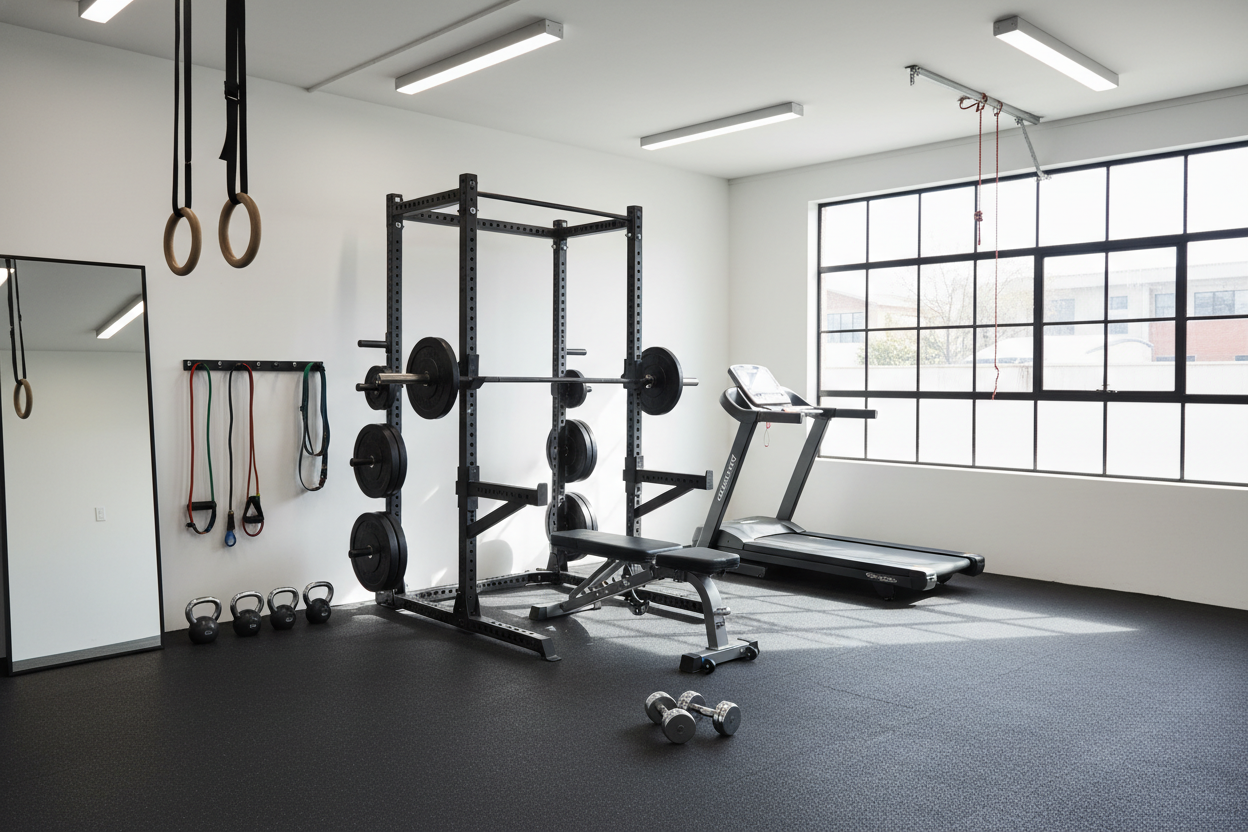
I remember the night I spent three hours scrolling through equipment forums, convinced that if I didn't buy a rack made of 3x3 11-gauge steel, my entire garage gym would eventually collapse under the weight of a 225-lb squat. I was obsessed with the idea of pro exercise equipment. Then the freight truck arrived, I nearly blew my back out moving the crates, and I realized half of what I paid for was just 'ego steel'—metal I’d never actually stress to its limit.
- Static steel is rarely worth the commercial premium for home users.
- Prioritize your budget for anything with a bearing, pulley, or pivot point.
- Commercial cardio machines are footprint killers; choose high-resistance compact alternatives.
- You can mimic high-end tension profiles with smart attachments and bands.
The 'Overbuilt' Illusion: Why Thicker Steel Isn't Always Better
Most people buying pro exercise equipment are paying for a durability cycle they will never utilize. In a commercial club, a power rack handles 100 lifters a day. In your garage, it handles one. That 11-gauge steel is beautiful, but a quality 14-gauge rack is rated for 800+ lbs. Unless you're chasing a world-record total, the extra $1,000 you're spending on 'pro' uprights is money that could have gone toward a better barbell.
The marketing departments know we love the 'tank' aesthetic. They sell us on oversized bolts and massive footprints that eat up your floor space. Before you buy, ask yourself: am I buying this because I need the structural integrity, or because I want my gym to look like a Westside Barbell video? Usually, it's the latter. Save the cash on the static iron and put it where the friction is.
When Pro Workout Equipment Actually Matters: Moving Parts
If there is a hinge, a cable, or a bearing involved, this is where you pull the trigger on the upgrade. Cheap home-grade machines use plastic bushings that stick and stutter. When you're mid-set, that 'hitch' in the movement ruins your mind-muscle connection. pro workout equipment is defined by its smoothness, not just its weight capacity. I've found that a Weight Bench Chest Press Machine Independent Arms Z1 Pro is a prime example of where the upcharge makes sense because the independent converging arms prevent the muscle imbalances you get from cheap, fixed-bar lever machines.
Precision engineering in the pivot points ensures the resistance stays consistent through the entire range of motion. On a budget machine, the weight often feels 'heavy' at the start and 'light' at the top because the geometry is off. Commercial gear is designed by biomechanical engineers to match your body's natural strength curve. If it moves, buy the best you can afford.
Cardio Machines: The Great Home Gym Compromise
Buying a full-sized commercial treadmill is the quickest way to turn a functional garage gym into a cramped storage unit. Those machines are built for 24/7 pounding and usually require a dedicated 20-amp circuit that your garage probably doesn't have. You’ll spend $5,000 on the unit and another $500 on an electrician just to get it to turn on.
Instead of chasing the 'club feel' with a massive motorized deck, look at a high-end magnetic resistance exercise bike. You get the same pro-level lung burn and durability without the 7-foot footprint. Magnetic resistance is silent, requires zero maintenance, and won't trip your breakers when you're trying to hit a sprint interval. It’s a smarter use of 'pro' dollars for a residential setting.
Can You Fake a Commercial Feel on a Budget?
You don't always need a $4,000 cable crossover to get a pro-level pump. I've personally recreated a pro setup with basic bodybuilding tools by using high-quality resistance bands to fix the 'dead spots' in cheap plate-loaded machines. By adding a band to a basic leg extension, you create a variable resistance profile that mimics the high-end cam systems found in brands like Hammer Strength.
One mistake I made early on was buying a cheap functional trainer with 1:1 ratio pulleys. It felt like pulling a bucket of rocks. I eventually swapped the pulleys for high-grade aluminum versions with sealed bearings. For about $60 and an hour of work, I made a $500 machine feel like a $2,000 'pro' unit. If the frame is solid, you can often upgrade the moving parts yourself.
The Verdict: How to Audit Your Next Gym Purchase
Before you click 'buy' on a heavy freight order, run the 'Moving Part Test.' If the equipment is just a frame to hold weight—like a squat stand or a flat bench—go with the mid-tier consumer option. If the equipment has a cable, a pulley, or a seat that needs to slide under load, that is where you invest in the professional grade.
My current setup is a hybrid: a basic, sturdy rack paired with high-end, commercial-grade plate-loaded machines. This approach gives me the 'pro' feel where it actually impacts my muscle growth while keeping enough floor space to actually move around. Buy for the feel of the movement, not the thickness of the steel.
FAQ
Is 11-gauge steel actually necessary for a home gym?
Strictly speaking, no. 14-gauge steel is more than enough for 99% of lifters. 11-gauge is mostly about stability and the ability to bolt heavy accessories onto the frame without it wobbling.
Why does commercial equipment feel so much smoother?
It comes down to the bearings and the pulley diameter. Commercial units use larger pulleys and sealed ball bearings which reduce friction. Cheap gear uses small plastic wheels and bushings that create 'drag.'
Can I put commercial cardio gear in my garage?
Check your electrical panel first. Many pro-grade treadmills require a NEMA 5-20R outlet. If you plug a commercial unit into a standard household outlet, you risk frying the motor controller or constantly tripping the breaker.
Share:
The 4 Rules I Swear By When I Shop for Gym Equipment
What Actually Makes the Best Workout Gym Machines Worth Buying