
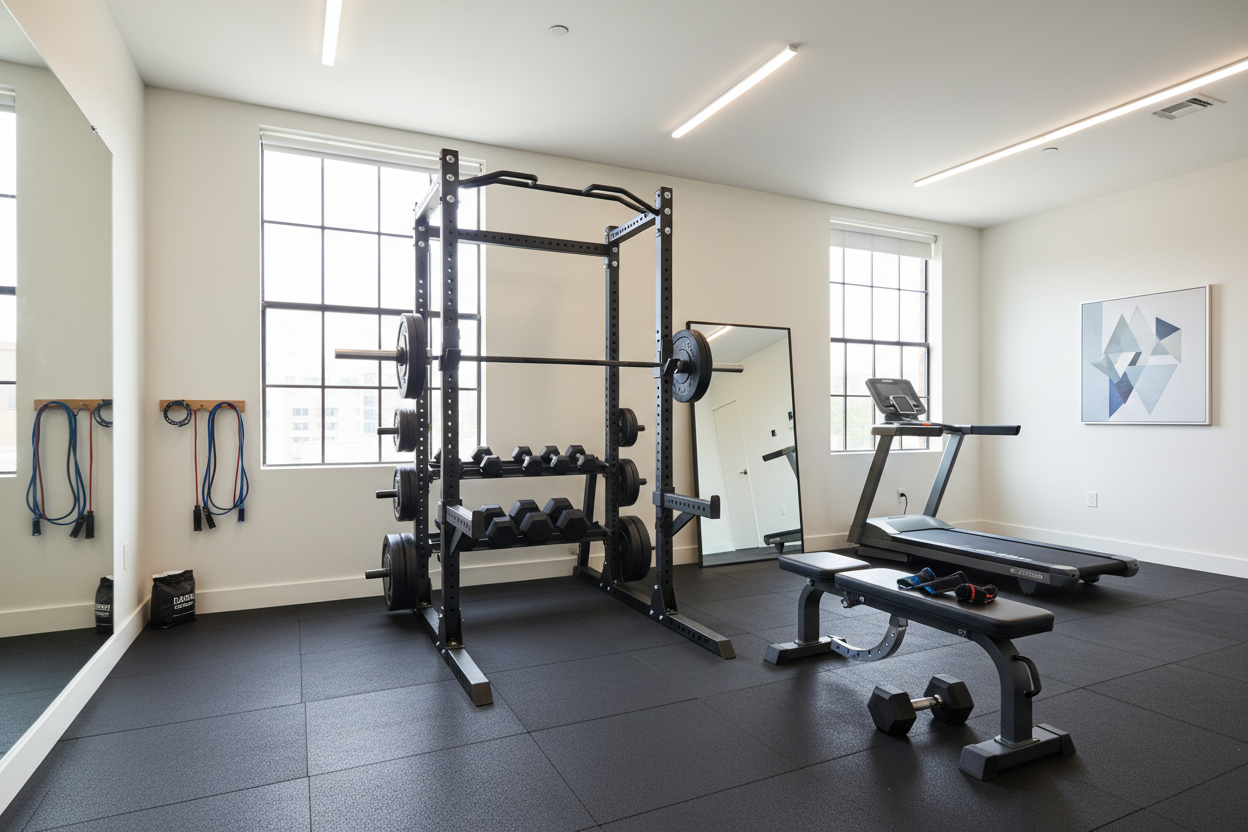
I remember the night I stood in my garage, surrounded by $400 worth of 'as seen on TV' equipment that was literally gathering dust. I had three different styles of ab wheels, a set of plastic adjustable dumbbells that rattled like a box of Legos, and enough tangled resistance bands to bungee jump off a bridge. Finding the right gym accessories home setups actually require is a minefield of marketing fluff. Most of what you see on social media is designed to look good in a 15-second clip, not survive a five-year training cycle.
The home gym and accessories market is flooded with low-grade plastic and 'innovative' handles that do nothing but clutter your floor. After years of testing bars, dropping plates, and tearing through cheap gear, I've realized that the best accessories are the ones you forget are there because they just work. They don't have Bluetooth, they don't have apps, and they aren't neon green. They are just tools that solve specific problems in a limited space.
Quick Takeaways
- Buy fractional plates before you buy another heavy pair of 45s.
- Horse stall mats are the only flooring worth your money.
- UHMW plastic on your J-cups will save your expensive barbell.
- A plate-loaded pulley system beats a $3,000 cable crossover for home use.
- Stability is the most important spec for any bench.
Stop Buying Attachments You'll Only Use Once
We've all been there—scrolling through Amazon at 11 PM, convinced that a new 'ergonomic' lat pulldown bar is the secret to a wider back. It arrives, you use it twice, and then it spends the next three years as a tripping hazard. The reality is that building a functional home gym is an exercise in subtraction, not addition. You have limited square footage. Every piece of gear needs to earn its keep.
Most cheap attachments use thin-walled steel and foam grips that degrade the moment you start sweating. If a handle has a 'maximum capacity' of 150 lbs, it’s going to feel flexy and unsafe when you’re actually moving weight. I’ve seen handles snap and carabiners bend under loads that any serious lifter would consider a warm-up. Stop chasing the 'perfect' grip and start investing in gear that won't break when you're mid-set.
Clear out the clutter. If you haven't touched an accessory in three months, sell it. Use that cash to buy one high-quality piece of steel that will outlast you. Your training space should be a cockpit, not a storage unit.
The 5 Pieces of Gear That Actually Survive Heavy Use
These aren't the flashy items you see in fitness influencer videos. These are the workhorses. I’ve picked these five because they solve the most common problems home lifters face: plateauing on small lifts, floor damage, bench instability, equipment wear, and limited exercise variety. If you have these five, you can run almost any program effectively without ever stepping foot in a commercial gym again.
1. Fractional Plates for Busting Plateaus
Progress isn't always linear, especially when you're training in a garage. Most home gyms only have 2.5-lb plates as their smallest increment, which means the smallest jump you can make on a barbell is 5 lbs. That’s a massive 10% jump if you’re struggling with a 50-lb strict press. Fractional plates—specifically 0.25, 0.5, and 1.25-lb increments—allow you to keep the needle moving when a 5-lb jump feels like hitting a brick wall.
I personally use 1.25-lb plates every single week for my overhead press and bench. It sounds small, but adding 2.5 lbs total to the bar every session is 10 lbs a month. You can't do that with standard plates. These are usually made of steel and fit easily in a gym bag. If you’re serious about strength, micro-loading is the most underrated strategy in the book.
2. Flooring That Won't Shift Under a Deadlift
I learned the hard way that those interlocking foam puzzle mats are useless for anything other than yoga. The first time I tried to pull 315 lbs on foam, the tiles separated, my footing shifted, and I nearly tweaked my lower back. Foam compresses. It creates an unstable surface that is actually dangerous for heavy squats and deadlifts. It also traps moisture against your concrete, which is a recipe for mold.
You need a thick 4x8 gym mat made from high-density vulcanized rubber. Often sold as horse stall mats, these 3/4-inch beasts weigh about 100 pounds each. They don't move, they don't compress, and they protect your foundation from the impact of dropped weights. They smell like a tire shop for the first week, but once they off-gas, they are the gold standard for a reason.
3. A Utility Bench That Actually Supports You
A cheap bench is a liability. I’ve used 'budget' benches that felt like they were made of soda cans; every time I laid down for a press, the frame would twist. If you’re pushing heavy weight, you need a pad that is at least 11 inches wide and made of high-density foam that doesn't bottom out. You also need a frame that doesn't wobble when you use leg drive.
For many, a weight bench with barbell rack combo is a smart way to maximize utility in a small footprint. Look for a bench with a tripod design or a very wide rear stabilizer. If the bench has a 1,000-lb capacity, you know it’s over-engineered enough to handle your 250-lb bench press without breaking a sweat. A solid bench gives you the confidence to actually push your limits.
4. Heavy-Duty J-Cups with UMHW Plastic
Look at your barbell. If you spent $300 or $500 on a quality bar, the last thing you want to do is grind the knurling off against raw steel J-cups. Most budget racks come with simple metal hooks that scratch your bar every time you rack it. This leads to rust and a 'dead' feeling in the knurl where you need grip the most.
Upgrade to J-cups lined with UHMW (Ultra-High-Molecular-Weight) plastic. This material is incredibly tough but softer than the steel of your bar. It acts as a buffer, protecting your investment. Some high-end J-cups even have plastic on the back and bottom to protect the uprights of your rack. It’s a $50 upgrade that saves a $500 barbell.
5. A Reliable Cable Pulley System
You don't need a $3,000 functional trainer to do cable work. A simple plate-loaded pulley that hangs from your rack’s crossmember can handle 90% of what a big machine does. I use mine for face pulls, tricep pushdowns, and lat pulldowns. It takes up zero floor space when you're not using it and costs a fraction of a standalone unit.
Look for a system with a high-quality bearing in the pulley and a coated steel cable. The cheap ones use nylon ropes that stretch and fray. A good pulley system should feel smooth, not jerky. It allows you to add that 'bodybuilding' volume to your heavy strength work without needing a commercial gym membership.
How to Audit Your Home Gym and Accessories Today
Go into your gym right now and look at every accessory. Ask yourself: 'When was the last time I used this for a heavy set?' If the answer is 'I don't remember,' it's time to purge. We often hold onto gear because of the sunk cost—we spent money on it, so we feel obligated to keep it. But a cluttered gym is a distracting gym. Every piece of unused gear is just a place for dust to settle.
Take photos of the stuff you don't use and list it on local marketplaces. Home gym gear holds its value surprisingly well. Use that money to fund one of the 'unsexy' upgrades mentioned above. I’d trade a box of 10 different resistance bands for one pair of high-quality J-cups any day of the week. Focus on the gear that facilitates your main lifts, and the results will follow.
Personal Experience: The $50 Lesson
Early in my home gym journey, I bought a 'comprehensive' resistance band kit from a random Instagram ad. It came with five different colors, door anchors, and ankle straps. Two weeks in, I was doing standing rows when the 'heavy' black band snapped at the handle. It whipped back and caught me right across the forearm, leaving a welt that lasted two weeks. That was the day I stopped buying cheap accessories. I realized that if I couldn't trust a piece of gear with my safety, it had no business being in my house. Now, I only buy accessories that are rated for at least twice the weight I plan to move.
FAQ
Are fractional plates really necessary for beginners?
Yes. In fact, beginners need them more. When you're first starting, a 5-lb jump on a 45-lb press is nearly 11%. That's a huge leap. Fractional plates let you progress consistently without failing reps every other week.
Can I just use plywood instead of rubber mats?
Plywood is great for a lifting platform base, but you still need rubber on top. Plywood is slick when sweaty and doesn't absorb impact. You'll end up cracking the wood and potentially the concrete underneath.
Why is UHMW plastic better than regular plastic?
UHMW is specifically designed for high impact and abrasion resistance. Regular plastic will crack or shave off under the weight of a loaded barbell. UHMW stays intact and keeps your bar's knurling sharp for years.
Share:
I Regret Buying Most Gear: My Actual At Home Workout Must Haves
I Wrote the Exercise Equipment Guide I Wish I Had on Day One