
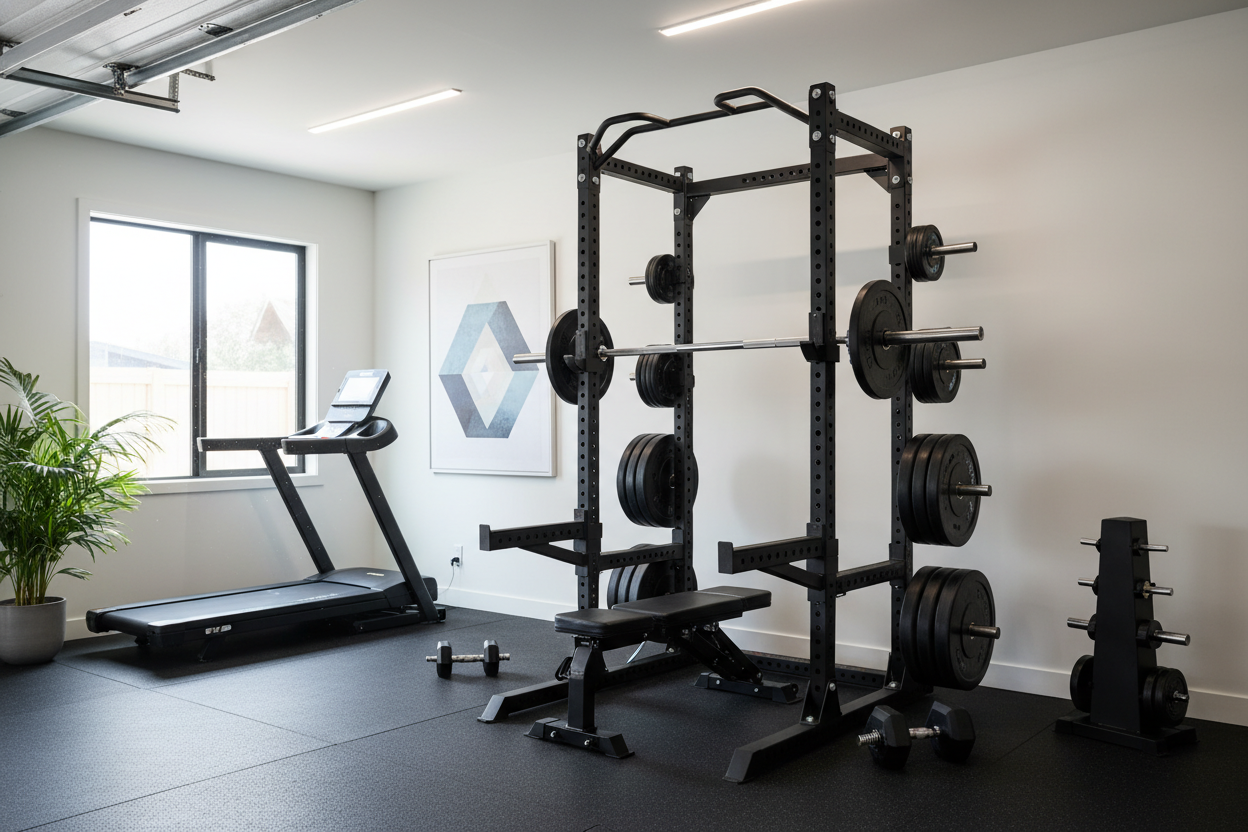
I remember the night I finally quit my big-box gym. I was tired of the rising monthly fees and the guys hogging the squat rack to do bicep curls. I went home and searched for the easiest way to get everything at once. I found an olympic weight set and rack bundle that looked like a steal, but it ended up being a major headache.
The problem is that convenience often masks compromise. When you buy everything in one box, you aren't getting the best of anything. You're getting the cheapest version of everything that can still survive a trip in a UPS truck without the company losing money on shipping.
Quick Takeaways
- Bundled bars usually have terrible knurling and dangerously low weight capacities.
- Cheap racks often use thin 14-gauge steel that wobbles under heavy loads.
- Shipping costs dictate the quality; if the price is too low, the metal is too thin.
- Modular setups allow for better upgrades as you get stronger over time.
The One-Click Trap of the All-in-One Bundle
It is incredibly tempting to just hit 'Buy Now' on a massive 300lb set. You think you're saving time, but you're usually buying a disposable product. Manufacturers know that shipping 500 pounds of steel is expensive. To keep the retail price attractive, they have to cut costs somewhere.
Usually, that 'somewhere' is the thickness of the steel and the quality of the barbell. A 2x2-inch upright made of thin steel might look okay in a photo, but once you put 200 pounds on it, the sway is terrifying. These bundles are designed for the casual user, not someone planning to actually move heavy weight.
Most of these kits also include a barbell that is barely better than a piece of plumbing pipe. The sleeves might be pinned rather than using snap rings, and the 'chrome' finish will start flaking off into your palms within a month. It’s a short-term solution that forces you to buy twice.
How to Actually Survive an Olympic Weight Set With Rack
If you are dead set on a bundle, you have to be a stickler for the spec sheet. First, look at the steel gauge. If it doesn't say 11-gauge or at least a solid 12-gauge, walk away. You want a rack that doesn't dance when you're trying to re-rack a heavy set of squats.
Next, check the J-cups. If they are just bare metal hooks, they will chew up the knurling on your bar. You want plastic-lined cups. Some combo units, like the Weight Bench With Barbell Rack And Biceps And Leg Extension Curl Station Z3, offer a lot of variety for accessory work. Just be honest about your goals; it's great for hypertrophy and accessory movements, but don't expect it to handle 600-pound squats.
The barbell is the most important piece of gear you'll touch. If the olympic weight set with rack comes with a bar that has a 250lb capacity, you'll outgrow it in six months. Look for a bar rated for at least 700lbs, even if you aren't there yet. It’s about the safety margin and the quality of the steel.
What to Do When the Garage is Already Full
Most bundled racks are 'bolt-together' units with wide, fixed footprints. They take up a massive 4x4 foot square and offer zero flexibility. In a standard two-car garage, that space is precious. I learned this the hard way when I realized I couldn't park my car because of a cheap, bulky power tower.
I eventually realized that a massive cage isn't always the answer, which I detailed in my post on Why I Traded My Full Rack for a Compact Weight Training Home Gym. If you're fighting for every inch, a Folding Wall Mounted Power Rack is a much smarter play. It gives you the stability of a wall-mounted unit but folds flat so you can actually use your garage for other things.
Don't let a 'good deal' on a bulky rack ruin the flow of your home. If the rack doesn't fit your life, you won't use it. Strategic space-saving gear is always worth the extra investment over a clunky bundle.
Planning Your Inevitable Upgrades
Buy your first set with the assumption that you will get stronger. If you buy a rack that can't be expanded, you're stuck. A good rack should be a foundation. You want a system that lets you add plate storage, dip bars, or cable attachments later.
When you finally outgrow that starter kit, you'll likely want something like the Power Rack With Lat Pulldown Low Row System C1 V4. This is the kind of setup that grows with you. It adds a lat pulldown and low row, which are essential for back development and much harder to DIY than a simple squat stand.
Spend the money on a high-quality barbell first. You can squat out of a cheap rack for a little while, but a bad bar is a safety hazard. Once you have the bar and plates, upgrade the rack to something that will last a lifetime.
Personal Experience: My Wobbling Wake-up Call
I bought a '300-pound Olympic set' from a big box store back in 2018. The first time I tried to rack 225 pounds, the uprights flexed so much I thought the whole thing was tipping over. I had to bolt it to a plywood platform just to feel safe. I ended up selling the rack for $50 on Craigslist and buying a real power rack three months later. I wasted money trying to save money. Buy the right steel the first time.
FAQ
Can I use bumper plates with a standard rack?
Yes, but check the width of the J-cups and the length of your barbell sleeves. Bumper plates are much wider than iron plates, so you might run out of room on a cheap, short-sleeve barbell included in a bundle.
Is 14-gauge steel enough for a home gym?
Only if you're doing light work. For serious squatting or benching, 11 or 12-gauge steel is the standard. 14-gauge is thin and prone to swaying under loads over 200 pounds.
Should I get iron or rubber-coated plates?
Iron is cheaper and sounds better (that classic clank), but rubber-coated plates are easier on your floors and quieter if you have neighbors or a sleeping family.
Share:
Is a Universal Gym Machine Actually Worth the Massive Footprint?
I Finally Figured Out What Is the Best At Home Gym Equipment