
I remember the day my local commercial gym hiked their monthly dues to $80 while half the cable machines were held together by duct tape and hope. I went home, opened my laptop, and saw a 'complete home gym' ad for $999. I thought I’d cracked the code. I was wrong. The actual full gym equipment price isn't just the sum of a barbell and some iron; it’s the logistics, the hardware, and the unsexy necessities that eat your budget alive.
- Budget at least 20% more than the equipment sticker price for shipping and taxes.
- Flooring is non-negotiable; skipping it will eventually crack your concrete slab.
- 'Free shipping' on heavy steel is usually a shell game where quality is sacrificed.
- All-in-one stations often provide better value for those with limited square footage.
The $1,500 Lie We All Fall For
Marketing departments love to show you a pristine garage gym with a shiny rack and a lone barbell for a price that seems too good to be true. They lead you to believe you can get a pro-level setup for the cost of a used MacBook. What they don't show you is the $150 shipping fee, the $200 in flooring mats, or the fact that the 'free' barbell has the tensile strength of a wet noodle.
When you start calculating the cost, you realize that the rack is just the skeleton. You still need the muscle. Most lifters underestimate the total tally because they focus on the big-ticket items and forget that a gym without collars, a bench, or a way to store plates is just a cluttered garage.
Breaking Down Gym Equipments and Their Prices (The Essentials)
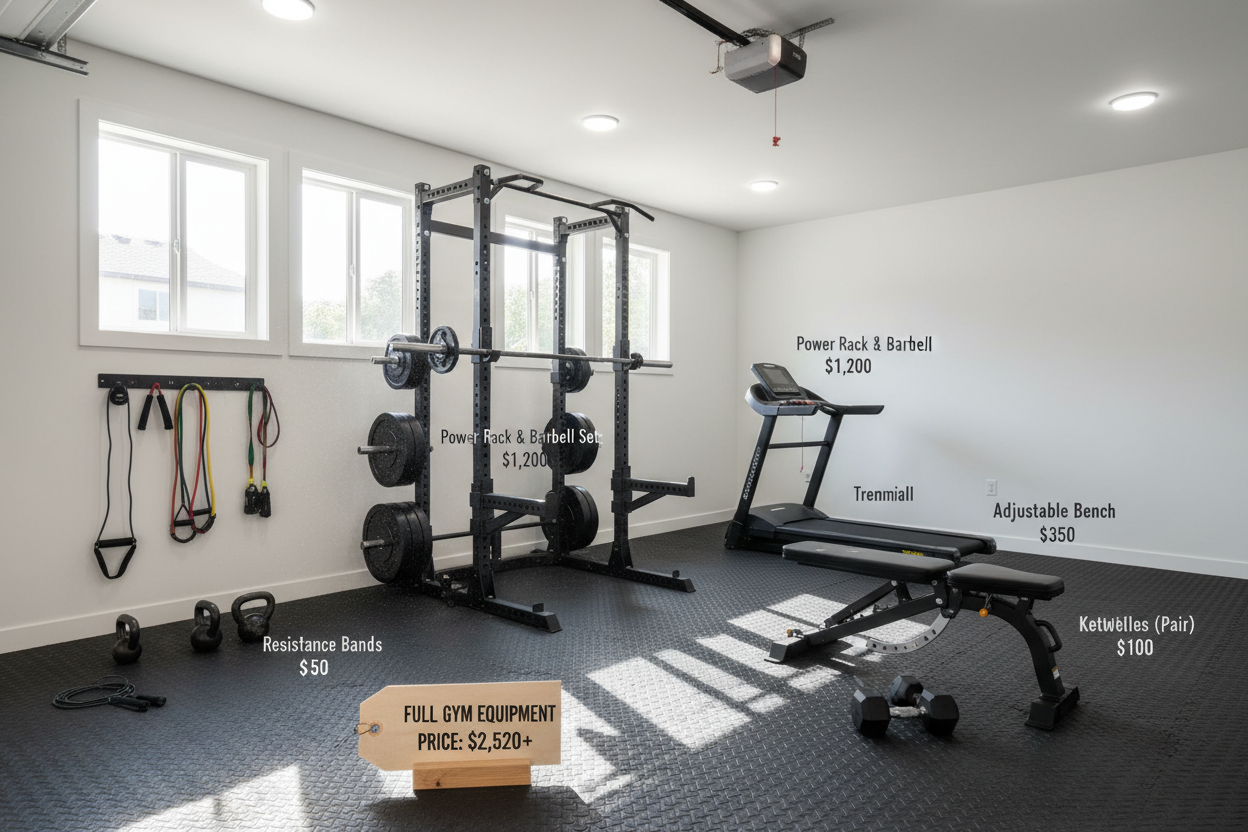
Let's talk gym equipments and their prices for what I call the 'Core Four.' First, you need a power rack. A decent 3x3-inch rack made of 11-gauge steel is going to run you between $600 and $1,200. Anything lighter and you’ll feel it swaying when you re-rack a heavy squat.
Next is the barbell. Do not buy a $50 bar from a big-box retailer. A quality Olympic bar with decent knurling and a 190,000 PSI tensile strength rating will cost $200 to $400. Then come the plates. Iron is currently hovering around $1.50 to $2.00 per pound. If you want a 300-lb set, expect to drop $500 easily. Finally, a reliable adjustable bench that won't wobble under a 225-lb press will cost about $300. When you're building a Home Gym, these four items are your foundation. If you go cheap here, you'll just end up buying them twice.
The Hidden Trap: Shipping, Taxes, and Flooring
The sticker price is a decoy. Moving 800 pounds of steel from a warehouse to your driveway requires freight shipping. Unless you're buying from a massive conglomerate, that freight bill can be $150 to $300. Then there's the tax, which can tack on another few hundred depending on where you live.
And please, for the love of your foundation, don't use those foam puzzle-piece mats. They are for yoga, not deadlifts. You need 3/4-inch horse stall mats. They are heavy, they smell like a tire factory for two weeks, and they cost about $50 per 4x6 foot sheet. For a standard two-car garage space, you’re looking at another $300 to $500 just in rubber.
Why 'Free Shipping' Usually Means Crappy Gear
Heavy steel costs real money to move. If a company is offering 'free shipping' on a 700-lb power rack bundle, they aren't eating that cost out of the goodness of their hearts. They’ve baked it into the price by using thinner 14-gauge steel or plastic pulleys that will snap in six months. I'd rather pay for shipping on high-quality steel than get 'free' shipping on a rack that shakes when I do pull-ups.
Does an All-In-One Machine Actually Save You Money?
If you're looking at the total bill and sweating, there is an alternative. Buying individual pieces adds up because of multiple shipping fees and the footprint required. A Full Body Multifunctional Training Station M1 can actually be more cost-effective. It combines a rack, a cable system, and a pull-up station into one unit with one shipping cost.
Similarly, a Smith Machine Home Gym Station provides a level of versatility that would cost thousands more if you bought standalone cable crossovers and plate-loaded machines. If you aren't planning to compete in powerlifting and just want to get jacked in your garage, these consolidated units often offer a better 'bang for buck' ratio than a traditional iron setup.
The Final Verdict: What You Should Actually Expect to Spend
Stop looking at the $500 bundles. Here is the reality of what you'll actually spend for a setup that lasts a decade. For a bare-bones setup with used plates and a basic rack, expect $1,200. For a mid-tier setup with brand-name gear and decent flooring, you're looking at $3,500. If you want the premium experience with specialty bars and a full cable array, $7,000 is a more realistic starting point.
I've Made the Mistakes So You Don't Have To
I once bought a 'budget' flat bench for $80 because I thought steel was steel. The first time I tried to bench 225 lbs, the frame groaned so loud I thought the welds were giving out. I spent the next twenty minutes scrolling for a replacement while my chest was still shaking from the adrenaline of almost being crushed. I sold that bench for $20 on Facebook Marketplace. The lesson? Buy once, cry once. Spend the money on the frame and the bar; they are the only things keeping the weight off your neck.
FAQ
Is iron or rubber better for plates?
Iron is thinner, so you can fit more weight on the bar, and it has that classic sound. Rubber bumpers are better if you plan on dropping weights or if you're training in a garage where noise is an issue for neighbors.
How much space do I actually need?
A standard 10x10 foot area is the minimum for a full power rack and an Olympic bar. Remember that a standard bar is 7 feet long, so you need at least 1.5 feet of clearance on each side to actually load the plates.
Should I buy used equipment?
Yes, for plates and dumbbells. Iron doesn't expire. However, I always recommend buying your barbell and your primary rack new so you know they haven't been dropped or compromised by a previous owner.
Share:
I Snapped 3 Cables Finding a Home Gym Pulley System That Works
Exactly How I'd Build the Best Home Gym Under 2000 Today