
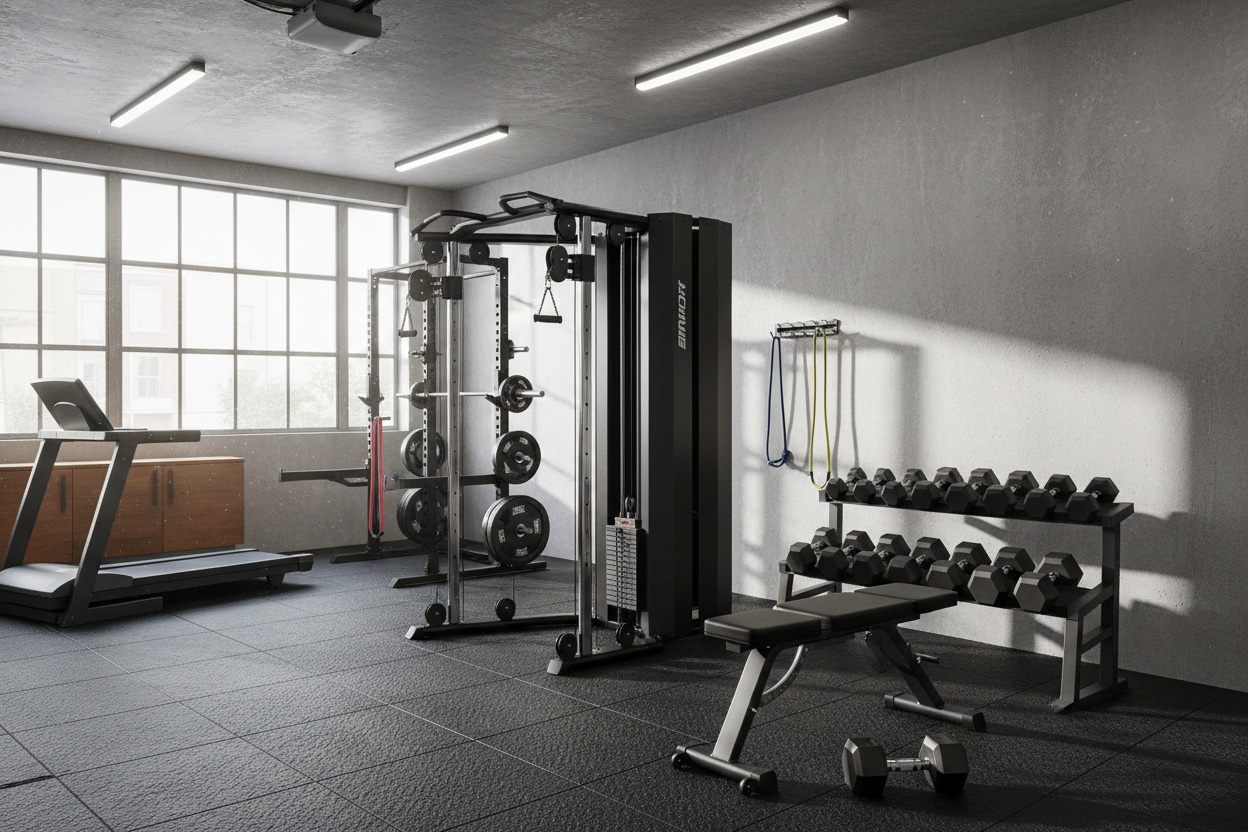
I used to be that guy. I’d walk into the gym, head straight for the power rack, and scoff at anyone sitting in a selectorized chest press. I thought machines were for people who didn't want to sweat, or for people who lacked the 'grit' for a 405-lb back squat. I spent a decade drinking the functional fitness kool-aid, convinced that if I wasn't stabilizing a shaking barbell, I wasn't actually getting stronger.
Quick Takeaways
- Stability allows you to push target muscles to absolute failure without your form breaking down.
- Machines remove the 'weakest link' (like grip or lower back) from the equation.
- You don't need a spotter to train with high intensity.
- Modern home gym equipment makes it possible to get commercial-grade isolation in a small footprint.
The 'Free Weights Only' Cult Cost Me Gains
For years, my training was dogmatic. If it wasn't a barbell or a heavy dumbbell, I didn't touch it. The result? My lower back was perpetually fried, and my quads looked like they belonged to a marathon runner despite my 400-pound squat. I was hitting a massive hypertrophy plateau because my systemic fatigue was through the roof, but my target muscles weren't actually getting the stimulus they needed.
I realized the hard way that the barbell is a tool, not a religion. When your goal is pure muscle growth, the advantages of machine weights become impossible to ignore. I started swallowing my pride and using a hack squat instead of a back squat. My legs finally started growing because I wasn't limited by my spinal stability anymore. I was finally training my muscles, not just my ego.
The Undeniable Advantages of Machine Weights
The biggest hurdle to muscle growth is often stability. When you're benching heavy dumbbells, a huge chunk of your neural output goes toward making sure those weights don't crush your skull. That's energy that isn't going into your pectorals. The benefits of weight machines start with the fact that the machine handles the stability for you.
By removing the need to balance the load, you can achieve much higher motor unit recruitment in the specific muscle you're trying to hit. You can focus entirely on the squeeze and the stretch. This mind-muscle connection isn't just bro-science; it's the difference between a workout that leaves you tired and a workout that actually triggers an adaptation.
You Can Actually Train to True Failure
We’ve all been there—the last rep of a heavy bench press where you're not sure if the bar is coming back up. Usually, you stop one or two reps short because you don't want to end up on a gym fail compilation. However, one benefit of resistance machines over free weights is that you can safely push a muscle to complete mechanical failure without risking a catastrophic injury.
If you can't finish a rep on a machine, you just let go. No harm, no foul. This safety allows for intensity techniques like drop sets and rest-pause sets that are suicidal with a barbell. When you're trying to Stop Guessing Your Real Smith Machine Resistance Weight, you can actually track your progress and push your limits without needing a spotter hovering over your face.
Bypassing the 'Weakest Link' Problem
Your quads are almost certainly stronger than your lower back. Your lats are definitely stronger than your grip. In the world of free weights, your set often ends because your lower back is rounding or your hands are slipping, even though the target muscle has plenty of gas left in the tank.
Machines fix this. A seated row machine doesn't care if your lower back is tired from yesterday's deadlifts. It allows you to hammer your back until your lats literally cannot pull another inch. This isolation is how you fix lagging body parts and build a physique that actually looks like you lift.
But What About 'Functional' Strength?
The 'functional' crowd loves to claim that machines don't build real-world strength. It's a tired argument. A bigger muscle is a stronger muscle, period. If you use a leg press to add two inches of meat to your quads, that strength will absolutely transfer to your squat, your sprint, and your ability to carry groceries.
You don't need to balance on a Bosu ball to be functional. Real-world strength comes from having a solid base of muscle mass and a nervous system that knows how to use it. Use machines to build the raw material (the muscle), and use your big compound movements to teach that muscle how to work in coordination. It's not an either-or scenario.
Getting Commercial-Grade Isolation in a Garage Gym
The biggest downside to machines used to be the space. Most of us don't have a 5,000-square-foot warehouse to house a dozen different Hammer Strength pieces. But the home gym market has evolved. You can now get high-end, fixed-path movement in a footprint that doesn't require a second mortgage or a commercial lease.
The Weight Bench Chest Press Machine Independent Arms Z1 Pro is a prime example of this evolution. It gives you that converging, independent arm movement that you'd usually only find in a pro bodybuilding gym, but it fits in a 6x8 foot corner. Leveraging multi-purpose lever systems allows you to get the isolation benefits of a machine without the bulk of a selectorized stack.
FAQ
Are machines better for beginners?
They are great for beginners because they teach a safe path of motion, but they are arguably even more valuable for advanced lifters who need the extra stability to push past plateaus. Don't graduate 'away' from machines; graduate 'into' using them correctly.
Do machines cause more joint pain?
Actually, the opposite is often true. Because the path is fixed, you can often find a position that avoids the joint 'tweaks' common with free weights. However, if a machine's pivot point doesn't align with your joints, it can be uncomfortable. Always adjust the seat height first.
Can I build a pro-level physique with only machines?
Absolutely. Some of the most famous bodybuilders in history, like Dorian Yates, relied heavily on machines to build massive amounts of tissue. As long as you are applying progressive overload, your muscles don't know if the resistance comes from a plate, a cable, or a selectorized stack.
Share:
The Only 3 Pieces of Bodyweight Equipment You Actually Need
Why Most Compact Gym for Home Setups Snap Under Heavy Weight