
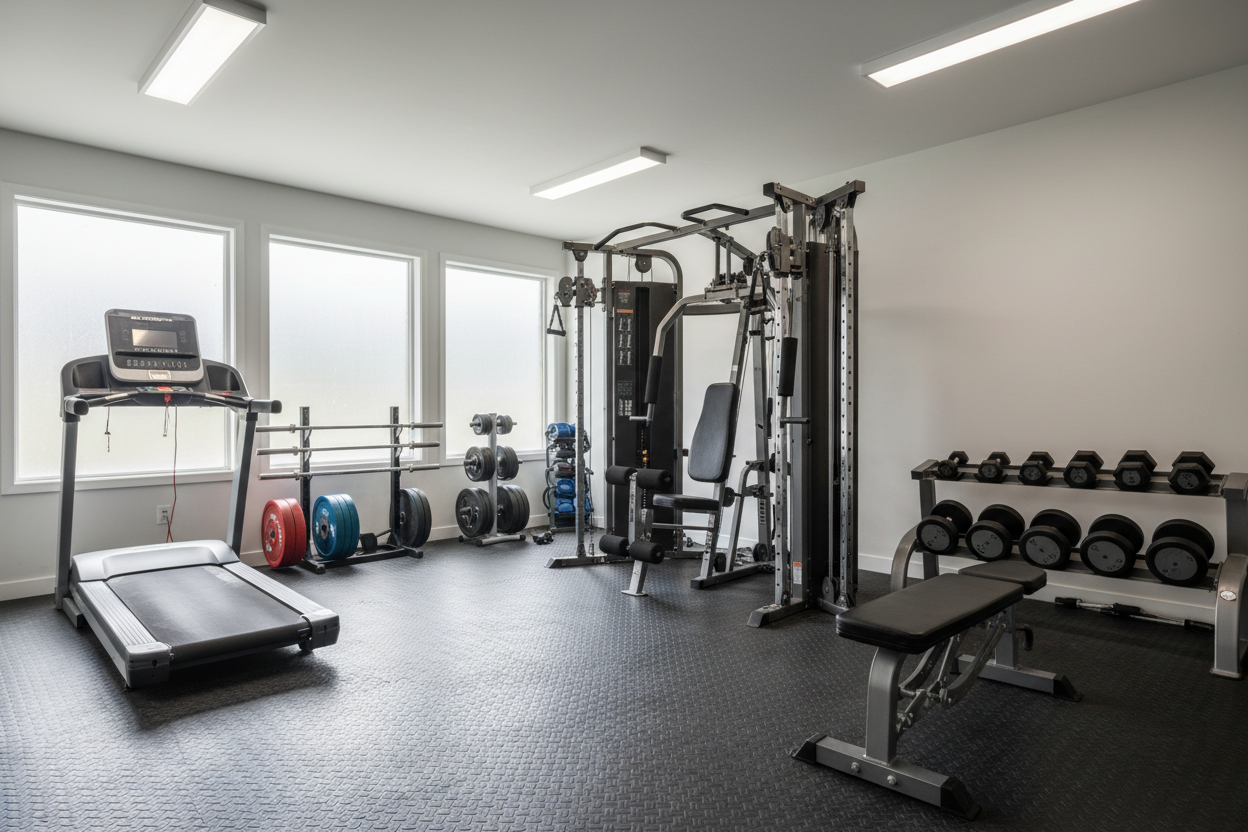
I remember scrolling through Facebook Marketplace at 11 PM and seeing it: a full-sized 4-stack Life Fitness unit for $800. My brain immediately started clearing space in my garage. I thought I was about to score the ultimate commercial multi gym for pennies on the dollar. I saw myself hitting cable crossovers and lat pulldowns in my own sanctuary, away from the crowds.
Then reality hit. I realized that a machine built to withstand 500 people a day in a Gold's Gym doesn't magically scale down for a residential driveway. Most of these deals end in broken backs, scratched floors, and a piece of equipment that sits unused because it’s too massive to actually train around.
Quick Takeaways
- Commercial rigs are built for 10,000-square-foot facilities, not 400-square-foot garages.
- The logistics of moving 800+ lbs of steel and weight stacks is a professional-grade nightmare.
- Ceiling height and 'working space' are the silent killers of home gym layouts.
- Modern compact trainers offer better versatility without requiring a structural engineer.
The Craigslist Dream vs. The 800-Pound Reality
When you see a multi gym for sale online, it looks manageable in a high-ceilinged commercial space. You think, 'It's just a few bolts and some cables.' But 11-gauge steel is heavy. Really heavy. A standard multi station machine usually clocks in at nearly half a ton once you account for the dual or triple weight stacks.
I’ve seen guys try to load these into a Ford F-150 only to watch the suspension bottom out before the second weight stack is even on the bed. That 'steal' of a price quickly evaporates when you realize you need a lift-gate truck and a crew of four friends who are willing to risk their lumbar health for a six-pack of beer.
What Actually Happens When You Try to Move One
The logistics of transporting gym station equipment are brutal. You aren't just moving a rack; you're moving a complex system of pulleys, tensioned cables, and precision-machined guide rods. If you find an old pro power multi gym 3 station or a similar club rig, expect seized bolts that haven't been turned since 2008.
Once you get it home, the real fun begins. You have to re-string those cables. If you didn't take a hundred photos during teardown, you're looking at a three-day puzzle. I once spent an entire Saturday trying to figure out why a cable was rubbing against a frame piece, only to realize the previous owner had used the wrong size bushing five years prior. It’s a headache you don't need.
Do You Even Have the Square Footage?
People often measure the base of the machine and think they're good. They forget about 'working space.' A multi station exercise machine might have a 6x8 footprint, but you need another three feet on every side to actually use the handles. In a standard garage, that eats up the space where your squat rack, bench, and dumbbells should live.
When planning home gym setups, you have to prioritize flow. A commercial rig is a 'centerpiece' machine. It sits in the middle of a room. In a garage, it becomes a massive obstacle you have to shimmy around just to get to your protein shaker. Unless you have a dedicated 30x30 outbuilding, it’s a space-killer.
The Modern Alternative: High-End Compact Stations
The market has changed. You no longer need a sprawling 4-stack rig to get a club-quality pump. If you’re looking at a multi station home gym for sale, look toward vertical integration. Modern designs take all that functionality and push it against a single wall.
I’m a huge fan of the Smith machine home gym station approach. It combines the safety of a fixed bar with the cable versatility of a commercial unit. For example, a full body multi training station gives you the lat pulldowns, low rows, and chest presses of a club rig but fits in a fraction of the space. You get the 1:1 or 2:1 cable ratios you want without the 100-inch width.
When Does a Club-Sized Rig Actually Make Sense?
Look, if you’re outfitting a firehouse or a high-school weight room, then a commercial multi gym sale is your best friend. Those environments have the square footage and the floor anchors to handle the vibration and weight of a multi-user station. But for the solo lifter in a garage? It’s overkill that actually hinders your progress.
After years of flipping gear, I learned that bigger isn't better—smarter is better. I eventually stopped chasing the 'club feel' and focused on footprint efficiency. My journey of buying multi function home gym equipment taught me that a well-designed compact unit beats a rusted commercial behemoth every time. Before you pull the trigger, ask yourself if you want to replace a power rack or just add to your arsenal. Usually, the compact route is the only one that doesn't end in buyer's remorse.
FAQ
Will a commercial multi gym fit under an 8-foot ceiling?
Most pull-up bars and pulley housings on commercial rigs sit right at 82 to 90 inches. If you have a standard 8-foot ceiling, it might fit, but you won't have room to actually do a pull-up without hitting your head on the drywall.
How do I transport a 3-station gym?
Don't use a minivan. Rent a box truck with a ramp and a heavy-duty appliance dolly. Label every single cable with masking tape before you disconnect anything, or you will never get the tension right again.
Are the weight stacks on older commercial machines accurate?
Often, no. Over time, friction in the pulleys and grime on the guide rods can add 'ghost weight.' A 100-lb setting might feel like 120 lbs if the machine hasn't been lubed with silicone spray in a decade.
Share:
Is American Exercise Equipment Actually Worth the Premium?
What Is the Precor Icarian Line Smith Machine Bar Weight, Actually?