
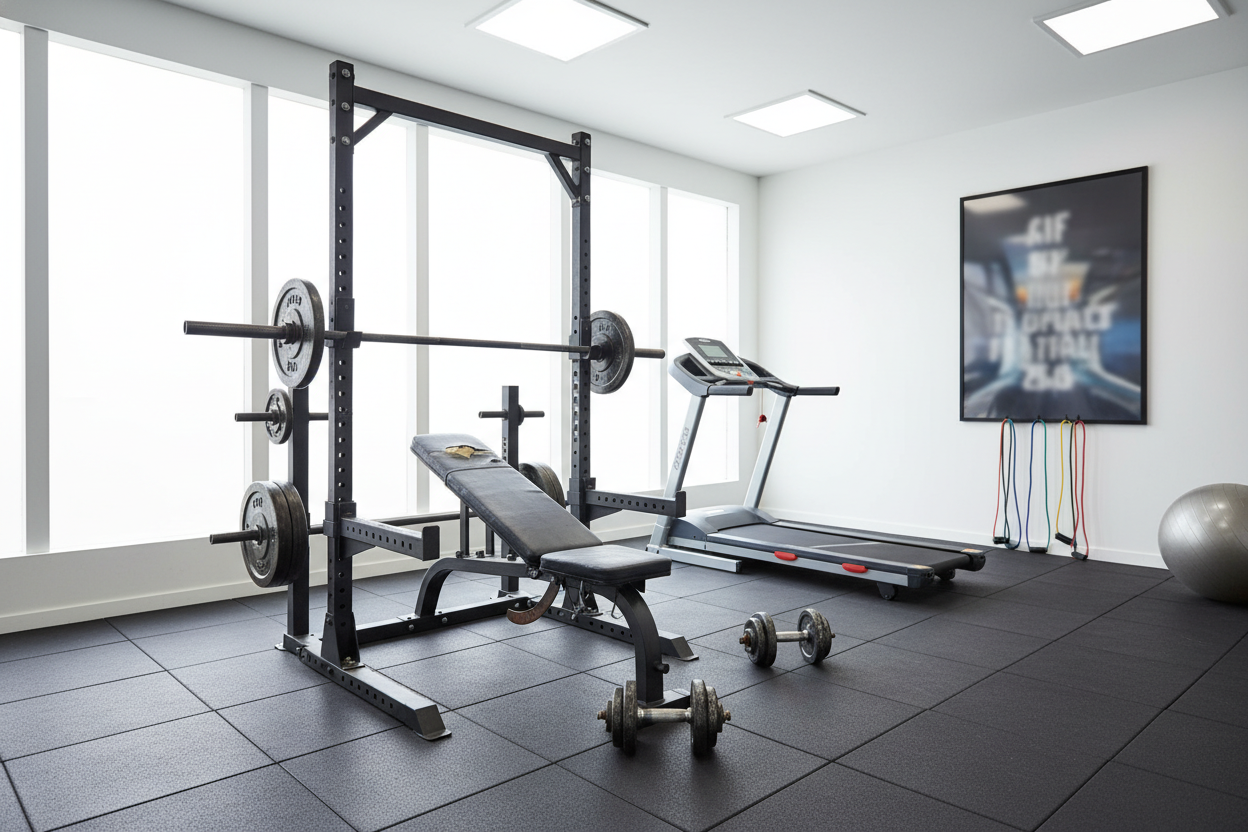
I remember the night I decided to build my first garage gym. I was scrolling through marketplace listings at 2 AM, looking for fitness equipment cheap enough to fit a budget that barely covered a pair of quality shoes. I found a 'heavy-duty' bench for sixty bucks and thought I’d outsmarted the industry. Three months later, that bench buckled under a 225-pound press, nearly pinning me to the concrete.
Finding cheap fitness items feels like a win until the equipment actually arrives. Most of the time, you're not paying for a deal; you're paying for thinner steel, plastic bushings where there should be bearings, and welds that look like they were done by a middle schooler in shop class. If you want a gym that lasts longer than a New Year's resolution, you have to know where to spend and where to skimp.
Quick Takeaways
- Avoid ultra-cheap load-bearing gear like benches and racks; they are safety hazards.
- Static items like cast iron plates and sandbags are great places to save money.
- Always check the 'shipping weight'—if a rack weighs less than you do, it’s a toy.
- Buy once, cry once: spending 20% more now saves you 100% on a replacement later.
The 'Buy It Nice or Buy It Twice' Rule
The biggest trap in the home gym world is the false economy of the entry-level kit. You see these cheap exercise machines for sale that promise a full-body workout for the price of a dinner out. They look great in the staged photos with high-contrast lighting, but the reality is a wobbly mess of 14-gauge steel and rattling bolts. I’ve coached enough people to know that when gear feels flimsy, you stop using it. You lose trust in the machine, and eventually, it becomes a very expensive clothes rack.
If you buy a $150 rack today and realize it shakes every time you re-rack a squat, you’re eventually going to shell out $500 for a real one. Now you’ve spent $650 and have a pile of scrap metal in your driveway that nobody wants to buy. I’m telling you this because I want you to stop buying cheap home gym equipment that isn't built for actual progress. A quality barbell or a solid rack is an investment that holds its value for a decade. Cheap gear is a liability from day one.
Think about the physics. If you're 200 lbs and you're moving 200 lbs, that’s 400 lbs of force hitting a structure. Most budget gear is rated for 300 lbs total capacity—and they’re being generous. When you push those limits, the metal fatigues. I've seen bolts shear off and uprights bend because the manufacturer used 'furniture grade' steel instead of structural tubing.
Where You Can Actually Cut Corners
It’s not all doom and gloom. You can absolutely find cheap fitness items that perform just as well as the name-brand stuff. For example, a 45-lb cast iron plate is a 45-lb cast iron plate. Unless you’re a competitive powerlifter who needs calibrated weights within 10 grams of accuracy, the 'old school' rusty plates you find at a garage sale work perfectly. They don't have moving parts, so there's nothing to break.
The best home gym fitness equipment often consists of just a few versatile, low-tech pieces. Resistance bands, PVC pipes for mobility, and even basic flat benches (if they have a welded frame) are safe bets. I also recommend looking for 'factory seconds' or 'blemished' gear. Often, a company will sell a kettlebell for 30% off just because the paint is chipped. That’s a smart budget move because the structural integrity is still 100%.
Rubber horse stall mats from a local tractor supply store are another legendary hack. They are 3/4-inch thick, indestructible, and cost a fraction of what 'official' gym flooring goes for. If it doesn't have a hinge, a cable, or a motor, you have my permission to go cheap.
Where 'Affordable' Becomes Dangerous
We need to talk about the 'danger zone.' When you search for at home gym equipment cheap, you'll inevitably see adjustable benches with 10 different positions for $49. Avoid these like the plague. A bench is the only thing standing between your spine and a heavy barbell. I’ve seen cheap benches where the pop-pin—the little metal piece that holds the seat up—is made of soft aluminum. One hard drop and that pin shears, sending you backward mid-lift.
The same goes for J-hooks and safety bars. If you’re looking at heavy-duty home gym setups, you’ll notice the steel is thick (11-gauge) and the welds are clean. On bottom-barrel racks, the J-hooks are often just thin strips of bent metal without any plastic lining to protect your bar. Not only is this unsafe, but it will also chew up the knurling on your barbell, ruining a $300 piece of steel in a week.
Pulleys are another failure point. Cheap cable machines use plastic pulleys with cheap bearings that create massive friction. This makes the weight feel 'stuttery' and inconsistent. More importantly, those thin cables can fray and snap. If a cable snaps while you’re doing a heavy lat pulldown, that bar is coming straight for your head. This is one area where 'affordable' is just another word for 'untested.'
Finding the Middle Ground for Cardio
Cardio equipment is notoriously expensive, but you don't need a $3,000 treadmill to get your heart rate up. To keep home gym equipment affordable, look for mechanical simplicity. Air bikes are a great example; they use a giant fan for resistance, so there are fewer electronics to fry. If you want something for a small space, a foldable upright exercise bike is a solid choice because it uses magnetic resistance, which is quiet and has very few wearing parts.
Avoid the 'smart' machines that require a monthly subscription just to turn on the screen. Those are essentially tablets attached to mediocre bikes. You’re better off buying a sturdy, 'dumb' bike and propping your own iPad on the handlebars. You’ll save $1,000 upfront and $40 a month in fees. Focus on the frame weight and the warranty—that tells you how much the company actually trusts their own product.
The 3-Question Litmus Test for Budget Gear
Before you hit 'buy' on that work out equipment cheap listing, ask yourself these three things:
- What is the shipping weight? If a power rack weighs 80 lbs, it is too light to be safe for heavy lifting. Look for a minimum of 130-150 lbs for a basic rack.
- Are the joints welded or bolted? Welded joints are generally stronger, but if it’s bolted, ensure it uses Grade 5 hardware or better. If the bolts look like they came from a toy set, pass.
- Does it have a real warranty? A company that offers a 90-day warranty knows their product won't last a year. Look for at least 1-2 years on frames.
Personal Experience: My $400 Mistake
I once bought a 'pro' cable crossover machine from a liquidator for $400. It looked the part, but the first time I tried a heavy chest fly, the entire frame flexed inward about three inches. The friction was so bad I had to 'help' the weights back up. I tried greasing the rods, replacing the cables, and eventually, I just gave up and sold it for $50. I wasted $350 and dozens of hours trying to fix a lemon. I should have just saved that money for a single, high-quality functional trainer.
FAQ
Is used equipment better than cheap new equipment?
Almost always. A used, high-end commercial rack from a closing gym is ten times better than a brand-new, budget-grade rack from a big-box store. Quality steel doesn't expire.
What is the one piece of gear I should never buy cheap?
The barbell. It’s the primary interface between you and the weight. A cheap bar will bend, the sleeves will stop spinning, and the knurling will disappear. Buy a decent multi-purpose bar and it will last a lifetime.
How can I tell if a weight bench is sturdy?
Look at the footprint. A wide rear stabilizer (at least 15-20 inches) prevents the bench from tipping. Also, check the pad thickness; if it's less than 2 inches, it’s going to be uncomfortable and likely uses cheap foam that flattens out.
Share:
You Don't Need Another Machine (Just Better Fitness Accessories for Home)
I Train Alone: Why the Best Leverage Home Gym Beats a Power Rack