
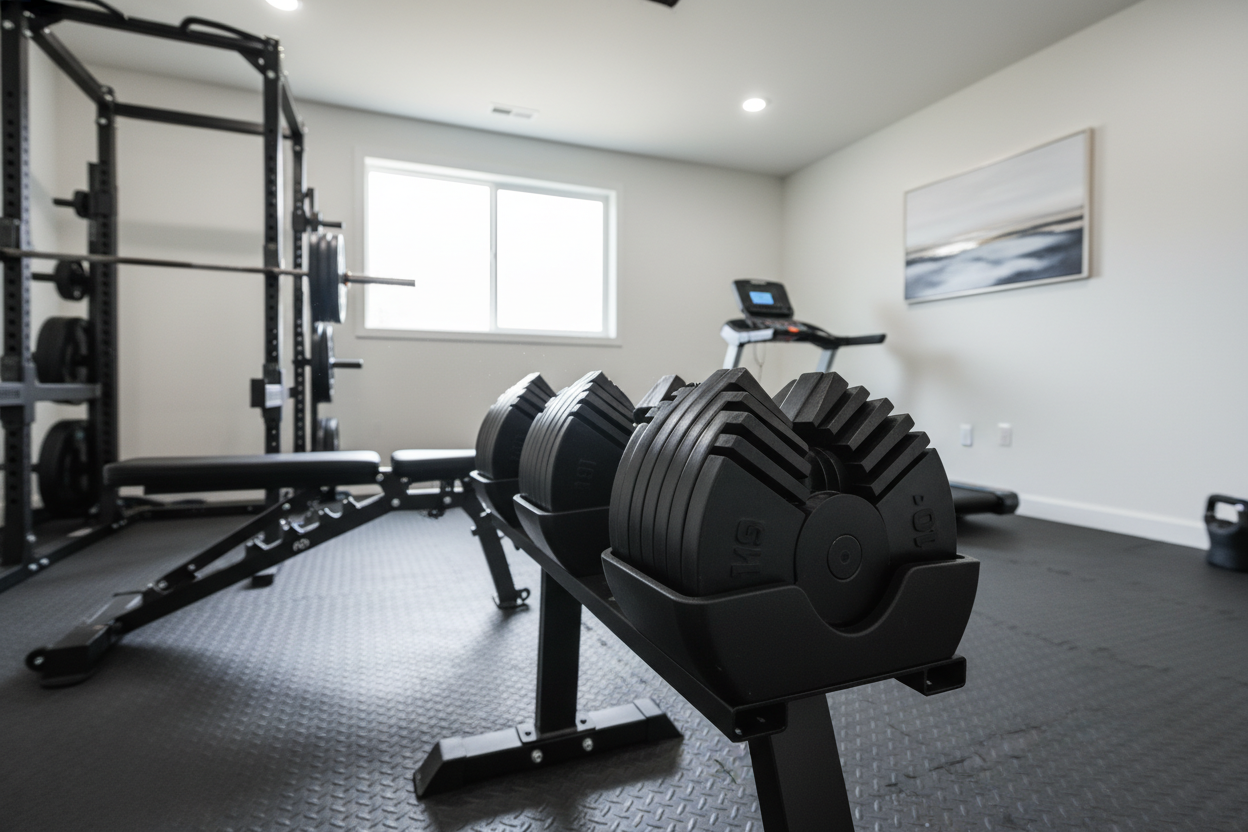
I remember the night I outgrew my first pair of selectors. I was hitting heavy rows in my garage, the air smelling like old rubber and sweat, and I realized I had no more weight to add. I went inside, hopped on my laptop, and started hunting for adjustable dumbbells 150 lbs thinking it would be an easy upgrade. It wasn't.
The reality is that most of the gear you see on Instagram or Amazon is built for the masses, not the heavy lifters. Finding a legitimate 150 lb adjustable dumbbell set that won't fall apart mid-set is a logistical nightmare. Most companies stop at 50 or 90 pounds because the engineering required to keep 150 pounds of iron from crushing your skull is expensive and complicated.
- Dial-based systems are almost never rated for triple-digit weights.
- Safety pins and plastic tabs are the primary fail points at high poundage.
- A 150-lb dumbbell can easily reach 20+ inches in length, ruining your range of motion.
- Loadable handles are the most reliable (and affordable) way to hit this weight class.
Why the Fitness Industry Suddenly Stops at 90 Pounds
Ever notice how every major brand seems to hit a wall at 90 pounds? That is not a coincidence. Most standard adjustable dumbbells use internal plastic gears or nylon gears to rotate the selector pins. While those materials are fine for a 50-pound set, they become a liability when you triple the load.
Manufacturers are terrified of the liability. If a gear slips on a 20-pound curl, you might bruise a toe. If a gear fails while you are benching 150 pounds over your face, you are looking at a hospital visit. The precision required to make a selectorized system that can handle 150 pounds with zero play or wiggle is just too high for the consumer market.
The Terrifying Physics of a 150 lb Adjustable Dumbbell Set
Physics is a cruel mistress when you are holding a 150 lb adjustable dumbbell set. Every time you drop those weights—and let's be honest, you will drop them after a heavy set of presses—the impact force is massive. A selectorized system has dozens of tiny moving parts that absorb that shock.
I have seen high-end sets literally explode because a plastic shim couldn't handle the vibration. Compare that to something like the Powerblock personal trainer adjustable dumbbell, which is a fantastic piece of kit for what it's intended for, but even their heaviest commercial sets use heavy-duty steel side rails that most home gym brands won't pay for. At 150 pounds, you cannot trust a dial.
The 'Width Problem' No One Talks About
Even if you find a set that holds the weight, they are usually comically long. To get to 150 pounds using standard 10-pound plates, the dumbbell ends up being nearly two feet long. Good luck hitting a full range of motion on a chest press without the dumbbells clacking together before you even get a stretch.
This 'width problem' makes heavy rows awkward too. The weight hits your hip before your lats are fully contracted. It’s the trade-off for not buying a full rack of fixed iron, and it’s one that a lot of guys regret once they actually start training with them.
The Only Mechanisms That Actually Survive 150 Lbs
If you are dead set on hitting 150 pounds per hand without a full rack, you have two real options: heavy-duty modular blocks or loadable handles. I personally swear by a solid adjustable dumbbell bar set that uses Olympic sleeves. It’s basically a miniature barbell for your hand.
These handles use actual collars. They don't have gears to strip or pins to bend. You can load them with 10-lb plates or even 25s if you don't mind the diameter. They aren't as fast to change as a dial system—you'll spend an extra 60 seconds between sets—but they are the only thing I trust when I'm going for a PR.
Should You Just Buy Fixed Iron Instead?
Before you drop $1,200 on a 150-lb adjustable set, look at your programming. Most people only need 150s for two or three movements: rows, presses, and maybe shrugs. You might be better off buying a high-quality rubber hex dumbbell set for your lighter work and then just buying two pairs of heavy fixed weights.
Buying traditional fixed dumbbells for your top-end weights is often cheaper and safer. There is zero setup time, and you can drop them without wondering if you just broke a $500 mechanism. Plus, they don't have that annoying 'rattle' that almost all heavy adjustable sets develop over time.
My Honest Take
I once tried to 'frankenstein' a set of old threaded dumbbells to hit 140 pounds. I used every spare plate I had and tightened the collars with a wrench. Midway through a set of rows, the collar vibrated loose and a 10-pound plate slid off, nearly taking my kneecap with it. That was the day I realized that at this weight class, you don't cut corners. If you want to move 150 pounds, buy gear that was actually engineered for it, or stick to the basics.
FAQ
Can I drop adjustable dumbbells if they weigh 150 lbs?
Generally, no. Even the most 'durable' sets are not designed for repeated drops from shoulder height at that weight. If you need to drop your weights, buy fixed rubber hex or urethane dumbbells.
Are loadable Olympic handles better than selectorized sets?
For heavy lifting, yes. They are significantly safer and much cheaper. The only downside is the time it takes to slide plates on and off and tighten the collars.
How long are 150 lb adjustable dumbbells?
Depending on the brand, they usually range from 19 to 24 inches. This can severely limit your range of motion on pressing movements compared to a standard fixed dumbbell.
Share:
Why Searching for a Weight Bench Nearby Is a $200 Mistake
My Take on the Body Flex Body Power Adjustable Multi-Purpose Weight Bench