
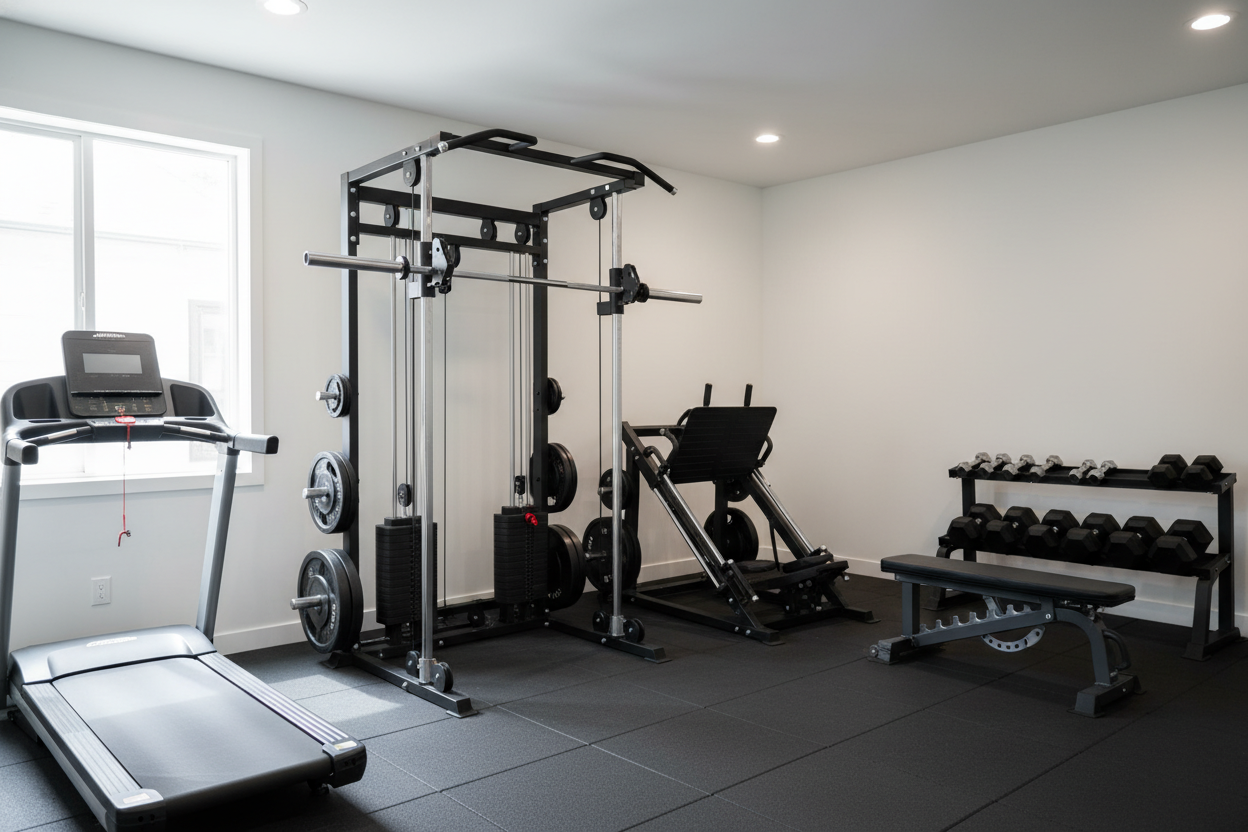
I remember the first time I bought a cheap cable tower from a big-box store. It looked great in the photos, but the first time I tried a heavy row, the whole frame tilted toward me like it was bowing to a king. It is a common story for anyone looking for gym machines for home: you want equipment that feels like the heavy-duty stuff at your local powerhouse, but you end up with a glorified clothes hanger that shakes when you breathe on it.
Quick Takeaways
- Leverage arms always beat cheap cables for smooth, consistent tension.
- Weight equals stability; if the machine is light, it will wobble during heavy sets.
- Independent arms prevent your dominant side from doing all the work.
- Avoid '40-in-1' machines—they usually do 40 things poorly.
The 'All-In-One' Illusion That Ruins Your Workouts
Most companies try to sell you the dream of a single machine that replaces an entire commercial gym. They promise 40 different exercises, but the reality is dictated by physics. A pulley positioned for a lat pulldown is rarely in the right spot for a low row or a chest fly. You end up with 'dead spots' in the movement where there is zero tension at the peak of the contraction.
These multi-station machines often use plastic pulleys and thin cables that stretch over time. When you are trying to hit a PR, the last thing you want is a cable that feels like a rubber band. The strength curves are almost always wrong because the pivot points are designed for marketing, not biomechanics. It is a waste of floor space that usually ends up as a place to hang your laundry.
Why Leverage and Plate-Loaded Systems Win
If you want that 'locked-in' feeling where you can actually focus on the muscle, you need to look at leverage arms. Instead of a steel cable that can snap or jerk, you are pushing against a solid steel pivot. This is why an independent arm chest press machine feels so much better than a standard bench or a cheap cable fly. The arc is fixed, and the muscle isolation is surgical.
Plate-loaded systems allow you to use the weights you already own, and they don't rely on a friction-heavy weight stack. When you use a dedicated home weights machine with independent leverage, you force each side of your body to carry its own weight. This fixes the imbalances that a standard barbell or a single-handle cable machine often hides.
The Free Weight vs. Fixed Path Dilemma
There is a constant debate about whether you should stick to a power rack or buy a machine gym setup. I have tested both racks and smith machines, and I can tell you that for hypertrophy, the fixed path is king. It allows you to train to absolute failure without the fear of a barbell crushing your windpipe.
A fixed path doesn't mean it is 'easier.' It means you can move more weight with better form because your stabilizing muscles aren't the limiting factor. If you want to grow your chest or legs, you need a machine that lets you push until the muscle literally quits, not until your balance gives out.
The 400-Pound Rule for Structural Stability
If your machine for gym use weighs less than you do, it is going to move. I have learned the hard way that a heavy-duty 400lb home gym machine is the baseline for serious lifting. Lightweight aluminum frames vibrate and shift, which ruins your mind-muscle connection.
Look for 11-gauge steel. It is the gold standard for a reason. When you are grinding out the last rep of a 300-pound row, you need the frame to stay dead quiet and perfectly still. If you see a machine that ships in a single small box, it is probably too light to be useful for anything other than high-rep fluff work.
Building Your Base Without Wasting Space
You do not need a 2,000-square-foot warehouse to get a professional-grade workout. You just need one or two high-quality pieces that cover your biggest weaknesses. Pick one solid gym home machine that handles your primary compound movements—like a leg press or a chest press—and build around it.
The key is to avoid clutter. Instead of five cheap machines, buy one heavy-duty home weights machine that will last a lifetime. You can find curated home gym setups that maximize every inch of your garage without turning it into a crowded storage locker. Quality over quantity is the only way to build a space you actually want to train in.
My Personal Lesson in 'Budget' Gear
A few years ago, I bought a 'budget' leg extension machine. Every time I loaded more than 150 pounds, the back of the machine lifted off the floor. I had to duct-tape sandbags to the frame just to keep it from flipping over during my sets. It was dangerous and distracting. I eventually sold it for a third of what I paid and bought a proper 11-gauge steel unit. Save yourself the headache and buy the heavy steel the first time.
FAQ
Are cable machines better than plate-loaded machines?
Cables offer more variety for accessory work, but plate-loaded leverage machines provide a much better feel for heavy compound movements and raw muscle isolation.
How much space do I really need?
A solid leverage machine usually requires a 6x4 foot footprint. Always account for the 'swing' of the arms and the space needed to load plates on the sides.
What maintenance do home gym machines need?
Keep the pivot points and guide rods clean. Use a dry silicone spray for lubrication once every few months. Avoid WD-40, as it attracts dust and turns into a sticky mess.
Share:
Is a 3D Jones Machine Actually Better Than a Power Cage?
How to Spot Rusted Junk When Buying 2nd Hand Home Gym Equipment