
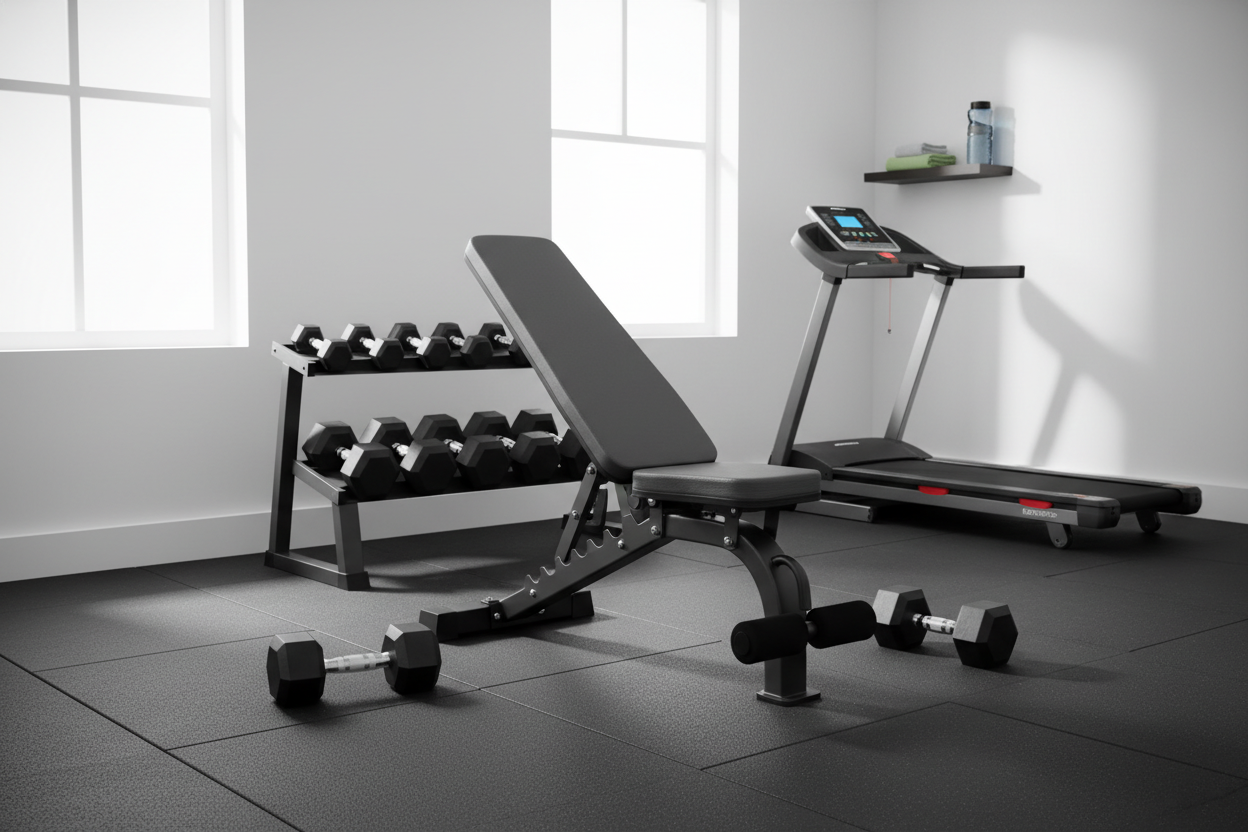
I remember the first time I tried to shove a commercial-grade bench into my 500-square-foot studio apartment. It was like trying to park a Humvee in a bike rack. I had to choose between having a kitchen table or a place to press, and for six months, I ate my oatmeal off a 12-inch vinyl pad. Finding a legit compact weight lifting bench that doesn't wobble like a toddler on ice is the holy grail for garage gym owners and apartment lifters alike.
- Look for a tripod or wide-footed base to prevent lateral tipping.
- Prioritize 11-gauge or 12-gauge steel over thin frames.
- High-density foam is non-negotiable; your shoulders shouldn't hit the wood backing.
- Check the folded dimensions, not just the 'in-use' footprint.
The Brutal Reality of Lifting in a Spare Bedroom
Most 10x10 bedrooms aren't designed for iron. When you factor in a bed, a desk, and a dresser, you’re left with a postage stamp of floor space. I’ve spent years trying to optimize these tiny footprints, and the biggest mistake I see is people buying 'standard' equipment that eats up 6 feet of length. You end up shimmying around your gear like you're in a submarine.
The frustration is real. You want to hit a heavy set of chest presses, but you're worried about your elbow smashing into the nightstand. Or worse, you buy a compact exercise bench that is so light it slides across the hardwood every time you try to rack the weight. I’ve been there, chasing a sliding bench across a room while holding 80-lb dumbbells. It’s not just annoying; it’s dangerous.
You need gear that respects your square footage without treating your training like a hobby. A compact weights bench needs to be heavy enough to stay put but smart enough to get out of the way when the workout is over. I’ve tested dozens, and the difference between a 'space-saver' and a 'life-saver' comes down to the frame geometry and total mass.
Why Space-Saving Designs Usually Sabotage Your Lifts
Manufacturers love to cut corners when they shrink a bench. The first thing to go is usually the steel thickness. They’ll swap out heavy-duty 3x3-inch tubing for flimsy 1x1-inch stuff that belongs on a lawn chair. When you lay down to press, the whole unit flexes. That lack of rigidity kills your force production. You can't drive your feet into the floor if the bench is swaying like a willow tree.
Then there’s the pad width. To make a smallest weight bench look 'compact,' brands often narrow the back pad to 8 or 9 inches. This is a disaster for your rotator cuffs. If your shoulder blades aren't fully supported, they can't retract properly, and you’re basically benching on a balance beam. It feels like a cheap ironing board when you’re trying to stabilize a heavy load.
Another common shortcut is the hinge mechanism on folding models. Cheap bolts and thin brackets create 'slop' in the joint. If there’s a half-inch of play in the hinge, your bench press for small spaces will feel unstable the moment you move off-center. I once tested a budget folder that actually started to fold while I was mid-set. If the hinge isn't reinforced with a massive steel pin, keep walking.
The 3 Specs That Make a Compact Weight Lifting Bench Actually Safe
If you're shopping for a bench press small space solution, ignore the marketing fluff and look at the spec sheet. First: the rear footbox. A compact bench shouldn't have a narrow base. You want the rear stabilizer to be at least 16 to 20 inches wide. This creates a 'T' or 'I' shape that prevents the bench from tipping sideways when you’re getting into position with heavy dumbbells.
Second, look for a high weight rating. A bench that claims a 1,000-lb capacity is usually built with the structural integrity you want, even if you’re only lifting 200 lbs. It’s about the safety margin. For example, a high-quality adjustable weight bench might have a footprint under 50 inches long but still uses heavy-gauge steel to ensure it doesn't groan under pressure. Look for 11-gauge steel—it’s the gold standard for a reason.
Third, check the pad density. Cheap benches use soft open-cell foam that bottoms out immediately. You want firm, closed-cell foam that’s at least 2.5 inches thick. When you press your thumb into it, it shouldn't hit the plywood base easily. This support is what allows you to actually 'sink' into the bench and create a stable platform for your upper back. If the pad is mushy, your lift will be mushy.
How to Configure a Legit Bench Press for Small Spaces
Setting up a bench press small space station is a game of inches. I always recommend aligning your bench with a wall stud if you’re using a wall-mounted rack, but if you’re strictly using dumbbells, center the bench in your 'clear zone.' You need at least 2 feet of clearance on either side of the pad so you can safely drop weights if you hit failure. Don't crowd the bench against a wall or a mirror.
I learned the hard way that floor grip matters just as much as the bench itself. If you're on laminate or hardwood, even a heavy dedicated weight bench will slide. Get a single 4x6-foot horse stall mat. It protects your floor, dampens the noise for your neighbors downstairs, and 'locks' the rubber feet of your bench in place. It turns a shaky apartment setup into a rock-solid lifting station.
Think about your vertical space too. If you have a low ceiling, an incline bench might put your head or the weights dangerously close to a ceiling fan or light fixture. Measure your 'reach height' while seated on the bench before you commit to a spot. I once took out a lightbulb during a set of overhead presses because I forgot to account for the 18-inch seat height.
Can a Storable Compact Exercise Bench Actually Hold Weight?
The skepticism around storable benches is usually well-founded, but the tech has improved. A modern, high-end folding compact weights bench can absolutely handle serious weight if the locking mechanism is over-engineered. Look for benches that use a pull-pin and a secondary screw-knob. That secondary knob removes the 'wiggle' that usually plagues portable gear.
I’ve found that these benches are perfect for people who need to reclaim their living room after a workout. However, you have to be honest about your goals. If you're chasing a 400-lb bench press, a folding unit is a compromise you shouldn't make. But if you’re working with dumbbells, a well-built storable unit will handle heavy dumbbells without a hitch.
My personal mistake? I once bought a bench that folded 'flat' but was still 10 inches thick when collapsed. It didn't fit under my bed or in my closet. Before you buy, measure your storage gap. If it’s going under a bed, you need a bench that collapses to 6 or 7 inches. If it’s going in a closet, check the standing height. Don't let your 'space-saver' become a permanent piece of furniture you trip over every night.
How much weight can a compact bench really hold?
Most entry-level compact benches are rated for 300-500 lbs (user plus weights). High-end models can go up to 1,000 lbs. Always check the static vs. dynamic load rating to be safe.
Is a folding bench safe for heavy lifting?
Yes, provided it uses heavy-gauge steel and a secure locking pin system. Avoid anything that looks like a card table. If it wobbles when you sit on it, don't put a barbell over your face.
What is the ideal pad width for a small bench?
Don't go narrower than 11 inches. 12 inches is the competition standard and provides the best support for your scapula. Anything less risks shoulder instability.
Share:
The 3 Features That Make a Dumbbell for Gym Use Actually Good
Please Don't Buy That Toy Weight Bench for Teenager Workouts