
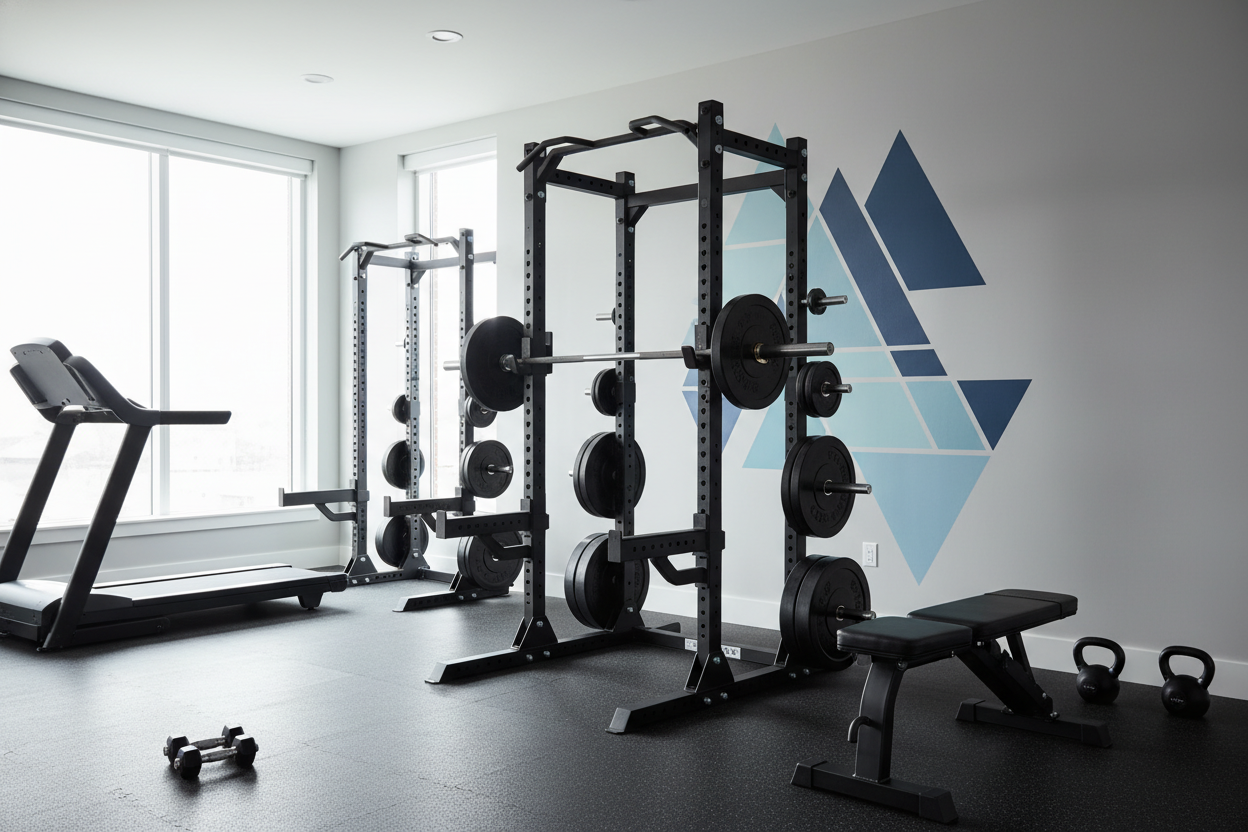
I used to be a total barbell snob. If it wasn't a free-weight back squat with a 45-lb Ohio Bar, it didn't count in my book. Then I moved into a smaller garage space, traded my power rack for a fixed-path rig, and tried to port my entire 5/3/1 program over. I loaded 315 pounds, expecting a breeze because of the 'easy' reputation these machines have, and I nearly pinned myself because the friction and the bar path were completely alien to my central nervous system.
That was the day I realized my smith machine weight conversion math was a total lie. My spreadsheet was built on the physics of a free-moving bar, not a heavy carriage sliding on steel rods. If you're trying to figure out how much your bench or squat translates between these two worlds, you're likely overcomplicating a problem that doesn't need a calculator. You're trying to compare apples to gravity-defying oranges.
Quick Takeaways
- Mechanical friction on guide rods makes 'plate weight' feel heavier than a free barbell.
- The lack of stabilizer muscle recruitment can make the top of the lift feel significantly easier.
- Starting bar weights vary wildly—from 0 lbs counterbalanced to 60 lbs of raw steel.
- Stop the math: treat the Smith machine as its own unique lift in your training log.
The Day My Spreadsheet Stopped Working
I spent years tracking every micro-load on a standard power bar. When I transitioned to a fixed-path setup, I assumed a 1:1 ratio. I walked up to the machine, slapped on the usual three plates, and felt like I was lifting through a vat of cold molasses. The smith machine to barbell conversion I had calculated in my head—thinking the machine would be an 'ego lift' booster—completely backfired. The bar didn't move where my body wanted it to go, and the resistance felt constant and unforgiving.
The issue wasn't my strength; it was the expectation. I expected the numbers to match my old logbook perfectly. Instead, I spent forty minutes getting frustrated, missing reps, and eventually stripping weight off the bar just to finish a set. My ego took a hit, but my training finally started making sense once I stopped trying to force the two movements to be identical. I realized that a 300-lb Smith squat is simply a different beast than a 300-lb barbell squat. One requires balance; the other requires overcoming pure mechanical drag.
Why a Perfect Smith Machine to Barbell Conversion Doesn't Exist
You can't just multiply your barbell max by 1.15 and call it a day. Physics doesn't work like that in a gym. When you use a barbell, a massive chunk of your energy goes into stabilization—keeping the bar from drifting forward or backward. On a Smith machine, the guide rods handle that for you, which theoretically lets you push more weight. This is why bodybuilders love them; you can take a muscle to absolute failure without worrying about the bar falling off your back.
However, that 'help' comes at a cost. Guide rods create mechanical friction. Even on high-end commercial rigs with linear bearings, there is a degree of drag that doesn't exist in free space. Furthermore, the bar path is often fixed at a slight 7-degree angle or perfectly vertical. If your natural squat path is a slight 'S' curve, you're fighting the machine's geometry the whole way down. This means the smith machine conversion is less about weight and more about leverage and drag. You might be stronger on the machine for bench press, but significantly 'weaker' on it for squats purely because of how the fixed path interacts with your limb lengths.
The Counterbalance Trap (And Why Plate Math Fails)
One of the biggest headaches is the starting weight of the carriage. Most Olympic bars are a standard 45 lbs. Smith machine carriages? They are all over the place. Some are counterbalanced with internal weights and cables, making the bar feel like it weighs zero pounds. Others are heavy steel assemblies that might weigh 60 lbs before you even add a plate. If you're guessing your Planet Fitness machine's resistance, you're already starting from a place of confusion because those commercial units are heavily counterbalanced to prevent injuries.
I've seen guys count the bar as 45 lbs when it was actually a 15-lb counterbalanced unit, leading them to believe they've hit a massive PR. Do you need to count the smith machine bar weight? Only if you want consistency. But since every machine is different—some use bushings, some use bearings, some are angled—that number only matters for the specific machine you're standing in front of. Trying to standardize it is like trying to standardize how 'heavy' a cable row feels across three different brands of machines.
A Better Way to Handle Your Smith Machine Conversion
Here is my honest advice: stop the math. Delete the conversion formulas from your brain. If you are moving from a barbell squat to a Smith machine squat, treat it like you're learning a brand-new exercise, like a leg press or a hack squat. You wouldn't try to 'convert' your leg press to a barbell squat, so don't do it here. The smith machine conversion isn't a bridge; it's a separate island.
Instead of using percentages of a free-weight max, use RPE (Rate of Perceived Exertion). If your program calls for a set of 8 at RPE 8, just add weight until it feels like you have two reps left in the tank. Your body doesn't care if the plates say 225 or 275; it only cares about the tension and the stimulus. Logging the lift as 'Smith Machine Press' instead of 'Bench Press' helps separate the two in your mind. This prevents you from feeling like you're 'getting weaker' just because the machine's friction is eating some of your output.
Resetting Your Maxes for Fixed-Path Rigs
If you really want to be precise, take one training week to establish new baselines. Don't guess. On your home gym Smith machine, run a simple linear progression for a session or two to find a comfortable 5-rep max. This gives you a real, data-driven starting point that accounts for your specific machine's friction and bar weight. It takes the guesswork out of your programming.
I did this for my incline press. I found out that while my free-weight incline was stalled, I could actually push more volume on the Smith because I wasn't wasting energy on bar path correction. Having a machine-specific max allowed me to actually progress rather than constantly comparing myself to a different version of the lift. Once I had that 5RM, I could use it to calculate my working sets for the rest of the block without ever thinking about a barbell.
Stop Overthinking and Just Lift
At the end of the day, your quads and pecs can't read your gym log. They don't know if you're using a $5,000 calibrated power bar or one of those all-in-one cable crossover setups. They only respond to load and mechanical tension. If you are adding weight over time and your form is locked in, you are winning. The exact mathematical conversion to a free barbell is a fun bar conversation, but it's useless for actual muscle growth.
The obsession with 'what this would be on a real bar' is just ego talking. The Smith machine is a tool for isolation, safety, and crushing high-intensity sets. Use it for what it's good for—smashing reps to failure without needing a spotter—and leave the math to the people who spend more time on their calculators than the platform. If the weight feels heavy and your form is clean, the conversion doesn't matter.
Share:
Why the Best Full Body Home Workout Machine Is Actually a Smith Rig
Why I Traded 6 Bulky Machines for Versatile Exercise Equipment