
I remember the exact Tuesday I quit my commercial gym. It was raining, the parking lot was a congested mess of SUVs, and I spent twenty minutes just trying to find a spot within a quarter-mile of the door. By the time I swiped my key tag and smelled that specific mix of industrial cleaner and stale sweat, my motivation was already in the gutter. I spent the next hour waiting for a squat rack while some kid filmed TikToks in the only power cage available.
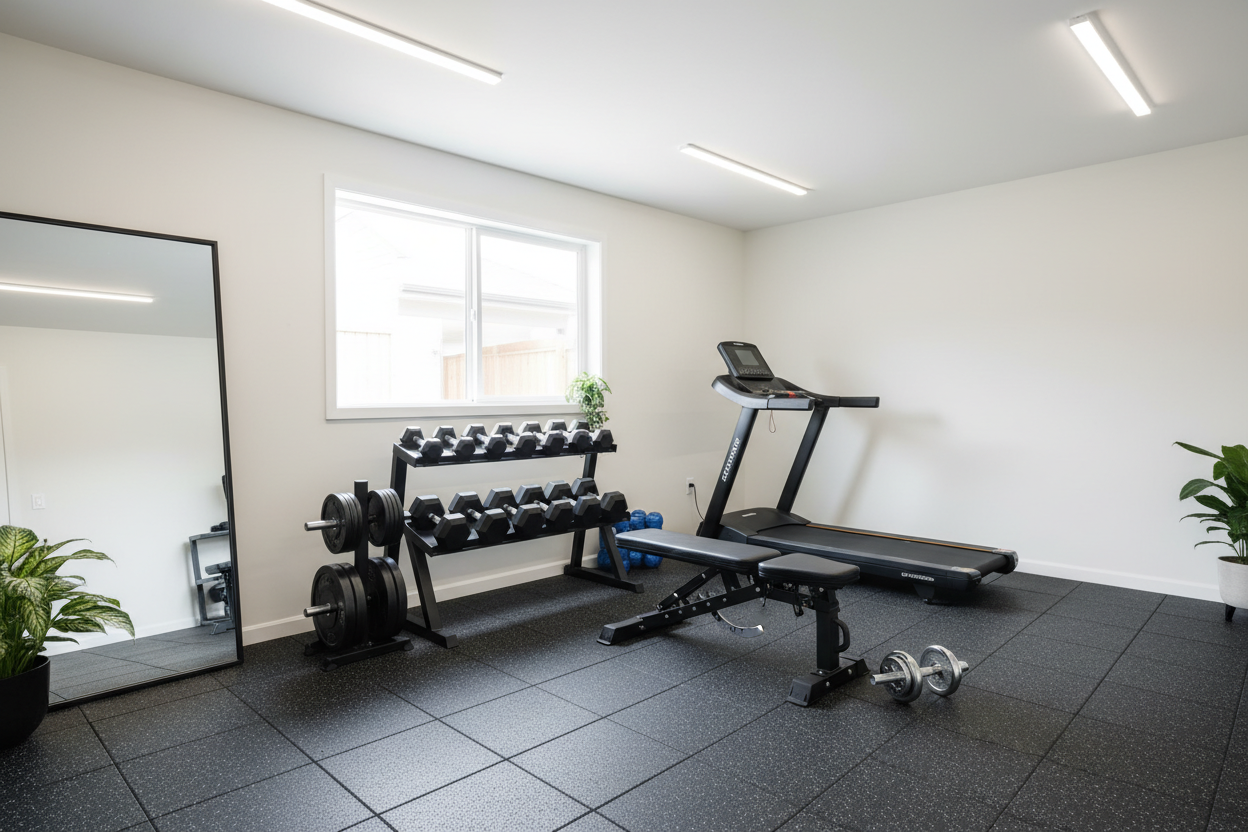
That was the day I stopped wondering about at home workouts vs gym efficiency and started building my own space. If you are tired of the 'gym or home exercise' debate, let me give it to you straight from someone who has spent a decade under both commercial fluorescent lights and garage-shop LEDs. The 'best' place to train isn't the one with the most machines; it is the one where you actually show up without a mental battle.
Quick Takeaways
- Consistency usually beats equipment variety every single time.
- Home gyms eliminate the 'commute friction' that kills 50% of workouts.
- Safety gear like spotter arms makes heavy home lifting perfectly viable.
- Commercial gyms are better for specialized machines (hack squats, cable crossovers).
- The long-term ROI of home equipment beats a $60/month membership in under two years.
The Shiny Gym Floor vs. The Cold Hard Commute
We have all been there. You sign up for that 'Premium' membership because they have three different types of leg presses and a sauna. For the first month, it feels like a playground. You are hitting gym or home workout comparisons in your head and thinking the gym wins because of the sheer volume of iron. But then, reality sets in. That 20-minute drive becomes a 40-minute round trip. Add in the time spent changing in a locker room and waiting for the bench press, and a 45-minute session suddenly takes two hours of your life.
The commercial gym floor is designed to look impressive during a tour, but it is rarely optimized for a serious lifter's flow. You want to superset? Forget it. Someone will take your dumbbells the second you turn your back. When you weigh gym vs home workout options, you have to account for the 'annoyance tax.' Every minute you spend navigating a crowd is a minute you aren't actually getting stronger. Eventually, the friction of the commute kills the habit entirely.
I found that my 'gym or exercise at home' decision came down to one thing: energy. I’d rather spend my limited daily energy on a heavy set of deadlifts than on navigating a crowded parking lot. If you find yourself skipping sessions because you 'just don't want to deal with the gym today,' the gym is officially failing you.
Why I Actually Train Harder in My Garage
There is a psychological shift that happens when you step into your own territory. In a commercial gym, you are a guest. You have to keep the noise down, wear 'appropriate' attire, and deal with the social anxiety of a hundred strangers watching your form. When you transition to a dedicated home gym, those barriers vanish. I have had some of my most productive sessions wearing nothing but old cargo shorts and a tattered shirt, blasting music that would get me banned from any Planet Fitness.
The lack of a crowd means you own the tempo. If I want to take exactly 90 seconds between sets, I can. I don't have to worry about someone hovering over me or asking if I am 'almost done.' This total control leads to better focus. You aren't scanning the room; you are looking at the bar. For me, the gym or workout at home choice became easy when I realized my intensity skyrocketed when I was alone.
People worry about distractions at home—the laundry, the TV, the kids. But if you treat your space like a sanctuary, those distractions fade. I have a strict 'phone stays in the locker' rule even in my garage. When you remove the performative aspect of the gym, you stop lifting for the crowd and start lifting for yourself. That is where the real gym vs home workout results come from.
Busted: The 'You Can't Go Heavy at Home' Myth
The biggest pushback I hear is: 'I want to go heavy, and I don't have a spotter at home.' Look, I get it. Pinning yourself under a 225-lb bench press in an empty basement is a legitimate fear. But the industry has solved this. If you are worried about gym vs exercise at home safety, you just need the right tools. A Smith machine home gym station is a massive win for solo lifters. It gives you the fixed path and safety catches you need to push to absolute failure without needing a gym bro to 'help' you on the last three reps.
I spent years thinking I needed a commercial-grade leg press to grow my quads. I was wrong. I just needed a solid rack and the ability to fail safely. When I was researching the best at home gym equipment, I realized that a few high-quality pieces beat a dozen mediocre machines. You can absolutely build pro-level strength with a barbell, a rack, and a set of dumbbells. The idea that you need a 10,000-square-foot facility to get 'real' results is just marketing fluff designed to keep your membership active.
Safety straps and spotter arms are your best friends. I have dropped 400 lbs on safety straps in my garage, and the only thing that got hurt was my ego. If you set your equipment up correctly, you can train with more aggression at home than you ever would at a commercial gym where 'dropping weights' gets you a dirty look from the staff.
What About Cardio and Conditioning?
A lot of people stick with the gym because they love the row of twenty treadmills and the stair climbers. But let's be honest: how many of those machines do you actually use? Most of us have one or two favorite ways to suffer. Instead of paying for a fleet of machines, you can get a high-quality, space-saving unit for your spare room. A foldable upright exercise bike is a perfect example. It has a small footprint, gives you 16 levels of resistance, and you can actually hear your own TV while you use it.
The 'gym vs home' debate for cardio usually favors the home. Why? Because cardio is boring. Doing 30 minutes on a treadmill at the gym while staring at a muted CNN broadcast is a special kind of torture. Doing 30 minutes on a bike in your living room while catching up on a series you actually like? That is a sustainable habit. If you want to know if it is better to exercise at home or gym, look at your historical cardio data. Most people find they do more volume at home because the 'boredom' barrier is lower.
The Final Verdict: Where Will You Actually Show Up?
At the end of the day, your muscles don't know if the iron you are lifting is in a $10 million facility or a dusty basement. They only know tension and frequency. The 'best' workout is the one you actually do. For some, the social energy of a gym is a must. But for the rest of us, the time saved and the focus gained by staying home is the real competitive advantage. It really comes down to exercise at home or gym which setup actually gets used.
My personal experience? I wasted years and thousands of dollars on memberships I used twice a week because the friction was too high. Once I moved my training home, I went from 'trying to find time' to 'making time.' If you are on the fence, start small. Get a bench, some weights, and a way to stay safe. You can always add more gear later, but you can never get back the hours spent sitting in gym traffic.
FAQ
Is working out at home as good as the gym?
Absolutely. As long as you have enough resistance (weights) to challenge your muscles and a way to progress over time, your body cannot tell the difference. Results come from effort, not the logo on the front of the building.
Is it better to workout at home or the gym for weight loss?
Weight loss is 90% nutrition. However, home workouts often win because you can squeeze in a 20-minute session on a busy day when you otherwise would have skipped the gym entirely. Consistency is the key to a caloric deficit.
What is the biggest downside to a home gym?
The upfront cost and the lack of specialized machines. You won't have a 45-degree leg press or a cable crossover unless you have a lot of space and money. You have to get creative with compound movements like squats and lunges.
Should I join a gym or workout at home if I am a beginner?
If you are totally new, a few months at a gym can help you learn form by observing others (or hiring a trainer). But once you know the basics, moving home removes the 'gym-timidation' that causes many beginners to quit.
Share:
The Harsh Truth About Dropping $15K on Elite Home Gyms
Where to Find Exercise Equipment Vancouver Lifters Actually Use